Compare commits
654 Commits
revert-108
...
main
| Author | SHA1 | Date |
|---|---|---|
 Rufus Pollock
|
f092a17954 | |
 khalilcodes
|
380f58013a | |
|
Rufus Pollock
|
57950e91a4 | |
 David Gasquez
|
9436ce7a1c | |
|
khalilcodes
|
41760f9634 | |
|
Rufus Pollock
|
f7dd228eee | |
|
Rufus Pollock
|
022b3a59df | |
 Rufus Pollock
|
81b5b64a2e | |
 theo-cox
|
298a176ad5 | |
|
theo-cox
|
842bd9a970 | |
|
theo-cox
|
4f0594fe7b | |
|
theo-cox
|
c1bb48450f | |
|
theo-cox
|
6c232bb0db | |
|
theo-cox
|
69f609cc62 | |
|
khalilcodes
|
c7cf839f04 | |
 EilidhRoss1
|
86844b9025 | |
|
EilidhRoss1
|
b1717a8105 | |
|
EilidhRoss1
|
dc1769a8c4 | |
|
EilidhRoss1
|
0ed5290d90 | |
|
EilidhRoss1
|
bbd73844e8 | |
|
EilidhRoss1
|
aa28a54a86 | |
|
EilidhRoss1
|
6a0042e5e8 | |
|
theo-cox
|
ca7ed7ebe1 | |
|
theo-cox
|
7f93f13079 | |
|
theo-cox
|
44c11b1ca6 | |
|
theo-cox
|
7d2088739a | |
|
EilidhRoss1
|
99204948d0 | |
|
EilidhRoss1
|
abde1f7928 | |
|
theo-cox
|
82161e05ab | |
|
theo-cox
|
bd8b7eb001 | |
|
theo-cox
|
7b510ca975 | |
|
theo-cox
|
f09d063675 | |
|
theo-cox
|
f9c1f99747 | |
|
theo-cox
|
4f749584ff | |
|
theo-cox
|
b10013af75 | |
|
theo-cox
|
1b24b65863 | |
|
EilidhRoss1
|
2c2586bb0b | |
|
theo-cox
|
2f6156ea3d | |
|
theo-cox
|
b794c5b4de | |
|
theo-cox
|
b8672b0a75 | |
|
EilidhRoss1
|
42577b1e52 | |
|
EilidhRoss1
|
bd7887878f | |
|
EilidhRoss1
|
17fcb92ddc | |
|
Rufus Pollock
|
c4e057a7ee | |
|
EilidhRoss1
|
7700977cff | |
|
EilidhRoss1
|
8e7964daec | |
|
EilidhRoss1
|
5f79dc22c0 | |
|
EilidhRoss1
|
ba0bc1a6dd | |
|
EilidhRoss1
|
766f0dbcc3 | |
|
EilidhRoss1
|
99838b2ee3 | |
|
EilidhRoss1
|
07423f3626 | |
|
theo-cox
|
740041b225 | |
|
theo-cox
|
1bb4cbd7b2 | |
|
theo-cox
|
a46580328b | |
|
theo-cox
|
d96d7cb991 | |
|
theo-cox
|
0ee43f01b9 | |
|
theo-cox
|
2c9cbc2a28 | |
|
theo-cox
|
7ec2807226 | |
|
theo-cox
|
e774024c12 | |
|
theo-cox
|
3fa5b09680 | |
|
theo-cox
|
bf82476c6b | |
|
theo-cox
|
817a01cf96 | |
|
theo-cox
|
c723b788b1 | |
|
theo-cox
|
fa2806dd09 | |
|
theo-cox
|
f88ea69797 | |
|
theo-cox
|
26644b135a | |
|
theo-cox
|
c4907872b0 | |
|
theo-cox
|
7de7e21344 | |
|
theo-cox
|
e12bc2cb19 | |
|
theo-cox
|
d3f788a3b7 | |
|
theo-cox
|
0feeae864d | |
|
theo-cox
|
37158c7079 | |
|
theo-cox
|
6dee198725 | |
|
theo-cox
|
e8dc9a1787 | |
|
theo-cox
|
2d48d9e743 | |
|
theo-cox
|
fe522eec80 | |
|
theo-cox
|
d4fdf0fb26 | |
|
theo-cox
|
ce0b29d33e | |
|
theo-cox
|
38c97a0e7d | |
|
theo-cox
|
5bb6118bee | |
|
theo-cox
|
0b491f52e6 | |
|
theo-cox
|
a31688c45e | |
|
theo-cox
|
a29b87c256 | |
|
theo-cox
|
bb15ff36c3 | |
|
theo-cox
|
f35cc3985b | |
|
theo-cox
|
7e22c5e402 | |
|
theo-cox
|
b1c7fd86b3 | |
|
theo-cox
|
8617b6c268 | |
|
theo-cox
|
1febf4b57c | |
|
theo-cox
|
6b13966ecd | |
|
theo-cox
|
9a89969e17 | |
|
theo-cox
|
8fddac8fd8 | |
|
theo-cox
|
ba72d849fd | |
|
theo-cox
|
17c600e136 | |
|
theo-cox
|
2956d1a58d | |
|
theo-cox
|
9cf8d9e28a | |
|
theo-cox
|
1b81e6b4d3 | |
|
theo-cox
|
9123c8daf7 | |
|
theo-cox
|
3f6dc8a12c | |
|
theo-cox
|
b2ce1bfec5 | |
|
theo-cox
|
8abe8be20a | |
|
theo-cox
|
61a700a51d | |
|
theo-cox
|
4ecd8fd14d | |
|
theo-cox
|
a880c0b131 | |
|
theo-cox
|
69a70801da | |
|
theo-cox
|
830a7c2e60 | |
|
theo-cox
|
ce1d1b21d4 | |
|
theo-cox
|
f701848829 | |
|
theo-cox
|
9671728271 | |
|
theo-cox
|
078bec94a8 | |
|
theo-cox
|
b4103b30d6 | |
|
theo-cox
|
ae5dcc50f5 | |
|
theo-cox
|
e4f5cefe78 | |
|
theo-cox
|
2f202c1fd9 | |
|
theo-cox
|
dbb35e8104 | |
|
theo-cox
|
e2d8c647aa | |
|
theo-cox
|
387781eb0e | |
|
theo-cox
|
16107f3a35 | |
|
theo-cox
|
fcc3dc0615 | |
|
theo-cox
|
95984566ea | |
|
theo-cox
|
6af7a9c113 | |
|
theo-cox
|
e9b0b81483 | |
|
theo-cox
|
22c285f745 | |
|
theo-cox
|
bcbbc9ac5e | |
|
theo-cox
|
cded157f83 | |
|
theo-cox
|
79012b9750 | |
|
theo-cox
|
85c570dde6 | |
|
theo-cox
|
7992ed590c | |
|
theo-cox
|
ba6647d4fc | |
|
theo-cox
|
d3c160fb07 | |
|
theo-cox
|
253062098b | |
|
theo-cox
|
fab41d6383 | |
|
theo-cox
|
91cf78fb8f | |
|
EilidhRoss1
|
17711baacf | |
|
EilidhRoss1
|
ce258a8ac1 | |
|
Rufus Pollock
|
a7cb38d25f | |
|
Rufus Pollock
|
bd67600579 | |
|
Rufus Pollock
|
0cc73f482c | |
|
Rufus Pollock
|
be66fc8e64 | |
|
Rufus Pollock
|
56b39724ad | |
|
Rufus Pollock
|
9a5b86ff0c | |
|
Rufus Pollock
|
44fcb61957 | |
|
EilidhRoss1
|
7373f0554f | |
|
EilidhRoss1
|
95ce1fb276 | |
|
EilidhRoss1
|
fbac46374e | |
|
EilidhRoss1
|
7e2bd97242 | |
|
EilidhRoss1
|
da0b38faef | |
|
EilidhRoss1
|
e83b3b166b | |
|
EilidhRoss1
|
6f63afdddd | |
|
EilidhRoss1
|
5fd90f73b3 | |
|
khalilcodes
|
d1151db846 | |
|
EilidhRoss1
|
de9a04ccb8 | |
|
Rufus Pollock
|
6e8b710056 | |
|
Rufus Pollock
|
89e97fa9b6 | |
|
EilidhRoss1
|
35e03ebfa5 | |
|
EilidhRoss1
|
ac744cfebe | |
|
EilidhRoss1
|
170cc50953 | |
|
EilidhRoss1
|
4e0401261e | |
|
EilidhRoss1
|
b9192a2a18 | |
|
EilidhRoss1
|
4a9c40b74d | |
|
EilidhRoss1
|
3bb7ddf360 | |
|
EilidhRoss1
|
8fbe6421be | |
|
EilidhRoss1
|
91722eaff3 | |
|
theo-cox
|
2b970f27bf | |
|
theo-cox
|
0381ca029c | |
|
theo-cox
|
490ebabf52 | |
|
Rufus Pollock
|
e3ec25eb98 | |
|
Rufus Pollock
|
e559b3c702 | |
|
Rufus Pollock
|
da348c6e13 | |
|
EilidhRoss1
|
e1f5479574 | |
|
EilidhRoss1
|
4e50999ebe | |
|
EilidhRoss1
|
189917a160 | |
|
EilidhRoss1
|
073dd54806 | |
|
EilidhRoss1
|
e974078ba7 | |
|
EilidhRoss1
|
5b591834a9 | |
|
EilidhRoss1
|
32bb1f68da | |
|
EilidhRoss1
|
45d433374c | |
|
EilidhRoss1
|
e6872fe464 | |
|
EilidhRoss1
|
c7c28503a7 | |
|
EilidhRoss1
|
0c301d156c | |
|
EilidhRoss1
|
76d5b26e1c | |
|
Rufus Pollock
|
c9415435fc | |
|
Rufus Pollock
|
4fb30db429 | |
|
Rufus Pollock
|
c0ad9604e1 | |
|
EilidhRoss1
|
885449e12f | |
|
EilidhRoss1
|
43c1306003 | |
|
EilidhRoss1
|
071e13985a | |
|
EilidhRoss1
|
04fdbd7dfc | |
 Nikolay Vlasov
|
09f32727a7 | |
|
EilidhRoss1
|
1e615c78cb | |
|
EilidhRoss1
|
44a1af82b3 | |
|
EilidhRoss1
|
2a16c5c2dd | |
|
EilidhRoss1
|
d932394834 | |
|
EilidhRoss1
|
34b7c508bf | |
|
EilidhRoss1
|
c4464ed439 | |
|
Rufus Pollock
|
cdd1efd392 | |
|
EilidhRoss1
|
361d6a6fae | |
|
EilidhRoss1
|
34185355f3 | |
|
EilidhRoss1
|
864df466e1 | |
|
EilidhRoss1
|
c729f16f03 | |
|
EilidhRoss1
|
b8df226acc | |
|
EilidhRoss1
|
7b7a2c33a3 | |
|
EilidhRoss1
|
af96406e46 | |
|
EilidhRoss1
|
88244f61e6 | |
|
Rufus Pollock
|
0578c68b0c | |
|
Rufus Pollock
|
82631308f7 | |
|
Rufus Pollock
|
da3467a7d9 | |
|
EilidhRoss1
|
98d29698fd | |
|
Rufus Pollock
|
5fb3bbbac2 | |
|
Rufus Pollock
|
7020714c26 | |
|
EilidhRoss1
|
826553f383 | |
|
EilidhRoss1
|
4dcf019e32 | |
|
EilidhRoss1
|
c72fc39f36 | |
|
EilidhRoss1
|
04f1689d2f | |
|
EilidhRoss1
|
4979dc87f1 | |
|
EilidhRoss1
|
8e63f098dc | |
|
EilidhRoss1
|
fad5640930 | |
|
EilidhRoss1
|
580a1ad577 | |
|
EilidhRoss1
|
4374d78a72 | |
|
Rufus Pollock
|
659eda48d3 | |
|
EilidhRoss1
|
0c6698a7e6 | |
|
Rufus Pollock
|
bb1533d4c8 | |
|
Rufus Pollock
|
822eab7b65 | |
|
Rufus Pollock
|
f53e4e46c0 | |
|
EilidhRoss1
|
1026248f0f | |
|
khalilcodes
|
8d904dccb4 | |
|
Rufus Pollock
|
4499e16734 | |
 catherinet1
|
5f4382e317 | |
|
catherinet1
|
189857f64f | |
|
catherinet1
|
35968fae93 | |
|
catherinet1
|
7534fad89b | |
|
catherinet1
|
c648c3d201 | |
|
EilidhRoss1
|
4ebfd906c8 | |
|
EilidhRoss1
|
ffc10ec364 | |
|
catherinet1
|
302f2beec9 | |
|
catherinet1
|
128ddd844b | |
|
catherinet1
|
0f5fb7a76d | |
|
catherinet1
|
d80c09fad9 | |
|
EilidhRoss1
|
3d5e809d42 | |
|
EilidhRoss1
|
2fa924b4e3 | |
|
EilidhRoss1
|
cfd4125a79 | |
|
EilidhRoss1
|
fc5fd8f358 | |
|
EilidhRoss1
|
f1d38bcaa8 | |
|
EilidhRoss1
|
ce7965ad5e | |
|
EilidhRoss1
|
cf12dd1c3e | |
|
EilidhRoss1
|
f4ac26ad5b | |
|
EilidhRoss1
|
2e093013a1 | |
|
EilidhRoss1
|
df0856497d | |
|
EilidhRoss1
|
0358d5eb6f | |
|
EilidhRoss1
|
c7a1e1c06d | |
|
EilidhRoss1
|
b28b248b85 | |
|
EilidhRoss1
|
7542fd72ab | |
|
EilidhRoss1
|
22f9bb08de | |
|
EilidhRoss1
|
4426f83dae | |
|
EilidhRoss1
|
d13aa63206 | |
|
EilidhRoss1
|
c5bf8275a1 | |
|
EilidhRoss1
|
f8bae969ea | |
|
EilidhRoss1
|
4ec758e791 | |
|
EilidhRoss1
|
ca2d0bf0cd | |
|
EilidhRoss1
|
a0442ebb2f | |
|
Rufus Pollock
|
9552319ee1 | |
|
Rufus Pollock
|
337a9606c2 | |
|
EilidhRoss1
|
6d645d09c8 | |
|
EilidhRoss1
|
b882ae5bfe | |
|
EilidhRoss1
|
e660777054 | |
|
EilidhRoss1
|
b72b78da6e | |
|
EilidhRoss1
|
c5100cd729 | |
|
EilidhRoss1
|
f3e6f8d06b | |
|
EilidhRoss1
|
91f4807a1f | |
|
EilidhRoss1
|
32b2ca048f | |
|
EilidhRoss1
|
63434e641c | |
|
EilidhRoss1
|
21c30ecee3 | |
|
EilidhRoss1
|
f5af18650a | |
|
EilidhRoss1
|
a30a281acf | |
|
khalilcodes
|
5ebae006cc | |
|
Rufus Pollock
|
075ae21a12 | |
|
Rufus Pollock
|
28e1d91a9b | |
|
Rufus Pollock
|
682cf4b720 | |
|
Rufus Pollock
|
c08c391146 | |
|
Rufus Pollock
|
6f778c5591 | |
|
EilidhRoss1
|
62c0dc1814 | |
|
EilidhRoss1
|
2986ccd05e | |
|
EilidhRoss1
|
c1027ea12d | |
|
EilidhRoss1
|
56ebcf001d | |
 Khalil Ali
|
e9754c12f0 | |
|
khalilcodes
|
b1d9b0cf2e | |
|
EilidhRoss1
|
ee8d5c2bcb | |
|
EilidhRoss1
|
6b839c7cee | |
|
EilidhRoss1
|
e162836a43 | |
|
khalilcodes
|
a1d5522d2d | |
|
Rufus Pollock
|
6a1268fb9b | |
|
Rufus Pollock
|
5dd0f691b2 | |
|
Rufus Pollock
|
42c464dfc2 | |
|
Rufus Pollock
|
20693d54ee | |
|
EilidhRoss1
|
67be1f6f44 | |
|
EilidhRoss1
|
73aa2fb530 | |
 Andreas S
|
41c8e058f4 | |
|
Andreas S
|
ea8ab33684 | |
|
Andreas S
|
7cbd5f9bfc | |
|
Andreas S
|
8194dfacfd | |
|
khalilcodes
|
b8bfb07cc9 | |
|
EilidhRoss1
|
eb44b6052c | |
|
Rufus Pollock
|
4395459b5e | |
|
Rufus Pollock
|
5ea215b529 | |
|
EilidhRoss1
|
c9daf3a6eb | |
|
khalilcodes
|
3ecdf4cca2 | |
|
EilidhRoss1
|
d284ea96ce | |
|
EilidhRoss1
|
17a616f576 | |
|
EilidhRoss1
|
f55a020f35 | |
|
EilidhRoss1
|
231adfe505 | |
|
Rufus Pollock
|
2d37128b00 | |
|
Rufus Pollock
|
2bd98407d2 | |
|
Rufus Pollock
|
09fcb2d112 | |
|
Rufus Pollock
|
054a5e259a | |
|
Rufus Pollock
|
5034be037a | |
|
Rufus Pollock
|
8bf85bac1e | |
|
khalilcodes
|
03041ec503 | |
|
khalilcodes
|
5182148867 | |
|
Andreas S
|
8231aff47b | |
|
Andreas S
|
777742b909 | |
|
Rufus Pollock
|
c5ca269f04 | |
|
Rufus Pollock
|
b866f0f5f8 | |
|
Rufus Pollock
|
49a1d03a7d | |
|
Rufus Pollock
|
5df9a1f10b | |
|
EilidhRoss1
|
085d1c790c | |
|
EilidhRoss1
|
802a81506f | |
|
EilidhRoss1
|
76275b4c2e | |
|
theo-cox
|
99ef78ad0d | |
|
khalilcodes
|
491046a173 | |
|
khalilcodes
|
efd9e0bebd | |
|
Khalil Ali
|
b4effcab09 | |
|
khalilcodes
|
83a41111b1 | |
|
khalilcodes
|
9d34954293 | |
|
khalilcodes
|
f970e70c75 | |
|
khalilcodes
|
43f9853382 | |
|
Rufus Pollock
|
7bfe5abf21 | |
|
khalilcodes
|
104078cb4f | |
|
khalilcodes
|
9a0eafe7df | |
|
khalilcodes
|
4cbe9ff6ed | |
|
khalilcodes
|
204af9a446 | |
|
khalilcodes
|
c53a038983 | |
|
khalilcodes
|
39d02329f4 | |
|
khalilcodes
|
2915f4d961 | |
|
Rufus Pollock
|
93691dbaef | |
|
Rufus Pollock
|
a01866f1a3 | |
 JM
JM
|
8ea1c5b48e | |
|
Khalil Ali
|
9411ba2270 | |
|
khalilcodes
|
07dd526992 | |
|
khalilcodes
|
5b9a091029 | |
|
Khalil Ali
|
6cce1c7620 | |
|
khalilcodes
|
c5e97ec0a2 | |
|
khalilcodes
|
77e41e922b | |
|
khalilcodes
|
007742af23 | |
|
khalilcodes
|
f2b08a248c | |
|
Khalil Ali
|
3173ba0915 | |
|
khalilcodes
|
627b395859 | |
|
Khalil Ali
|
72080c50f5 | |
 olayway
|
d2a17b726b | |
|
olayway
|
e63bec7fd2 | |
|
Khalil Ali
|
41cf2c33de | |
|
olayway
|
73ecbcf7a2 | |
|
Khalil Ali
|
4be8f9a35a | |
|
EilidhRoss1
|
b368b841c3 | |
|
EilidhRoss1
|
9cf9d5da22 | |
|
EilidhRoss1
|
0b3fddfe93 | |
|
EilidhRoss1
|
ddd6908942 | |
|
EilidhRoss1
|
e672f309f4 | |
|
EilidhRoss1
|
b37929e1e3 | |
|
EilidhRoss1
|
4796507351 | |
|
EilidhRoss1
|
a0b5ce7155 | |
|
EilidhRoss1
|
21f814647f | |
|
EilidhRoss1
|
f84945caff | |
|
EilidhRoss1
|
139c80d0df | |
|
EilidhRoss1
|
e502b64874 | |
|
EilidhRoss1
|
ad8082a5d7 | |
|
Khalil Ali
|
6631b23179 | |
|
olayway
|
ba190c7f1e | |
|
olayway
|
5524c73614 | |
|
olayway
|
1ae7095d69 | |
|
EilidhRoss1
|
e24873e408 | |
|
catherinet1
|
986168678a | |
|
olayway
|
89d1c58f97 | |
|
olayway
|
cc74f3a892 | |
|
olayway
|
706c7b0d02 | |
|
olayway
|
e0a316e5ec | |
|
olayway
|
2cd437f985 | |
|
olayway
|
fc54af730b | |
|
olayway
|
748df6f46f | |
|
olayway
|
2230fa22ec | |
|
olayway
|
20637a6ce4 | |
|
olayway
|
cf95061bec | |
|
olayway
|
a00a90a345 | |
|
olayway
|
59ff08b247 | |
|
olayway
|
fa0775f43a | |
|
olayway
|
bfb8c52953 | |
|
olayway
|
683d1b7503 | |
|
olayway
|
f83027bd8e | |
|
olayway
|
11bd57fcc7 | |
|
olayway
|
034bb1eb3d | |
|
olayway
|
95f661eae9 | |
|
olayway
|
0d5f8f5540 | |
|
olayway
|
73adb71e10 | |
|
olayway
|
ac93858d82 | |
|
olayway
|
90cbf2be8f | |
|
olayway
|
ccc29184f6 | |
|
olayway
|
2ff44763df | |
|
olayway
|
dba48484b9 | |
|
olayway
|
df069f75c3 | |
|
olayway
|
2baae59588 | |
|
olayway
|
ee95033e87 | |
|
olayway
|
6b8a0f2699 | |
|
Khalil Ali
|
f440456dd0 | |
|
khalilcodes
|
f7a9da04bf | |
|
khalilcodes
|
3e7049c2bc | |
|
khalilcodes
|
1dd20f1581 | |
|
khalilcodes
|
efe69b8f10 | |
|
khalilcodes
|
4c0c3770b6 | |
|
khalilcodes
|
dfb33d1c7b | |
|
khalilcodes
|
6245208bab | |
|
khalilcodes
|
1d527ca329 | |
|
khalilcodes
|
fa80441cbf | |
|
khalilcodes
|
d04ee80ea6 | |
|
khalilcodes
|
ed85806958 | |
|
khalilcodes
|
a9b303d029 | |
|
catherinet1
|
0171c58d35 | |
|
catherinet1
|
a44e55a70a | |
|
catherinet1
|
2929cbb74d | |
|
catherinet1
|
b098d38757 | |
|
catherinet1
|
161e173eca | |
|
catherinet1
|
d7209e0efe | |
|
catherinet1
|
14d2589cf8 | |
|
catherinet1
|
b583af2f8a | |
|
catherinet1
|
4d54c56ee3 | |
|
catherinet1
|
37eaaefa9c | |
|
EilidhRoss1
|
1a1c8716b7 | |
|
EilidhRoss1
|
34a5ada5fb | |
|
EilidhRoss1
|
94eaf000af | |
|
EilidhRoss1
|
933ceae58c | |
|
Khalil Ali
|
8c249af204 | |
|
olayway
|
75e63c6bbf | |
|
olayway
|
75d5a06334 | |
|
olayway
|
466944599b | |
|
Khalil Ali
|
7def64b5c2 | |
|
theo-cox
|
bd7c692c1b | |
|
olayway
|
e79aa43ae8 | |
|
olayway
|
5b3b07e0f1 | |
|
olayway
|
86c1f8f4cb | |
|
olayway
|
40a51ac22b | |
|
Rufus Pollock
|
ae629e3127 | |
|
EilidhRoss1
|
6c7cb62d56 | |
|
EilidhRoss1
|
2cafb63864 | |
|
EilidhRoss1
|
51803aebaf | |
|
khalilcodes
|
60d820d856 | |
|
EilidhRoss1
|
ee2e29af2e | |
|
EilidhRoss1
|
d14511772b | |
|
EilidhRoss1
|
8097c58083 | |
|
EilidhRoss1
|
cfa8993cc3 | |
|
EilidhRoss1
|
992e5e0c75 | |
|
EilidhRoss1
|
1cdae6db9b | |
|
EilidhRoss1
|
19f3885780 | |
|
olayway
|
6af3ef9bd2 | |
|
olayway
|
03c73b4c47 | |
|
olayway
|
87f7098319 | |
|
olayway
|
40efb6b6da | |
|
olayway
|
6e3f95c70d | |
|
olayway
|
2ea5347d2e | |
|
olayway
|
f67cb04898 | |
|
olayway
|
9033ca0214 | |
|
olayway
|
1a13aed153 | |
|
olayway
|
5589b2244d | |
|
olayway
|
28c087e31d | |
|
olayway
|
5290e24d95 | |
|
olayway
|
0b65f7d404 | |
|
olayway
|
1ba2193870 | |
|
olayway
|
5ef39edfe7 | |
|
olayway
|
8cb4fe4852 | |
|
khalilcodes
|
22fbbe3ad5 | |
|
khalilcodes
|
2fe9d5487e | |
|
khalilcodes
|
161e08a9c2 | |
|
khalilcodes
|
20baae0c68 | |
|
khalilcodes
|
48cbd1f0d9 | |
|
khalilcodes
|
0be1d0b72f | |
|
khalilcodes
|
3b1e0350d6 | |
|
Rufus Pollock
|
3b1671f882 | |
|
Khalil Ali
|
52145b575d | |
|
khalilcodes
|
2924b5e858 | |
|
Khalil Ali
|
cf59428eec | |
|
khalilcodes
|
7faadb9492 | |
|
khalilcodes
|
c4321f3009 | |
|
olayway
|
eb16e1ba4b | |
|
Khalil Ali
|
8036fcd860 | |
|
Khalil Ali
|
979815a7ce | |
|
olayway
|
2b98e35dc4 | |
|
olayway
|
feb3ada3ca | |
|
olayway
|
711b5e9871 | |
|
olayway
|
8e0be3b869 | |
|
olayway
|
c93f439794 | |
|
Rufus Pollock
|
e4e7b9ce1f | |
|
Rufus Pollock
|
840fddb355 | |
|
Rufus Pollock
|
2152afcb37 | |
|
Rufus Pollock
|
72bdc99b7e | |
|
Rufus Pollock
|
9aaaebac61 | |
|
EilidhRoss1
|
a956e843f7 | |
|
EilidhRoss1
|
a922286b5c | |
|
EilidhRoss1
|
4befcb03ff | |
|
EilidhRoss1
|
c015f34d83 | |
|
EilidhRoss1
|
cf69d77545 | |
|
EilidhRoss1
|
72e19c425c | |
|
EilidhRoss1
|
c42133177f | |
|
Rufus Pollock
|
a0f48b58d6 | |
|
EilidhRoss1
|
bc5a65513a | |
|
Rufus Pollock
|
2ee5df2759 | |
 Catherine
|
6b6d560599 | |
|
EilidhRoss1
|
ce363f0628 | |
|
EilidhRoss1
|
fd4f93e699 | |
|
EilidhRoss1
|
7b7149a906 | |
 sdiehl
|
a42c8dd4e0 | |
|
sdiehl
|
f1b7ff739e | |
|
EilidhRoss1
|
d7f0890536 | |
 olarubaj
|
a5c67fcc7e | |
|
Aleksandra Rubaj
|
45c65b272f | |
|
Aleksandra Rubaj
|
c163f91d13 | |
|
Aleksandra Rubaj
|
dd1b1c78ed | |
|
EilidhRoss1
|
62dc18e379 | |
|
Rufus Pollock
|
76154ec3a0 | |
|
Rufus Pollock
|
fa940a7177 | |
|
Rufus Pollock
|
207288872d | |
|
Rufus Pollock
|
9a32699421 | |
|
EilidhRoss1
|
4d8fd8c316 | |
|
EilidhRoss1
|
f1c2943a5f | |
|
EilidhRoss1
|
550abcfa61 | |
|
EilidhRoss1
|
43a2ceb012 | |
|
Stephen Diehl
|
0d2b567765 | |
 Sal Bayat
|
2593b5a4d8 | |
|
EilidhRoss1
|
4a4a996590 | |
|
EilidhRoss1
|
820eee0366 | |
|
EilidhRoss1
|
e46019a418 | |
|
EilidhRoss1
|
e718676bf5 | |
|
EilidhRoss1
|
851b3ca85c | |
|
EilidhRoss1
|
18d79c2ea1 | |
|
EilidhRoss1
|
8baff9669e | |
|
EilidhRoss1
|
bd5e9e7b64 | |
|
EilidhRoss1
|
bb9ca985ca | |
|
EilidhRoss1
|
a0ad7e08ea | |
|
Rufus Pollock
|
2ac4a8368f | |
|
EilidhRoss1
|
5b85b68353 | |
|
EilidhRoss1
|
15aaeca7d8 | |
|
EilidhRoss1
|
55f698a5fa | |
|
EilidhRoss1
|
310466dae6 | |
|
EilidhRoss1
|
88e511d89f | |
|
EilidhRoss1
|
2f1b759a7d | |
|
EilidhRoss1
|
cab88740d4 | |
|
khalilcodes
|
5c7452ac00 | |
|
khalilcodes
|
cd9c4df2c9 | |
|
khalilcodes
|
ec6c9c40b7 | |
|
khalilcodes
|
6fb734eccd | |
|
khalilcodes
|
74660d2ac1 | |
|
Rufus Pollock
|
5b799b8373 | |
|
Rufus Pollock
|
a0e846f142 | |
|
Rufus Pollock
|
439abfde94 | |
|
theo-cox
|
f4b3a1039d | |
|
theo-cox
|
81a704fcaf | |
|
Rufus Pollock
|
b1d7dae66d | |
|
khalilcodes
|
030318cd32 | |
|
khalilcodes
|
55811517a6 | |
|
khalilcodes
|
02e3b31de2 | |
|
Khalil Ali
|
9c29a37007 | |
|
EilidhRoss1
|
82e589e342 | |
|
Khalil Ali
|
dd29dc9907 | |
|
EilidhRoss1
|
68af9e2e35 | |
|
catherinet1
|
171aeddf76 | |
|
EilidhRoss1
|
fd47550701 | |
|
EilidhRoss1
|
f266beb103 | |
|
EilidhRoss1
|
8ccabc6027 | |
|
EilidhRoss1
|
e0f32a20f6 | |
|
catherinet1
|
e3a93e3908 | |
|
Khalil Ali
|
48313aa6bf | |
|
Khalil Ali
|
a842d712ee | |
|
Catherine
|
6ac0e1865a | |
|
Sal Bayat
|
1b824ef4d1 | |
|
Catherine
|
98707c8625 | |
|
Khalil Ali
|
b3b4924320 | |
|
sdiehl
|
7980ea93f9 | |
|
sdiehl
|
81fa0751eb | |
|
catherinet1
|
1a642750ac | |
|
Khalil Ali
|
b1c06e18a3 | |
|
sdiehl
|
4e762852ca | |
|
sdiehl
|
24b46d4f22 | |
|
sdiehl
|
c2f51a5841 | |
|
catherinet1
|
b61c9c43c6 | |
|
sdiehl
|
865952f5ef | |
 13Colours
|
ce2bc8b737 | |
|
sdiehl
|
45f3ea51f9 | |
|
sdiehl
|
91fb26e731 | |
|
sdiehl
|
1d3c21990c | |
|
Rufus Pollock
|
554e52f8ab | |
|
khalilcodes
|
80addb5d6f | |
|
khalilcodes
|
1b78e616cf | |
|
khalilcodes
|
1e90dc44b1 | |
|
khalilcodes
|
f49bcb9e1e | |
|
khalilcodes
|
e4019fba59 | |
|
sdiehl
|
575c18f1ab | |
|
sdiehl
|
1e3ea462ba | |
|
theo-cox
|
c47c4aef15 | |
|
khalilcodes
|
5f05f681a5 | |
|
khalilcodes
|
89259c252d | |
|
Rufus Pollock
|
090071f05e | |
|
EilidhRoss1
|
468bc2c4fb | |
|
sdiehl
|
4e0b1ccd69 | |
|
Rufus Pollock
|
9358618abf | |
|
Rufus Pollock
|
15c932b613 | |
|
Rufus Pollock
|
fc79ed184c | |
|
Rufus Pollock
|
5a8467bf4d | |
|
khalilcodes
|
5b438fb232 | |
|
khalilcodes
|
e9a3bf963c | |
|
Rufus Pollock
|
7c73e4c504 | |
|
Rufus Pollock
|
2334fd42bd | |
|
Rufus Pollock
|
194fdbc462 | |
|
Rufus Pollock
|
4e7f4d4f56 | |
|
Rufus Pollock
|
5d4d8081f9 | |
|
sdiehl
|
2362707080 | |
|
sdiehl
|
904acb504b | |
|
sdiehl
|
40a0b14d55 | |
|
sdiehl
|
6798d0ba59 | |
|
EilidhRoss1
|
b26c0634b7 | |
|
khalilcodes
|
17a95bafa2 | |
|
EilidhRoss1
|
99c12341d5 | |
|
Rufus Pollock
|
731feddb19 | |
|
Rufus Pollock
|
1879619557 | |
|
sdiehl
|
2086c6ca7d | |
|
sdiehl
|
30a29db700 | |
|
sdiehl
|
17c5ce05d5 | |
|
khalilcodes
|
060579acd7 | |
|
khalilcodes
|
11cdfd42d5 | |
|
khalilcodes
|
66094775b1 | |
|
Rufus Pollock
|
4ba31668f5 | |
 Martin Thomson
|
b4d282a7e4 | |
|
Rufus Pollock
|
028ab56fe9 | |
|
Stephen Diehl
|
12118c1e12 | |
|
sdiehl
|
6adc08249f | |
|
sdiehl
|
00add61d50 | |
 Dennis Schubert
|
d6dbf82a7e | |
|
khalilcodes
|
d0b3a3009f | |
|
khalilcodes
|
c9c4c00c2b | |
|
khalilcodes
|
5e75ffc8bb | |
|
sdiehl
|
dc2bb1c171 | |
|
khalilcodes
|
c7ab0cbd41 | |
|
khalilcodes
|
18cf86b8e5 | |
|
EilidhRoss1
|
f1d5d403db | |
|
EilidhRoss1
|
b0e4e83958 | |
|
sdiehl
|
64dce00b0a | |
|
Rufus Pollock
|
8569885ea4 | |
|
EilidhRoss1
|
2b0e217806 | |
 eilidhrosstest
|
06da1d94b7 |
10
README.md
10
README.md
|
|
@ -1,6 +1,10 @@
|
|||
# Awesome critique of crypto/web3
|
||||
# Awesome sensemaking for crypto/web3
|
||||
|
||||
Awesome critique of crypto/web3, etc. Contributions are welcome.
|
||||
## 👉 April 2022 [Website for the web3 sensemaking project](https://web3.lifeitself.org/) 👈
|
||||
|
||||
## 🎉 Nov 2022 [Full guide to web3 & crypto including evaluation of claims pro and con](https://web3.lifeitself.org/guide/) 🎉
|
||||
|
||||
Awesome rigorous evaluation of crypto/web3, etc. Contributions are welcome.
|
||||
|
||||
## Critique
|
||||
|
||||
|
|
@ -78,6 +82,7 @@ Awesome critique of crypto/web3, etc. Contributions are welcome.
|
|||
* [Charlie Stross: Why I want Bitcoin to Die in Fire](https://www.antipope.org/charlie/blog-static/2013/12/why-i-want-bitcoin-to-die-in-a.html) - 2013-12
|
||||
* [The Maltese Falcon](https://privatebank.jpmorgan.com/content/dam/jpm-wm-aem/global/pb/en/insights/eye-on-the-market/the-maltese-falcoin.pdf) - critique of bitcoin and financial properties of crypto assets from the CIO of JP Morgan bank. 2021-02-10
|
||||
* [Vivaldi CEO: Why Vivaldi will never create ThinkCoin](https://vivaldi.com/blog/why-vivaldi-will-never-create-thinkcoin/) - 2022-01-13 - Jon von Tetzchner: “if you look beyond the hype, you’ll find nothing more than a pyramid scheme posing as currency.”
|
||||
* [Centralizing Control: Why Bitcoin is Dangerous](https://salbayat.org/centralizing-control-why-bitcoin-is-dangerous/) - 2022-04-02 - Sal Bayat: “Democratic governance is fundamentally incompatible with existing cryptocurrency systems as they can only represent the interests of those in control of the system.”
|
||||
|
||||
### Economists
|
||||
|
||||
|
|
@ -160,6 +165,7 @@ Non-fungible tokens.
|
|||
* [Don’t Understand Bitcoin? This Man Will Mumble An Explanation At You](https://www.youtube.com/watch?v=4APcgsRdW6w) by ClickHole - 2015-07-7
|
||||
* [If Cryptocurrency was Honest](https://www.youtube.com/watch?v=GUs5y9leCyA)
|
||||
* [If NFTs were Honest](https://www.youtube.com/watch?v=sG_v4bb2e4k)
|
||||
* [Brave New Web](https://medium.com/coinmonks/brave-new-web-7bae50e916eb) - ani utopian Web3 satire by Nikolay Vlasov - 2022-04-10
|
||||
|
||||
### Twitter users
|
||||
|
||||
|
|
|
|||

|
|
@ -0,0 +1,3 @@
|
|||
version https://git-lfs.github.com/spec/v1
|
||||
oid sha256:ca53ff6b3314cbc4078c212424d64f750f3abebf4fa276ae923356984667bcb1
|
||||
size 667691
|
||||

|
|
@ -0,0 +1,3 @@
|
|||
version https://git-lfs.github.com/spec/v1
|
||||
oid sha256:dc4e4a9b1b9e01994c8e10ac1bc41deb7d2261f6a5861619a1f8d4b77aef09f9
|
||||
size 263612
|
||||

|
|
@ -0,0 +1,3 @@
|
|||
version https://git-lfs.github.com/spec/v1
|
||||
oid sha256:21df1846b4de6e5b67adb96cfe1682d15d8cb936453e75417672d4f3439cf9f0
|
||||
size 1108030
|
||||

|
|
@ -0,0 +1,3 @@
|
|||
version https://git-lfs.github.com/spec/v1
|
||||
oid sha256:a0b074fb9bc8b647a82b5342a73e9de5baeb40a561bd9ee7eacf4a17f64b14e0
|
||||
size 894694
|
||||

|
|
@ -0,0 +1,3 @@
|
|||
version https://git-lfs.github.com/spec/v1
|
||||
oid sha256:66142a39a53ee64f29970e1f6ce7ff215016483949546191da8eb64636eba2c5
|
||||
size 1071256
|
||||

|
|
@ -0,0 +1,3 @@
|
|||
version https://git-lfs.github.com/spec/v1
|
||||
oid sha256:daa04da37262b7c5a1a8892e564de5806a9def2738ac9d163f0ca355466da3f8
|
||||
size 522579
|
||||

|
|
@ -0,0 +1,3 @@
|
|||
version https://git-lfs.github.com/spec/v1
|
||||
oid sha256:26e6402c5eb45277f697d7f4f488856850d6a8b0055b8997b70e65e2efb1bc19
|
||||
size 644054
|
||||

|
|
@ -0,0 +1,3 @@
|
|||
version https://git-lfs.github.com/spec/v1
|
||||
oid sha256:5cc938a1209983d5966ce09c079615a3cb88887e6fed343cedf165a036a686d8
|
||||
size 415425
|
||||

|
|
@ -0,0 +1,3 @@
|
|||
version https://git-lfs.github.com/spec/v1
|
||||
oid sha256:9b8081d0acf2dd990b8af2ddddbb0633ba491bef9d50f5554c2422034e12b790
|
||||
size 816044
|
||||

|
|
@ -0,0 +1,3 @@
|
|||
version https://git-lfs.github.com/spec/v1
|
||||
oid sha256:58a321d08943101e9ef78d7a45c9b95a2a126de24024da2a720dcea72dec773c
|
||||
size 48556
|
||||

|
|
@ -0,0 +1,3 @@
|
|||
version https://git-lfs.github.com/spec/v1
|
||||
oid sha256:6a840677ad321c852daf0b570145aa3cfda7beb0e7bea30a5c4dc4a40745ccc8
|
||||
size 246841
|
||||

|
|
@ -0,0 +1,3 @@
|
|||
version https://git-lfs.github.com/spec/v1
|
||||
oid sha256:51c1e8b3958002742a7e632618f50e0e15792c822a5be6385d901064342c3f49
|
||||
size 96110
|
||||

|
|
@ -0,0 +1,3 @@
|
|||
version https://git-lfs.github.com/spec/v1
|
||||
oid sha256:4a1d014fe416a6fc4d49c194adf99be89b76af9e5b4e27603a3ceeb08940aa59
|
||||
size 876688
|
||||

|
|
@ -0,0 +1,3 @@
|
|||
version https://git-lfs.github.com/spec/v1
|
||||
oid sha256:7323c1f7ee0db904c0e1031836ddf5315866953fe97a02d19c2e078326d7d1fd
|
||||
size 593031
|
||||

|
|
@ -0,0 +1,3 @@
|
|||
version https://git-lfs.github.com/spec/v1
|
||||
oid sha256:20692a0e96b137fde5eac93455519c8b79a9cdaaa3a633db7705e4f6cbadb104
|
||||
size 3306792
|
||||

|
|
@ -0,0 +1,3 @@
|
|||
version https://git-lfs.github.com/spec/v1
|
||||
oid sha256:3b46e7239e8bcb3493eea1541a03de237070e29713fcf1a1497de3e9192d8ac6
|
||||
size 865437
|
||||

|
|
@ -0,0 +1,3 @@
|
|||
version https://git-lfs.github.com/spec/v1
|
||||
oid sha256:236a05fffa8f86363735218652eab08e6047fc2604b5c3c887c93f251b0cc769
|
||||
size 696453
|
||||

|
|
@ -0,0 +1,3 @@
|
|||
version https://git-lfs.github.com/spec/v1
|
||||
oid sha256:f23bb7de16b4bf614daf5bca15cdf037ead748c9af2e1b0b44b85d7b11e8d3c3
|
||||
size 7802868
|
||||

|
|
@ -0,0 +1,3 @@
|
|||
version https://git-lfs.github.com/spec/v1
|
||||
oid sha256:1fdfa063ca98b77510f1b27cb80fb46d0f4433570d5b6f1cbb4b110d9c357cb2
|
||||
size 5475614
|
||||

|
|
@ -0,0 +1,3 @@
|
|||
version https://git-lfs.github.com/spec/v1
|
||||
oid sha256:3a33239ed5c0c22f5169f64c28a247edabe211bbd39db155d9d3daf32d7e8017
|
||||
size 2567710
|
||||

|
|
@ -0,0 +1,3 @@
|
|||
version https://git-lfs.github.com/spec/v1
|
||||
oid sha256:ecba40f838ba37e4ea78e1823708f7dfe89ea3917e2900289cc16d6ab0626e95
|
||||
size 2909124
|
||||

|
|
@ -0,0 +1,3 @@
|
|||
version https://git-lfs.github.com/spec/v1
|
||||
oid sha256:434bd78f062e6bac3b613ea6ac9037684483d32e16137cf5dc92393848f5fa61
|
||||
size 2683688
|
||||

|
|
@ -0,0 +1,3 @@
|
|||
version https://git-lfs.github.com/spec/v1
|
||||
oid sha256:b253584b6a16ac833237af8d204f256635f13e29635380756bbd92ede4a88f4b
|
||||
size 2296274
|
||||

|
|
@ -0,0 +1,3 @@
|
|||
version https://git-lfs.github.com/spec/v1
|
||||
oid sha256:e198ca326d19b50b705bc97bed7f3e433e0f86f7e3a8e0c7847f52664e5e9987
|
||||
size 36480
|
||||

|
|
@ -0,0 +1,3 @@
|
|||
version https://git-lfs.github.com/spec/v1
|
||||
oid sha256:6e3e9cf837f7afd24922a48d24a4d7fa4a043c870788c9c8976c62f99e01aa88
|
||||
size 1753403
|
||||

|
|
@ -0,0 +1,3 @@
|
|||
version https://git-lfs.github.com/spec/v1
|
||||
oid sha256:6ede9ec4b208887702c72d8b4f60951d4cc9290e434879e17f2fcce7bb0b6491
|
||||
size 2671272
|
||||

|
|
@ -0,0 +1,3 @@
|
|||
version https://git-lfs.github.com/spec/v1
|
||||
oid sha256:a2f9a88955f5d293cb1d420df26e5fddeb1838a2514ee486d64381a5f2dfb379
|
||||
size 1527542
|
||||

|
|
@ -0,0 +1,3 @@
|
|||
version https://git-lfs.github.com/spec/v1
|
||||
oid sha256:74eb810136263877f0516834302b6e6e0c389deed0e0ec67432015025e3704ac
|
||||
size 1507221
|
||||

|
|
@ -0,0 +1,3 @@
|
|||
version https://git-lfs.github.com/spec/v1
|
||||
oid sha256:da67b88a8a56908473864dbd08de42dca77ff35abc3f4488dfe58934461d4242
|
||||
size 578867
|
||||

|
|
@ -0,0 +1,3 @@
|
|||
version https://git-lfs.github.com/spec/v1
|
||||
oid sha256:c8314bae9c02e19ae62fbe36da1d6340a097d5eb95390129343b9469572beb64
|
||||
size 115757
|
||||

|
|
@ -0,0 +1,3 @@
|
|||
version https://git-lfs.github.com/spec/v1
|
||||
oid sha256:ec8dbb7e4e0dac94a2d4cbed3161a8a5c053fbc4cf81511515dd3d8e3156404e
|
||||
size 127352
|
||||

|
|
@ -0,0 +1,3 @@
|
|||
version https://git-lfs.github.com/spec/v1
|
||||
oid sha256:651c2f61bd0180c546ff308e42070565be27e042826ef990f904dc3ee2e2f27a
|
||||
size 686068
|
||||
|
|
@ -0,0 +1,3 @@
|
|||
version https://git-lfs.github.com/spec/v1
|
||||
oid sha256:0ace7b44f27c87a8d26c9c859b4916da67692d48247d56c7047f732f228ee067
|
||||
size 1000806
|
||||

|
|
@ -0,0 +1,3 @@
|
|||
version https://git-lfs.github.com/spec/v1
|
||||
oid sha256:1c32373eb2b436d57147edc5e18f8d3b48c8f93cce3dbc07ef19b48886c0461b
|
||||
size 589139
|
||||

|
|
@ -0,0 +1,3 @@
|
|||
version https://git-lfs.github.com/spec/v1
|
||||
oid sha256:0a5eb9517b909d0604b61d4f99ccc743b5e258e1c01d5cf472bb1d1c50d8d0e4
|
||||
size 494993
|
||||
|
|
@ -0,0 +1,370 @@
|
|||
---
|
||||
title: "Web3 provides better mechanisms for financializing non-financial value"
|
||||
description: "In this essay we explore three subclaims inherent to the overarching claim: 1) more financialization of non-financial value is itself desirable; 2) the current monetary and financial systems are deficient in their ability to capture what we think is really valuable; and 3) Web3 technology is capable of addressing these deficiencies. While we accept subclaim 2 to be true, overall we conclude that web3 does not seem to provide many plausible means for better financializing value."
|
||||
category:
|
||||
- claim: y
|
||||
- featured: y
|
||||
- interview: n
|
||||
- deepdive: n
|
||||
claim:
|
||||
- evaluation: N
|
||||
- confidence: H
|
||||
---
|
||||
|
||||
# Overview
|
||||
|
||||
## Key points
|
||||
|
||||
* Financializing value in this context means capturing things considered as intrinsically valuable, such as some artistic or social value, in units of financial value capable of being allocated. This contrasts with the traditional definition of financialization as the expansion of the financial sector, which we cover [elsewhere.](/notes/fintech-incrementalism-and-responsible-innovation)
|
||||
|
||||
**Steel-manning subclaim 1: more financialization of non-financial value is itself desirable**
|
||||
* Financialization is useful as it allows us to effectively direct resources towards the things we care about.
|
||||
* The dysfunctionalities present in our current financial sector are not inherent to financialization itself. Financial value can be a powerful enabler of other types of value creation, without any of the negative impacts on other values (e.g. a well functioning environment) currently associated with money and finance.
|
||||
* Besides, whether we like it or not, we live in a financialized world; our only recourse is to embrace the reality of hyper-financialization and try to make it work for everyone.
|
||||
|
||||
**Steel-manning subclaim 2: the current monetary and financial systems are deficient in their ability to capture what we think is really valuable**
|
||||
* Value can be better or more extensively financialized than is possible under the current system.
|
||||
* This is shown by the funding shortfall for things that matter to us e.g. education and climate change prevention; and there are cases where significant resources are devoted to things that don’t have social value e.g. the whole host of financial instruments totally detached from the productive economy.
|
||||
* Left to their own devices markets won’t create a socially optimal allocation of resources, as market prices won’t naturally “internalize” externalities such as environmental damage.
|
||||
* Positive social impacts, e.g. of art, are often not internalized into market prices.
|
||||
|
||||
**Steel-manning subclaim 3: Web3 technology the route to addressing these deficiencies**
|
||||
* Web3 offers new means of financializing value through tokenization. We're not touching on those targeting public goods funding, as we've explored these [elsewhere.](/claims/can-solve-public-goods-problem)
|
||||
* NFTs: By locking artistic value into the NFT format and selling this directly to buyers, the true value of art can be better financialized as artists receive financial compensation for their work that is actually commensurate with its value.
|
||||
* Alternative currencies: Communities can come together and decide on the rules for how they represent value. This can be done by creating tokens to represent all sorts of value and, in turn, better manage resource flows between them.
|
||||
|
||||
**Evaluating subclaim 1: more financialization of non-financial value is itself desirable (likely false, either totally or mostly)**
|
||||
* There are many reasons to be skeptical of this claim.
|
||||
* In trying to financialize all that we hold valuable we risk losing touch with what makes it valuable in the first place. The essence of some value isn't reducable in this way; can we really capture all of the value of the natural world in financial terms, for example? This depends on one's philsophical understanding of what value is, or certain values are.
|
||||
* More financialization may lead to a world we find undesirable, irrespective of the level of non-financial value it generates
|
||||
* Financialization may perpetuate self-serving dynamics we see in today’s society as people seek to game the system to optimize for the _rewards_ for value generation rather than value itself.
|
||||
* There is concern about becoming a “market society”, where the mentalities, relations and incentives of the market come to dominate all areas of our lives.
|
||||
* There may be opportunity costs to more financialization. It may just be a suboptimal route to generating more non-financial value, compared with alternatives.
|
||||
|
||||
**Evaluating subclaim 2: the current monetary and financial systems are deficient in their ability to capture what we think is really valuable (true)**
|
||||
* There is clear evidence of this in the world, with the unfolding environmental catastrophe being the most obvious.
|
||||
|
||||
**Evaluating subclaim 3: Web3 technology is the route to addressing these deficiencies**
|
||||
|
||||
* NFTs
|
||||
* NFTs do not guarantee artists better remuneration for their work.
|
||||
* Minting NFTs costs many smaller artists more money than they make and there is still a reliance on centralized marketplaces.
|
||||
* The technical complexity of NFT creation means that many artists are excluded or forced to partner with more tech-literate others in often extractive agreements.
|
||||
* The apparent pop of the wider crypto bubble, which was the source of high rates of return for some artists using NFTs, has been accompanied by a slump in the NFT market.
|
||||
* Digital marketplaces may help artists reach new audiences but are not unique to web3 and in fact already exist.
|
||||
* NFT markets are a private market just like any other, open to the same exploitation by middle-men and “whales”.
|
||||
* We must distinguish between the social value of art and “the arts”. The positive externalities of the arts sector are to some degree nonexcludable, creating a [public goods problem](/concepts/public-goods-problem) which cannot be addressed through markets.
|
||||
* Centralized arts funding is a far more promising solution to this problem than tokenization.
|
||||
* Alternative Currencies
|
||||
* Past a certain point of complexity, every state has coalesced on a single, state-backed numeraire. We always end up with exchange problems otherwise.
|
||||
* Many societies in history have had systems where alternative currencies could be created, but these did not work well. They were highly susceptible to fraud, failure, and created difficulty trying to trade between regions which used different monetary systems.
|
||||
* Using tokens to represent goods such as reputation has the potential to turn dystopian, as the social credit system in China shows.
|
||||
* The utility of atlerantive currencies requires they have a material impact on obtaining other things we value. This means we either need something akin to the social credit system, where non-tradeable tokens impact access to other goods in a potentially dystopian manner, or a tradeable market for tokenized currencies which leads us to the exchange problem above.
|
||||
* Something needs to underpin the value of a currency for it to be meaningfully worth something. In traditional currency terms the value of a currency is underpinned by the fact that the state collects tax in that currency. The state’s monopoly of violence can also backstop trust for trade, as it can enforce the terms of contracts.
|
||||
* Either alternative currency systems rely on radical shifts in individual ways of being such that everyone becomes entirely trustworthy and cooperative all the time, or they must rely on some state-like entity to underpin them.
|
||||
* The former case is such a radical shift that if it were to take place, the nature of our currency system would pale as a source of impact.
|
||||
* The latter (more likely) case has huge implications; it requires either massive political action such that existing states adopt new currency systems or secession by small groups to use their own currencies.
|
||||
* If we can get a state to act so radically as to shift its entire currency system, then why not just get it to unilaterally legislate away our problems by other means?
|
||||
* States don’t tend to view secession very kindly; the community enforcement activity required to monopolize violence and underpin a stable currency system would inevitably violate the laws of existing nations. Plus, they'd still need to e.g. pay tax in mainstream currency.
|
||||
* Even if alternate currencies were the answer, there’s no need for the blockchain. All currencies which do not serve the purpose of direct exchange can be tacked onto existing monetary systems without the need for blockchain.
|
||||
* The idea of internalizing externalities has existed in orthodox economics for some time. There are lots of “traditional” mechanisms for doing this e.g. taxes and subsidies. They're not used enough because of political will, not technological shortfall.
|
||||
* A further reason why traditional currencies fail to capture so much non-financial value is that much of what we deem valuable is incredibly hard to measure. The measurement problem is the hard part. If we can solve this, how we then represent value i.e. traditional or alternative currency is incidental.
|
||||
* Alternative currencies partly seek to address the lack of democratic rules for recognising diverse value. But doing this doesn't need blockchain. Remuneration rights funds and participatory budgeting methods fix this issue more easily if well designed.
|
||||
* The reason our current monetary and financial systems don’t adequately “financialize” the totality of social value is not a technical question of the medium of value representation (i.e. money) they use, but is more of a political and social question of how they are structured and governed.
|
||||
|
||||
|
||||
## Evaluation: Largely false (medium-high confidence)
|
||||
|
||||
Web3 does not seem to provide many plausible means for better financializing value. NFTs have failed to live up to their promise regarding value distribution in practice, and even the theory behind them is spurious upon closer examination. Both the economics and political economy of alternative currencies appear highly questionable such that we have a low confidence in their capability to work in practice. There may be room for them to act as a complementary layer on top of traditional currency systems, for example as enhanced versions of eBay seller ratings carried through wider society. This in one sense might be understood as financializing value better. But, as China’s social credit system shows it is questionable whether this would even be desirable at all, and such systems certainly do not appear to require Web3 tokens to function.
|
||||
|
||||
The main reason we are giving our evaluation “medium/high” confidence rather than simply “high” is that we have had to grasp our understanding of how alternative currencies are meant to function in practice from publications by alternative currency projects, which we have found lacking in the meaningful detail required for a deep understanding of how they are intended to function at the social scientific level. Rather than cynically assume that this is because such detail does not exist, we instead wish to acknowledge that we are evaluating an incomplete picture and express our desire to engage those working on alternative currency design in productive discourse.
|
||||
|
||||
|
||||
## Evidence of claim being made
|
||||
|
||||
**CoinDesk. ‘The Financialization of Everything: DeFi-Ning the Next Era of Financial Services’, 19 May 2022. https://www.coindesk.com/sponsored-content/the-financialization-of-everything-defi-ning-the-next-era-of-financial-services/.**
|
||||
|
||||
“One of the key elements of DeFi is that it can go into areas that aren’t covered by TradFi. One is that it can create an underlying value for assets that were previously untouched by finance. It can make these assets liquid and fungible and so be used for transactions in the traditional sense, such as collateral for loans or margins for trading.”
|
||||
|
||||
**Macdonald-Korth, D., V. Lehdonvirta, and E. Meyer. ‘The Art Market 2.0: Blockchain and Financialisation in Visual Arts’, 2018. [https://ora.ox.ac.uk/objects/uuid:a4c8847c-6755-4781-ba9c-9c0864608201](https://ora.ox.ac.uk/objects/uuid:a4c8847c-6755-4781-ba9c-9c0864608201).**
|
||||
|
||||
“Art market liquidity and value are likely to soar if digital ledger technologies are successfully introduced, creating new side industries, such as a boom in art-based lending, and making art an integral part of the financial industry.”
|
||||
|
||||
**Deloitte Private and ArtTactic ‘Art & Finance Report 2021’ [https://www2.deloitte.com/content/dam/Deloitte/lu/Documents/financial-services/artandfinance/lu-art-finance-report-2021.pdf](https://www2.deloitte.com/content/dam/Deloitte/lu/Documents/financial-services/artandfinance/lu-art-finance-report-2021.pdf)**
|
||||
|
||||
“Tokenization, however, has the potential of transforming non-bankable assets into liquid assets, making them accessible to a much wider audience.
|
||||
|
||||
[...]
|
||||
|
||||
[Distributed ledger technology] can not only improve the way art is traded by keeping a secure digital record of every owner, but it can also enable new forms of ownership and introduce smaller players into the market...This will shift the paradigm of art investment and the regulations tied to them, creating a more accessible, fair, and democratized art ecosystem.”
|
||||
|
||||
**The MetaCurrency Project 'FAQ’ [https://metacurrency.org/faq/](https://metacurrency.org/faq/)**
|
||||
|
||||
"Entire communities — people, villages, cities, regions, companies, NGOs, public services, countries — are undermonetized. They do have wealth –competencies, resources, time, love, genius, assets, entrepreneurship skills, culture– but exchanges don’t happen. Not because of lack of wealth, but because of lack of transactional units: money...Open currencies allow for sufficient, non-scarcity based systems for tradable wealth."
|
||||
|
||||
# Full analysis
|
||||
|
||||
## Some preliminary notes
|
||||
|
||||
What is “financializing value”? Here we use the term to refer to capturing things considered as intrinsically valuable, such as some artistic or social value, in units of financial value capable of being allocated. In other words, attaching financial value to forms of non-financial value. For example, a project might create tokens designed to capture the social value of land that is free from debris and pollution, or the value of a piece of artwork. This analysis brackets deeper philosophical questions around how we should understand value as a concept and what should count as valuable. It focuses on things whose value is fairly uncontroversial, such as creating beautiful art and avoiding climate breakdown). This definition contrasts with the traditional definition of financialization as the expansion of the financial sector, which we cover [elsewhere.](/notes/fintech-incrementalism-and-responsible-innovation)
|
||||
|
||||
We use ‘_monetary and financial systems_' to refer to the economic infrastructure underpinning how we represent and exchange value. We also assume that these claims refer to economically developed countries unless otherwise stated; as these are where monetary and financial systems are supposed to work best they are the most appropriate contexts in which to evaluate the strongest versions of the claims.
|
||||
|
||||
## Subclaims:
|
||||
|
||||
* P1: More financialization of non-financial value is itself desirable
|
||||
* P2: The current monetary and financial systems are deficient in their ability to capture what we think is _really _valuable; we could financialize value better or more extensively
|
||||
* P3: Web3 technology is the route to addressing these deficiencies
|
||||
|
||||
|
||||
## Steel-manning the claims
|
||||
|
||||
|
||||
### P1: More financialization of non-financial value is desirable
|
||||
|
||||
Financialization itself is a useful thing, as it allows us to effectively direct resources towards the things that matter in our societies. Financialization creates a common value metric for making allocation decisions; when we can think of everything in financial terms it allows us to more easily divide resources between our social priorities. It also allows for financial instruments to facilitate investment into valuable activities, for example as means to allow long term borrowing to fund investment. It is exactly these mechanics which underpin modern economies, and they have seen economic development give rise to huge increases in living standards. Note, this holds not just under a conception of markets being the primary driver for development, but financialization is also required for governments to make effective allocation decisions. Governments need to know how to trade-off investment in health versus education or between certain industries given finite resources, and financialization is a means of doing this.
|
||||
|
||||
It is of course true that financialization has become somewhat of a dirty word to many in the modern era. It is associated with vast financial sector profits divorced from productive economic activity in the real economy, and the instability of financial bubbles and crashes. However, the problem isn’t that money or financial assets are being used as a numeraire to mediate between other forms of value, the problem is _how_. None of these dysfunctionalities are inherent to financialization itself, as can be seen by historical examples such as the investment-led approach to economic development favored by the “Asian Tiger” economies in the late 20th century, where governments used financialization as a tool to direct resources to the areas required for economic development (and without the bubble dynamics we saw in the West in the lead up to the 2008/9 financial crisis)[^1]. We can live in a world where financial value is a powerful enabler of all other types of value creation, without any of the negative impacts on other values (e.g. a well functioning environment) currently associated with money and finance.
|
||||
|
||||
An alternative argument in support of this claim is, whether we like it or not, we live in a financialized world. Pandora's box has already been opened, and retracting simply isn’t an option. Under these circumstances our only recourse is to embrace the reality of hyper-financialization and try to make it work for everyone. We can’t fight against the tide, we can only steer it for our benefit.
|
||||
|
||||
|
||||
### P2: The current financial system is deficient in its ability to capture what we think is really valuable
|
||||
|
||||
We could financialize value better or more extensively than is possible under the current system. This claim can be supported both intuitively and through more academic concepts. First, basic intuition. We might ask ourselves, is there currently enough monetary and financial support for the whole spectrum of what we think is valuable? In the inverse, are there cases where significant monetary and financial resources are devoted to things we don’t think have much social value?
|
||||
|
||||
We can very plausibly answer no to the first question. As an example we might see the shortfalls of funding for education[^2], the arts or even climate change prevention[^3] common even in many rich nations. We can just as plausibly answer yes to the second. Consider the complex financial derivatives of subprime mortgages which underpinned the 2008 financial crash[^4] and the host of other financial instruments totally detached from the productive economy which exist today[^5]. In sum: there’s a gap between where our current monetary and financial systems direct resources, and where we’d intuitively think resources _should_ go if we only cared about the things that are truly valuable in life. This can be seen as powerful evidence that our societies are not adequately financializing value. If they were, this gap would not exist.
|
||||
|
||||
We can also draw on economic concepts, particularly that of externalities. Externalities refer to indirect costs or benefits accruing to third parties from the activity of other actors. They can be positive, for example the benefits to my neighbors of me making my front garden look beautiful, or they can be negative, such as the air pollution resulting from car use. It is commonly accepted across even orthodox economics that markets have negative externalities which can lead to market failures; left to their own devices markets won’t create a socially optimal allocation of resources, as market prices won’t naturally “internalize” externalities. This is because, as externalities don’t show up as direct costs to firms, they have no incentive to price them in (even if they could measure and incorporate them easily, which is another matter entirely).
|
||||
|
||||
Environmental damage is one prominent case of negative externalities not being fully internalized into prices. As we note in our analysis around the [Web3 and the public goods problem](https://web3.lifeitself.org/claims/can-solve-public-goods-problem), the price of carbon does not reflect the environmental damage of emissions. This also holds for almost every product utilizing carbon intensive inputs. For example, a McDonald’s Big Mac would cost considerably more if the environmental impact of intensively farming cows were fully internalized[^6].
|
||||
|
||||
Art provides another interesting economic case that something is amiss. Art generates significant social value, and yet many artists remain poor even as they become reasonably well known. At one level we may consider this to be a further failure to internalize externalities, with the positive social impacts of artistic creation not being internalized into the prices artists are paid for their work. We can also draw on the Marxian notion of _surplus value extraction_[^7], to point to another economic failure. When applied to creative value, this notion lays the blame at the door of the middlemen such as record labels in the music industry, who buy up intellectual property and extract the monetary gains from its consumption while only passing a fraction of this onto the original producers[^8]. Here, inadequate financialization of value is less an issue of value not being captured, but of a system which does not see it captured by the correct actors. One may argue that this is not really a problem of inadequate financialization; in many areas of, for example, the overall music industry, financial value generation does seem to reflect broader social value generation even if this financial value isn’t shared with artists to what many would deem a fair degree. However, given discussions of Web3’s power to benefit artists through fairer distribution is treated as a matter of financialization by proponents[^9] we will avoid getting bogged down by semantics and follow in the same vein for our analysis. Note here that, whatever one’s view of Marxian economics or the notion of surplus value extraction, the seeming disconnect between the relative impoverishment of many artists and the huge value we attach to art at the social level should be an indicator that something is going wrong with respect to the financialization of this value.
|
||||
|
||||
|
||||
### P3: Web3 technology is the route to addressing these deficiencies
|
||||
|
||||
Web3 offers new means of financializing value through tokenization. This refers to creating digital representations of value (tokens) on the blockchain. The two forms of tokenization which we’ll focus on for this analysis are NFTs and alternative currencies. Note, much of the Web3 work around public goods funding is also a matter of financializing their value, however we won’t deal with them here as we give this area its [own analysis elsewhere](https://web3.lifeitself.org/claims/can-solve-public-goods-problem).
|
||||
|
||||
[NFT](https://web3.lifeitself.org/concepts/nft) stands for “non-fungible token”. These are unique digital assets stored on the blockchain. Most tokens are fungible, meaning one token is the same as the next; they’re interchangeable. NFTs, in contrast, have a unique digital signature cryptographically encoded into them. This means that even two qualitatively identical NFTs will not be numerically identical. Two identical pictures can become distinct digital assets, for example.
|
||||
|
||||
NFTs are best known for their use in creating tradeable digital artwork. The major purported advantage here is that NFTs can be traded in a peer-to-peer fashion, meaning that they allow artists to retain all of the financial value of their artwork. Artists can lock artistic value into the NFT format and sell this directly to those who recognise the true level of this value, receiving the entirety of the proceeds from the sale. In this manner, the true value of art can be better financialized as artists receive financial compensation for their work that is actually commensurate with this value.
|
||||
|
||||
Second is the design of alternative currencies, as embodied by groups such as the [MetaCurrency project](https://metacurrency.org/). At the outset we should note that such groups may take issue with the specific term “financialization” given that they are actively trying to shift away from money as the only representation of value and director of resources, and financialization can imply that we’re just trying to better _monetize _value[^10]. This is understandable, but again to get bogged down in semantics would be a mistake. We can reconfigure the claim in line with these aspirations to argue that Web3 will allow value to be better represented and for resources thus to be directed more effectively towards what is valuable. This core idea appears very much shared by alternative currency projects and so we will still discuss them here, acknowledging that “financialization of value” is a perhaps imperfect shorthand for their aspiration.
|
||||
|
||||
The idea behind alternative currencies is that communities can come together and decide on the rules for how they represent value. This can be done by creating tokens to represent all sorts of value and, in turn, better manage resource flows between them. To take some toy examples, my community might decide to create reputation tokens which are allocated to individuals on the basis of their trustedness by others, or joy tokens which people can receive for making others smile and laugh.
|
||||
|
||||
Alternative currencies provide a means to deliberately engineer economic systems to better capture what we think is valuable in society, and to direct resources towards this. We can create new rules of the game for what we want to be recognised as valuable and for how we want to distribute our resources. We can create token-based currencies for just about anything, and can intentionally guide the establishment of the rules for their creation and distribution by our sense of what matters in life. This is a marked contrast to traditional monetary and financial systems, whose dynamics default to extraction and accumulation even while many of us would not actively desire this. To borrow an analogy, you can be incredibly wise and ethical and yet experience the same outcome when playing a game of monopoly: one person ending up with everything and everyone else ending up with nothing[^11]. Escaping this trap requires rewriting the rules, and alternative currencies allow us to do this.
|
||||
|
||||
|
||||
## Evaluation: Largely false (medium-high confidence)
|
||||
|
||||
|
||||
### P1: More financialization of non-financial value is itself desirable (probably false, totally or mostly)
|
||||
|
||||
Whether finance is the right means of supporting non-financial value creation is a highly complex issue, and one’s conclusions will depend to a large degree both on one’s broader philosophical commitments as well as assessments of the outcomes of financialization. Each of these contingencies could be the subject of their own analysis and so we will deliberately give them only a brief treatment here. The core point is simply that it is far from obvious that more financialization of non-financial value is desirable.
|
||||
|
||||
At the outset we might think that, as long as financialization leads to more of what we value then it can only be a good thing. This is not a given, and one can make the case that in trying to financialize all that we hold valuable we risk losing touch with what makes it valuable in the first place. We should consider the type of societies and ways of being which result from such systems; they might superficially create non-financial value while, in their reductionist efforts towards financialization, lose a lot of what makes this value _valuable_. To take an admittedly crude example, monoculturing as a form of greenwashing can be seen as the result of a highly financialized approach to environmental preservation, where all plant life is reduced down to a common metric irrespective of its form[^12].
|
||||
|
||||
Relatedly, we may worry that such financialization will foster ways of behaving and seeing the world which are undesirable. It is hard to envision a world where all value is financialized divorced from a world which is also intensely marketized. We may worry that the path to simply trying to optimize financial incentives to generate value is a dead end, leading us further down the path that got us into our current state of deep inequity and decline. We might argue that while we should of course set up our economies to provide for people’s basic needs and respect planetary boundaries, we would be better placed to then focus on creating cultures which foster human flourishing and the pursuit of peoples’ gifts and passions out of _intrinsic motivation_.
|
||||
|
||||
Trying to make value generation simply a matter of extrinsic incentives risks continuing the harmful social mindset we see currently. It may even perpetuate the self-serving dynamics we see now as people eventually seek to game the system to optimize for the rewards for value generation rather than value itself. This is akin to “reward hacking” in AI training - optimizing for a proxy of what we want has the potential to lead to unintended outcomes[^13]. This can hold irrespective of our philosophical position on the “true nature” of the value we’re financializing, which is what’s at the heart of the first worry above. Concerns of this flavor relate to the work of thinkers such as neuroscientist Ian McGilChrist, who posits that Western society has become overtaken by a “left brain” mode of thinking (analytical, logical, reductionist and goal-orientated) and has lost touch with a more gestalt mode of engaging with the world characterizing the right brain hemisphere[^14]. The financialization of all value appears paradigmatic of a left hemispheric approach to problem solving. You can read our [summary of The Master and His Emissary here](https://lifeitself.org/2018/05/01/mcgilchrist-master-and-his-emissary-notes/), which gives more detail. Similarly, while we acknowledge that hyper-marketization may not be intended to go along with this financialization (although we find it hard to see how the two detach), Karl Polanyi’s dire warnings about the “market society”, where the mentalities, relations and incentives of the market come to dominate all areas of our lives, should also provide pause[^15]. A final such worry comes from the idea of “technological solutionism” popularized by Evgeny Morozov’s _To Save Everything, Click Here_[^16]_. _
|
||||
|
||||
_Solutionism, in his view, takes for granted that social issues can be recast in the form of clearly described “problems” with easily computed “solutions.” It assumes that there are always multiple possible solutions to any given problem, that some solutions are better or worse than the others, and that the criteria for evaluating them are self-evident. In reality, of course, the terms of public conflicts are always complex and contested: different stakeholders may have wildly different criteria for evaluating acceptable solutions, and some may deny that a solution is needed at all. The ideal solutionist scenario bulldozes this plurality in favor of a kind of Schumpeterian marketplace in which a progression of novel “fixes” continually disrupts existing solutions. Morozov cautions that this “never-ending quest to ameliorate” favors short-term tweaks over systemic change: “It very well may be that, by optimizing our behavior locally […] we’ll end up with suboptimal behavior globally.” The danger of solutionism lies not its solutions, but in how narrowly it defines its problems._
|
||||
|
||||
…
|
||||
|
||||
_“Most public institutions should not be held to the same standards as their private counterparts,” since “their mission is to provide goods and services that markets cannot or should not provide.” Such institutions will almost inevitably appear “broken” when judged according to the bottom-line economic measures favored by business-minded solutionists: efficiency, for instance, or productivity._[^17]_ _
|
||||
|
||||
Again, the parallels are clear. The question may not be whether financialization “gets results” but whether it casts all that is valuable in human existence as a matter for technical optimization problems. If this is as insidious as Morozov argues, then we have a problem irrespective of success on the former metric.
|
||||
|
||||
Finally, we should note that all of the above worries are based on financialization in some sense “working” - that the value capture aimed for is possible to an adequate degree and that it will at least at some level increase the generation of non-financial value and lead to better social outcomes for value generators. This claim itself can be countered: the financialization of non-financial value is undesirable because, even if it might do _something _(see sub-claim 2 below) it will be ineffective at leading to the level of non-financial value generation required. This is an argument from _opportunity cost_[^18] - beyond the lowest hanging fruit we’re better off focusing our efforts elsewhere if we want to support the creation of non-financial value. This relates to the point about fostering intrinsic motivation above, but is a more technical economic argument which doesn’t rest on any philosophical claims on the nature of society or the good life. It simply says that, beyond a point, more financialization isn’t the most effective tool to get what we want. We’ll explore why this is the case in our evaluation of sub-claim 3.
|
||||
|
||||
|
||||
### P2: The current financial system is deficient in its ability to capture what we think is really valuable (true)
|
||||
|
||||
As we note in our reference to carbon pricing above, this claim is quite obviously true. Current monetary and financial systems do not sufficiently internalize economic externalities and as such are leading to dire environmental consequences and material resource distributions which do not at all reflect social value creation.
|
||||
|
||||
|
||||
### P3: Web3 technology is the route to addressing these deficiencies (almost certainly false)
|
||||
|
||||
|
||||
#### NFTs
|
||||
|
||||
We will evaluate NFTs and alternative currencies in turn. There are two glaring things to note with NFTs. First, in practice NFTs do not in any way guarantee artists better remuneration for their work. Evidence shows that minting NFTs costs many smaller artists more money than they make[^19] and there is still a reliance on centralized marketplaces to sell them who often extract large amounts of value and leave the artists with little direct remuneration (just like the so often critiqued middle-men of traditional marketplaces)[^20]. Further, the technical complexity of NFT creation means that many artists are excluded or forced to partner with more tech-literate others in often extractive agreements which mirror the dynamics of the traditional artworld. All of this is aside from the slump in the NFT market which has accompanied the apparent pop of the speculative bubble, which was the source of high rates of return for some artists in the first place[^21]. Digital marketplaces may help artists reach new audiences but are not unique to web3 and in fact they already exist. They certainly do not enable better financialization of value if this is understood as better compensation for artists.
|
||||
|
||||
One of the major problems here is that NFTs are a private market just like any other. Private markets favor those with high levels of resources, leaving the market open to the same exploitation by middle-men and “[whales](/concepts/whale)” regardless of whether it is digitized or not. Small artists will have very little market power wherever they are. More importantly, however, is the distinction between the social value of “the arts” and an individual work of art. The arts sector is more than the sum of its parts. Individuals may value a flourishing arts sector far more than they value a given piece of art in a marketplace. Even as a society we predominantly care about the sector as a whole rather than any individual contributor to it (save a few major figures, who are already well compensated). The problem is that the positive externalities of the arts sector are to some degree nonexcludable; I can benefit from living somewhere “cultured” whether I individually buy art or not, and this benefit often far exceeds the benefit I get from owning a piece of art directly. We thus have somewhat of a public goods problem, which as we have explored elsewhere [cannot be addressed through markets](https://web3.lifeitself.org/claims/can-solve-public-goods-problem). Ensuring the social value of a flourishing arts sector is passed on to the artists underpinning it can almost definitionally never be a matter of better financialization of individual pieces of art. This is why centralized arts funding exists, and is a far more promising solution to this problem than tokenization.
|
||||
|
||||
|
||||
#### Alternative Currencies
|
||||
|
||||
We should flag at the outset that, to our knowledge, there’s little detailed technical documentation as to how economies reliant on alternative currencies will function nor case studies of them underpinning value generation and exchange to a meaningful degree in the “real economy” on the technical definition of the term[^22]. Thus our evaluation is necessarily addressed towards the somewhat vague descriptions we have found online. We would welcome the opportunity to speak with those involved in alternative currency projects to gain a better understanding and hear responses to our concerns.
|
||||
|
||||
First, we should examine why we have the current monetary and financial systems we do. Even conceding the role of corruption, greed and undue influence in creating certain specific circumstances, one fact remains clear: every state has, past a certain point of complexity, coalesced on a single, state-backed numeraire. There are reasons for this, the main one being that exchange problems will always rear their head otherwise. While we may want to expand the definition of currency to a broader notion of value representation, the primary purpose of currency remains directing resources to securing the things we think are valuable in life. Given this, we will need to be able to exchange currency. This is both because what I value and what you value might be different, and because some degree of division of labor within societies remains valuable (requiring us to be able to somehow exchange the fruits of our labor). These tenets of classical economics hold almost irrespective of one’s ideology, with the only real, yet undesirable, alternative being standardized, centralized provision of everything in life in equal proportions to everyone.
|
||||
|
||||
So we need a way of comparing value. How many of your cabbages is my chicken worth? Or even how many cabbages is my painting worth? Traditional money universally emerges because it is massively more efficient than direct barter exchange of valuable items, and this efficiency requires it to be universal.
|
||||
|
||||
Many societies did historically have systems where alternative currencies could be created. To say these systems of private money did not work very well would be an understatement. They were highly susceptible to fraud (there’s little to stop me just printing huge amounts of private money, exchanging it for something valuable and then running off), failure, and created headaches trying to trade between regions which used different monetary systems[^23]. Even if our aspiration is a society full of micro-communities each run by their own rules–a la the libertarian ideal of _Anarchy, State and Utopia_[^24]–it would still make sense for them to agree to use a shared currency system if they wanted to economically interact with one another at all.
|
||||
|
||||
We acknowledge that projects such as MetaCurrency explicitly state that they intend for currency to extend beyond just money as we know it today, and for currency to be more than just a medium of exchange. However, it is hard to see what this might look like in practice, much less how this might add meaningful value to society. One example which has been raised is representing goods such as reputation. We might see one’s reputation as a value beneficial to capture in currency form, which might impact one’s treatment in a community (e.g. via terms of trade or resource access). This even seems a potential solution to the fraud risk from private money outlined above.
|
||||
|
||||
This tokenization of reputation is possible and may be useful, as the example of eBay seller ratings shows. However, there’s real potential for these to slide into dystopia, as the social credit system in China shows.[^25] Even under democracy there is potential to persecute certain groups; we only need to look at how perceptions of those claiming unemployment benefit show up in much mainstream Western media to see the dangers of such a system, let alone the repeated concessions of systemic racism by major institutions. When systemic bias exists within populations, an uncontroversial fact in most reasonable circles, then democratic control of the rules by which reputation tokens are allocated is no defense against dystopia.
|
||||
|
||||
Further, as in China, these alternate “currencies” can exist perfectly easily alongside regular money, and, as in eBay, there’s nothing that needs the blockchain. All currencies which do not serve the purpose of direct exchange can be tacked onto existing monetary systems without issue. China’s example should give us pause as to whether this would risk shifting society for the worse.
|
||||
|
||||
Further, while such systems may technically financialize otherwise uncaptured value, it appears unlikely to move the needle on the huge gaps in value generation in things that matter. We might allocate “joy tokens” to those people who make us smile, but how much extra joy will this really foster unless these tokens can be exchanged for something else we value? There doesn’t seem to be a benefit for representing certain values as tokenized currencies unless this has a material impact on our access to other things we value. This either means something akin to the social credit system, where non-tradeable tokens impact one’s access to other goods in a potentially dystopian manner, or a tradeable market for tokenized currencies which leads us again to the exchange problem outlined at the start. If the idea is that alternative currencies are going to somehow facilitate value exchange, then the tendencies which led to our current monetary system will again likely cause convergence into a single numeraire nearly indistinguishable from what we have now.
|
||||
|
||||
Putting all this to the side, let’s say we can make a system of alternative community currencies work with respect to exchange, and that these systems are worth replacing or even meaningfully complementing existing currencies with. We are still presented with a further problem which has again led us to the current currency systems we have today: something needs to underpin the value of a currency for it to be meaningfully worth something. Otherwise, I might say one unit of currency is worth one orange, and you may say it is worth two. Or, I might think my joke is worthy of one joy token being allocated and you may disagree. Even if we initially agree on terms of valuation, what’s to stop me changing my mind and refusing to honor them? In general, how can I be sure that the currency we’re using today will be worth anything tomorrow, such that I can plan my life around how much of it I possess?
|
||||
|
||||
In traditional currency terms this is where the state comes into play. The value of a currency is underpinned by the fact that the state collects tax in that currency, the knowledge of which means it will always be worth something to everyone living under state jurisdiction[^26]. And the state’s collection of tax comes from its monopoly on violence; the state is the actor with the police and the army who can compel people to pay up and respect the commonly accepted value of a currency. Individuals can rely on this monopoly of violence as a backstop to trusting trade. I can happily agree with you on a shared value for a unit of currency via a contract (e.g. that it’s worth the one chicken I’ve given you) on the understanding that if you suddenly change your mind, I can ask the state to intervene and enforce our agreement on my behalf. So, I always know the currency will be worth something tomorrow such that I can plan and I can be confident that I have recourse should others deviate from agreed understandings of how value should translate to currency.
|
||||
|
||||
Alternative currency systems seem to rely on communities coming together and agreeing on terms for the system e.g. what should be represented by token/currency? How much certain values should be “worth” in new currencies/tokens? And so on. But how does this work in practice? Either they rely on radical shifts in individual ways of being such that we all become enlightened and wholly cooperative _or_ they must rely on some state-like entity to underpin them. The former case is such a radical shift that, were we to reach such a world, the nature of our currency system would pale as a source of impact. If we could all just get along and cooperate in absolute trust without any worry for self-interested defection then basically all our problems are solved there and then. Suffice to say, such a world sadly remains unlikely for the time being. That means we must probably need something like a state. This is both to stop things descending into chaos, disagreement and uncertainty and because, as game theoretic evolutionary modeling shows, even if everyone does behave well it only takes one hawk in a system of doves to destroy the harmonious order[^27].
|
||||
|
||||
If we do need a state then this has huge implications. It will require either massive political action such that existing states underpin new currency systems or secession by small groups. If we can get a state to act so radically as to shift its entire currency system, or even meaningfully support a complementary one to a significant degree, then why not just get it to unilaterally legislate away our problems by other means? For example by stringently enforced legal minimums for pollution, or massive taxation of immovable capital and wealth to fund the arts. This level of political action is so far from our reality and so utopian that, again, our currency system of choice becomes incidental.
|
||||
|
||||
Alternatively, if the idea is that small groups use these currencies internally instead of regular money, then if this is to happen in today’s world it requires a form of secession. Groups would have to not only agree to use these currencies, but agree on sanctioning and enforcement mechanisms to underpin their value and use. In the real world, this necessitates force. Excluding people from the group is not as simply as a vote to do so in a DAO, and extracting unfairly gained material resources from a resistant party may require physical violence. Not only is such a system difficult and costly to enact, states don’t tend to view secession very kindly; the community enforcement activity required to monopolize violence and underpin a stable currency system would inevitably violate the laws of existing nations. Such communities risk being bulldozed by the states they exist in at the point their hosts inevitably find out about them. There would also be the challenges of still needing to do things like pay tax in regular currency while one still exists inside a broader nation state. It would seem that under any reasonable conception there still needs to be a place for normal money, and, given this, there needs to be an impressive commitment to not simply drift back into the use of the dominant currency. This drift can be seen in the failure of complementary community currencies such as the Bristol Pound to really gain traction[^28].
|
||||
|
||||
The above arguments present significant difficulties for alternative currency systems. But, there are further concerns stemming from the _reasons_ traditional currencies don’t adequately reflect the true value of the things they’re used to represent. To reiterate, the idea of internalizing externalities has existed in orthodox economics for some time, with lots of “traditional” mechanisms for doing this (e.g. taxes and subsidies). The reason this hasn’t happened adequately isn’t a matter of the technical limitations of existing currencies, it's a matter of political will. One only has to see the perpetual watering down of succeeding COP agreements to see the role of politics in action. We expand on this point in our related analysis of [Web3 and the public goods problem](https://web3.lifeitself.org/claims/can-solve-public-goods-problem).
|
||||
|
||||
A further reason why traditional currencies fail to capture so much non-financial value is that much of what we deem valuable is incredibly hard to measure. It is in some sense tacit; we might be able to describe all the features of a Kandinsky painting that make it a great work, but there is an element of how we are made to feel which is not amenable to being reduced to these technical features. Some significant part of the value just isn’t able to be explicitly outlined, just as the experience of seeing the color red can never be truly understood by someone who is colorblind. Given this, finding a way to fully financialize or capture this value in a unit of currency will always be doomed to extreme difficulty if not impossibility.
|
||||
|
||||
Similarly, we might wish to compensate or recognise someone creating joy in the community. Creating collective joy is not something we can easily put a number on. It’s fitting these tacit values into a quantitative frame that’s the crucial problem. If we can solve this then the particular unit we then allocate on this basis, be it an alternative currency token or unit of fiat money is secondary.
|
||||
|
||||
Part of the problem with existing monetary and financial systems that alternative currencies are seeking to solve is that there aren’t democratically agreed rules for recognising diverse forms of value. This may be true, but again lots of this seems fixable through a more democratic traditional economy. For example, we can create remuneration rights funds[^29] to compensate creators of value, and democratically agree the formulae by which these funds make allocations. We can similarly envision certain participatory budgeting setups to similar ends (e.g. the community decides to earmark a pot of funds of X amount for joy, and then the fund is allocated on the basis of who gets the most peer votes). The technical tools are already available to fix the issue, they’re just not being used. The problem is not the technical features of existing currencies, but how they’re used and allocated.
|
||||
|
||||
As has become a recurring theme in many of our web3 evaluations, the deficiency of alternative currencies as a solution is that they use technology to try to fix a problem which does not require, and in fact is not particularly amenable to, a technological solution. Even aside from the severe difficulties we envision these alternative currency systems would face in practice, the reason our current monetary and financial systems don’t adequately “financialize” the totality of social value is more of a political and social question of how they are structured and governed than it is a technical question of the superficial medium of value representation (i.e. money) they use. Reform at the level of political economy and culture appears far more plausible as a route to better financialization of value than trying to bypass these highly difficult processes through tokenized currencies.
|
||||
|
||||
# Related content
|
||||
|
||||
## Deep dives and notes
|
||||
|
||||
* [Analysis: Web3 Can Solve the Public Goods Problem](/claims/can-solve-public-goods-problem)
|
||||
* [Deep Dive: A Macroeconomics Perspective on Cryptocurrencies ](/notes/a-macroeconomics-perspective-on-cryptocurrencies)
|
||||
* [Deep Dive: Market Fundamentalism](/notes/market-fundamentalism)
|
||||
* [Notes on Dan Olson's 'Line Goes Up'](/notes/olson-2022-line-go-up)
|
||||
* [Notes on Münecat's 'Web3.0: A Libertarian Dystopia'](/notes/web3-dystopia)
|
||||
|
||||
## Concepts
|
||||
|
||||
* [Art](/concepts/art)
|
||||
* [NFTs](/concepts/nft)
|
||||
* [Cryptoasset](/concepts/cryptoasset)
|
||||
* [Predatory inclusion](/concepts/predatory-inclusion)
|
||||
* [Externalities](/concepts/externalities)
|
||||
* [Bandwagon bias](/concepts/bandwagon-bias)
|
||||
* [Fictitious commodity](/concepts/ficticious-commodity)
|
||||
* [Fiat money](/concepts/fiat-money)
|
||||
* [Finanical asset](/concepts/financial-asset)
|
||||
* [Price formation](/concepts/price-formation)
|
||||
* [Assets](/concepts/assets)
|
||||
* [Private money](/concepts/private-money)
|
||||
* [Fundamental value](/concepts/fundamental-value)
|
||||
* [Governance token](/concepts/governance-token)
|
||||
* [Public goods problem](/concepts/public-goods-problem)
|
||||
* [Blockchains](/concepts/blockchain)
|
||||
* [Bubble](/concepts/bubble)
|
||||
* [Liquiduty](/concepts/liquidity)
|
||||
* [Speculation](/concepts/speculation)
|
||||
* [Commodity](/concepts/commodity)
|
||||
* [Market value](/concepts/market-value)
|
||||
* [Market](/concepts/market)
|
||||
* [Cryptoasset](/concepts/cryptoasset)
|
||||
* [Currency](/concepts/currency)
|
||||
* [Value](/concepts/value)
|
||||
* [NFT](/concepts/NFT)
|
||||
* [Whale](/concepts/whale)
|
||||
|
||||
## FAQs
|
||||
|
||||
* [Are NFTs good for artists?](/claims/is-nfts-artists)
|
||||
* [Is Web3 decentralized?](/claims/is-web3-decentralized)
|
||||
* [Are crypto assets predatory investments?](/claims/is-predatory)
|
||||
|
||||
# Notes
|
||||
|
||||
[^1]:
|
||||
[Robert Wade, ‘What Can Economics Learn from East Asian Success?’, The Annals of the American Academy of Political and Social Science 505 (1989): 68–79.](https://www.zotero.org/google-docs/?IAMZRK)
|
||||
|
||||
[^2]:
|
||||
[Education Policy Institute, ‘Current Estimates of School Funding Pressures’, Education Policy Institute, accessed 12 December 2022, https://epi.org.uk/publications-and-research/current-estimates-of-school-funding-pressures/.](https://www.zotero.org/google-docs/?giHhIH)
|
||||
|
||||
[^3]:
|
||||
[‘Analysis: Why Climate-Finance “Flows” Are Falling Short of $100bn Pledge - Carbon Brief’, accessed 12 December 2022, https://www.carbonbrief.org/analysis-why-climate-finance-flows-are-falling-short-of-100bn-pledge/.](https://www.zotero.org/google-docs/?Wylsiv)
|
||||
|
||||
[^4]:
|
||||
[‘How Derivatives Could Trigger Another Financial Crisis’, The Balance, accessed 12 December 2022, https://www.thebalancemoney.com/role-of-derivatives-in-creating-mortgage-crisis-3970477.](https://www.zotero.org/google-docs/?3KvlKu)
|
||||
|
||||
[^5]:
|
||||
[Deniz Igan, Divya Kirti, and Soledad Martinez Peria, ‘The Disconnect between Financial Markets and the Real Economy’ (International Monetary Fund, 2020).](https://www.zotero.org/google-docs/?xOW07L)
|
||||
|
||||
[^6]:
|
||||
[Milo Boyd, ‘Big Mac and McNuggets among Most-Loved McDonald’s Items Awful for Environment’, mirror, 1 November 2021, https://www.mirror.co.uk/news/uk-news/revealed-beloved-mcdonalds-items-worst-25277394.](https://www.zotero.org/google-docs/?sPIG7U)
|
||||
|
||||
[^7]:
|
||||
[‘Vigodsky - Surplus Value’, accessed 12 December 2022, https://www.marxists.org/archive/vygodsky/unknown/surplus_value.htm.](https://www.zotero.org/google-docs/?3SeFRe)
|
||||
|
||||
[^8]:
|
||||
[Aleksandr V. Buzgalin and Andrey I. Kolganov, ‘The Anatomy of Twenty-First Century Exploitation: From Traditional Extraction of Surplus Value to Exploitation of Creative Activity’, Science & Society 77, no. 4 (October 2013): 486–511, https://doi.org/10.1521/siso.2013.77.4.486.](https://www.zotero.org/google-docs/?4g4qIP)
|
||||
|
||||
[^9]:
|
||||
[Li Jin [@ljin18], ‘Everything Is Already Financialized, but Today People Who Contributed Value Aren’t Being Compensated It. Web3 Unlocks People Owning the Product of the Financialization of Everything.’, Tweet, Twitter, 17 September 2021, https://twitter.com/ljin18/status/1438699940478398465.](https://www.zotero.org/google-docs/?Js8Yll)
|
||||
|
||||
[^10]:
|
||||
[‘FAQ’, The MetaCurrency Project, accessed 12 December 2022, https://metacurrency.org/faq/.](https://www.zotero.org/google-docs/?C7jyeg)
|
||||
|
||||
[^11]:
|
||||
Ibid.
|
||||
|
||||
[^12]:
|
||||
[‘The Soil Grab Greenwashing by Agribusiness’, accessed 12 December 2022, https://www.twn.my/title2/susagri/2022/sa979.htm.](https://www.zotero.org/google-docs/?paoANQ)
|
||||
|
||||
[^13]:
|
||||
[Joar Skalse et al., ‘Defining and Characterizing Reward Hacking’ (arXiv, 26 September 2022), http://arxiv.org/abs/2209.13085.](https://www.zotero.org/google-docs/?1pYY1L)
|
||||
|
||||
[^14]:
|
||||
[Iain McGilchrist, The Master and His Emissary: The Divided Brain and the Making of the Western World, New expanded edition (New Haven: Yale University Press, 2019).](https://www.zotero.org/google-docs/?UfmFy1)
|
||||
|
||||
[^15]:
|
||||
[Karl Polanyi, The Great Transformation: The Political and Economic Origins of Our Time, 2nd Beacon Paperback ed (Boston, MA: Beacon Press, 2001).](https://www.zotero.org/google-docs/?VH9I58)
|
||||
|
||||
[^16]:
|
||||
[Evgeny Morozov, To Save Everything, Click Here: The Folly of Technological Solutionism (New York: PublicAffairs, 2013).](https://www.zotero.org/google-docs/?AAVvTW)
|
||||
|
||||
[^17]:
|
||||
[Kevin Driscoll, ‘The God That Failed: Evgeny Morozov’s “To Save Everything, Click Here”’, Los Angeles Review of Books, 17 March 2013, https://lareviewofbooks.org/article/the-god-that-failed-evgeny-morozovs-to-save-everything-click-here/.](https://www.zotero.org/google-docs/?6jYyZd)
|
||||
|
||||
[^18]:
|
||||
[‘Opportunity Cost Formula, Calculation, and What It Can Tell You’, Investopedia, accessed 13 December 2022, https://www.investopedia.com/terms/o/opportunitycost.asp.](https://www.zotero.org/google-docs/?rGRtHM)
|
||||
|
||||
[^19]:
|
||||
[‘NFTs Don’t Work the Way You Might Think They Do | WIRED’, accessed 13 December 2022, https://www.wired.com/story/nfts-dont-work-the-way-you-think-they-do/.](https://www.zotero.org/google-docs/?c2vXUP)
|
||||
|
||||
[^20]:
|
||||
Ibid.
|
||||
|
||||
[^21]:
|
||||
[‘NFT Prices Slump as FTX’s Collapse Shadows Digital Collectibles’, accessed 13 December 2022, https://www.cbsnews.com/news/ftx-nft-nonfungible-token-crypto-prices-bored-ape/.](https://www.zotero.org/google-docs/?aGXWI2)
|
||||
|
||||
[^22]:
|
||||
[‘Real Economy’, accessed 13 December 2022, https://dictionary.cambridge.org/dictionary/english/real-economy.](https://www.zotero.org/google-docs/?ftm59Z)
|
||||
|
||||
[^23]:
|
||||
[Ha-Joon Chang, ed., Rethinking Development Economics, Anthem Studies in Political Economy and Globalization (London: Anthem Press, 2003).](https://www.zotero.org/google-docs/?tNgn3S)
|
||||
|
||||
[^24]:
|
||||
[Robert Nozick, Anarchy, State, and Utopia, Nachdr. (Malden, MA: Blackwell, 2012).](https://www.zotero.org/google-docs/?3QyAAa)
|
||||
|
||||
[^25]:
|
||||
[Condé Nast, ‘The Complicated Truth about China’s Social Credit System’, Wired UK, accessed 13 December 2022, https://www.wired.co.uk/article/china-social-credit-system-explained.](https://www.zotero.org/google-docs/?1CGkhX)
|
||||
|
||||
[^26]:
|
||||
[Dror Goldberg, ‘The Tax-Foundation Theory of Fiat Money’, Economic Theory 50, no. 2 (June 2012): 489–97, https://doi.org/10.1007/s00199-010-0564-8.](https://www.zotero.org/google-docs/?8vsmIE)
|
||||
|
||||
[^27]:
|
||||
[Omar Tonsi Eldakar, ‘Hawk-Dove Model, The’, in Encyclopedia of Personality and Individual Differences, ed. Virgil Zeigler-Hill and Todd K. Shackelford (Cham: Springer International Publishing, 2020), 1905–10, https://doi.org/10.1007/978-3-319-24612-3_1645.](https://www.zotero.org/google-docs/?F688Ak)
|
||||
|
||||
[^28]:
|
||||
[‘Why Did the Bristol Pound Fail - and How Can We Support Local Businesses Now? | BristolWorld’, accessed 13 December 2022, https://www.bristolworld.com/business/end-of-the-bristol-pound-why-did-it-fail-and-what-next-3339270.](https://www.zotero.org/google-docs/?yvqYDo)
|
||||
|
||||
[^29]:
|
||||
[Rufus Pollock, The Open Revolution (London: A/E/T Press, 2018).](https://www.zotero.org/google-docs/?OhdeX4)
|
||||
|
|
@ -0,0 +1,252 @@
|
|||
---
|
||||
title: "Web3 can revolutionize human cooperation"
|
||||
description: "The claims being evaluated here are a) cooperation in the Web3 sphere is in some sense better than the way we tend to cooperate now, b) Web3 technology provides a unique value add, and c) The unique value add provided by Web3 is sufficient to shift human cooperation more broadly i.e. make this better form of cooperation dominant."
|
||||
category:
|
||||
- claim: y
|
||||
- featured: y
|
||||
- interview: n
|
||||
- deepdive: n
|
||||
claim:
|
||||
- evaluation: N
|
||||
- confidence: H
|
||||
-
|
||||
---
|
||||
## Evaluation: Largely false (medium-high confidence)
|
||||
Web3 organizations such as DAOs may well model better ways of collaborating, at least in the context of some private or third sector organizations. The popularity of Web3 may well provide inspiration which has a positive impact on how such organizations are structured or operate in the future, such that there is potential for Web3 to bring about a change.
|
||||
|
||||
However, not only are we doubtful that this would amount to a revolution, we note that this inspiration and education is not what the spirit of the claim gestures to. When it comes to the idea that Web3 technology itself will be vital to, and underpin, a paradigmatic shift in how humans cooperate with one another, we can confidently assert that this is false. The more democratic and decentralized forms of cooperation characterizing DAOs have largely existed in other forms, be they cooperatives or Teal organizations, before Web3 rose to prominence. The reason they have not become dominant has not been one of insufficiently powerful technology. Further, unique features of Web3 technology particularly seem on closer inspection to add little to actors’ ability to cooperate effectively that is not already provided by off-chain technologies.
|
||||
|
||||
## Evidence of claim being made
|
||||
|
||||
Andreessen Horowitz “How to Win the Future: An Agenda for the Third Generation of the Internet” October 2021: https://a16z.com/wp-content/uploads/2021/10/How-to-Win-the-Future-1.pdf
|
||||
|
||||
> “web3 - a group of technologies that encompasses blockchain, cryptographic protocols, digital assets, decentralized finance and social platforms, NFTs, and DAOs - is the third generation of the internet. These innovations… will serve as the basis for new forms of economic and social interaction arising from platforms that allow people to collaborate, create, exchange, and take ownership of their digital identity and assets… We are radically optimistic about the potential of these solutions to restore trust and enable new kinds of cooperation and governance.”
|
||||
|
||||
OECD. ‘Blockchain at the Frontier: Impacts and Issues in Cross-Border Co-Operation and Global Governance’. OECD Business and Finance Policy Papers. Vol. 04. OECD Business and Finance Policy Papers, 25 May 2022. https://doi.org/10.1787/80e1f9bb-en.
|
||||
|
||||
> “Blockchain technology is expected to drive digital transformation in the way businesses, governments and societies interact in the years ahead, including at an international level.”
|
||||
|
||||
[...]
|
||||
|
||||
> “blockchain innovations have already yielded promising results across sectors, and the technology is being harnessed with the aim to deliver efficiency gains to business and public sector processes through digitalisation, decentralisation and automation. Uses to date have also hinted at its potential to create novel markets and alternative systems of economic and social interaction. Some of these innovations may offer marginal improvements, others might prove to be transformative.
|
||||
|
||||
> In some quarters the technology has also prompted a re-imagination of current systems of governance, using more automated and decentralised systems. Examples of such hypothetical systems include “trust chains” that use blockchain and other emerging technologies to create entirely new trade systems, fully integrating digital currencies, payments, credentials, taxation, shipping and customs processes (Pentland, 2021), or a “global social contract”, with the rules and objectives of global governance and cross-country co-operation encoded onto a decentralised network, hosted by governments and civil society, and with agreements monitored and enforced by smart contracts (De Filippi, 2021[13]). While these may seem like distant possibilities, they illustrate future scenarios where blockchain is woven into the fabric of economic, financial and social life.”
|
||||
|
||||
Hypha. ‘What Is a DAO?’ Hypha (blog). Accessed 25 October 2022. https://52.211.147.246/what-is-a-dao/.
|
||||
|
||||
> “We are at a transformational moment in time, as DAO’s create a fertile space for many new opportunities for global collaboration and coordination. While corporations were built for the industrial age, DAOs are built for the information age. Hypha builds for the age of Systemic Regeneration and the fundamental evolution of civilization.”
|
||||
|
||||
Ethereum. ‘Decentralized Autonomous Organizations (DAOs)’. ethereum.org. Accessed 25 October 2022. https://ethereum.org.
|
||||
|
||||
> “Starting an organization with someone that involves funding and money requires a lot of trust in the people you're working with. But it’s hard to trust someone you’ve only ever interacted with on the internet. With DAOs you don’t need to trust anyone else in the group, just the DAO’s code, which is 100% transparent and verifiable by anyone.
|
||||
|
||||
> This opens up so many new opportunities for global collaboration and coordination.”
|
||||
|
||||
#
|
||||
# Full analysis
|
||||
## Subclaims
|
||||
|
||||
* P1: Cooperation in the Web3 sphere is in some sense better than the way we tend to cooperate now
|
||||
* P2: Web3 technology provides a unique value add
|
||||
* P3: The unique value add provided by Web3 is sufficient to shift human cooperation more broadly i.e. make this better form of cooperation dominant
|
||||
|
||||
|
||||
## Claims steel-manned
|
||||
|
||||
|
||||
### P1: Cooperation in the Web3 sphere is in some sense better than the way we tend to cooperate now
|
||||
|
||||
Revolutionizing human cooperation first requires that the form of cooperation characterizing Web3 interactions is somehow better than ordinary cooperation. For this premise, we’ll focus on DAOs, as this is the area of Web3 which often features in these claims.
|
||||
|
||||
To steel man this claim, let’s take some of the features which are most often lauded in DAOs as an improvement on traditional forms of cooperation:
|
||||
|
||||
* Decentralized, participatory governance and ownership
|
||||
* More fluid forms of association
|
||||
* Recognition of diverse forms of value
|
||||
|
||||
#### Decentralized, participatory governance and ownership
|
||||
|
||||
One of the most lauded features of DAOs is that their governance and ownership (understood as entitlement to the gains of the collaborative enterprise, given many DAOs are not legal objects capable of being owned in a traditional sense) is often far more **decentralized and participatory than traditional organizations.** While specific details such as voting mechanisms and profit allocation calculations may vary, DAOs are generally regarded as **modeling principles of non-hierarchical and egalitarian coordination,** in stark contrast to the command and control governance and concentrated private ownership characterizing much of the wider economy[^1].
|
||||
|
||||
DAOs are also a **breeding ground for experiments with novel decision-making mechanisms such as quadratic and conviction voting**[^2]**.** These are purported to further enhance these participatory governance models by not only making them inclusive but also highly effective in **harnessing the collective intelligence of members to the end of optimal decision-making.**
|
||||
|
||||
#### More fluid forms of association
|
||||
|
||||
DAOs are also seen as unique in the fluidity of their association. **Members can come and go as they please with very little friction,** with ad hoc participation in individual projects able to coexist side by side with full time work carried out over months and years[^3]. This again stands apart from many more traditional forms of organization, where participation is often on the basis of a long term contractual commitment or, where there is flexibility, it is often used in an exploitative manner by firms in ways that create precarity for workers (for example, zero hours contracts or the gig economy). The DAOist movement prides itself on existing outside of either of these opposing poles.
|
||||
|
||||
One notable feature of DAOs which speaks to this fluidity is “rage quitting”. Within the DAO movement, rage quitting refers to the rights of members to leave the DAO if they disagree with decisions or approaches to management, and take their financial investment in the organization with them[^4]. These immediate rights to cash out are painted as marking a significant departure from basic shareholding–where I must find a buyer for my shares if I wish to cash out–and are said to facilitate greater degrees of peer accountability as a result. Deliberately making exit easy is intended to create stronger incentives for DAOs to operate in ways that truly benefit their members.
|
||||
|
||||
#### Recognition of diverse forms of value
|
||||
|
||||
Finally, DAOs are said to hold the potential to allow more diverse forms of value and contribution to be recognised in compensation decisions, compared with traditional organizations. For example, the DisCo Coop model (which we are aware posits itself as a subtly different form of organization as DAOs, but which we use illustratively nonetheless) explicitly incorporates recognition of care work into its internal profit allocation mechanism[^5]. Similarly, tools such as Coordinape[^6] are designed to democratize the process of resource allocation internally to groups, which not only speaks to the governance point above but also leaves room for allocations to reflect activities and contributions which may not be recognised in the compensation decisions of ordinary firms.
|
||||
|
||||
The idea here, then, is that DAOs are uniquely placed to reward all sorts of contribution and value creation. Rather than collaboration which only privileges time banked or directly monetizable activities such as sales made, the emerging DAO infrastructure can facilitate fair rewards for all sorts of activity which directly generate or underpin the creation of value. Given the longstanding critiques of the market economy as it stands and its failure to adequately capture large swathes of the social value generated in our societies (for example from feminist economics, which DisCo Coops draw on heavily) this appears to have the potential to be a revolutionary proposition indeed.
|
||||
|
||||
### P2: Web3 technology provides a unique value add
|
||||
|
||||
Web3 opens up possibilities which were impossible before.
|
||||
|
||||
Blockchain technology can facilitate deep collaboration in the absence of interpersonal relationships of trust. One mechanism for this is the ability to encode rules for cooperation into automatic smart contracts[^7], removing them from the domain of human interpretation or implementation. Ensuring rules are explicitly encoded in a manner that is visible to all ensures that there are shared expectations around the terms of cooperation, and having them be implemented algorithmically means that there is no room for subjective interpretations or personal preferences to muddy how they are applied. Participants can be confident that they are participating on an equal footing under the rules as everyone else.
|
||||
|
||||
Similarly, the activity of organizations, including the results of votes, can be recorded publicly and immutably on the blockchain. This transparency and security can further bolster trust that these processes are operating in a manner that is above board.
|
||||
|
||||
The nature of blockchain based organizations as “trustless systems'' is particularly pertinent when it comes to their often transnational composition. It is argued that part of what makes Web3 revolutionary is its ability, through the above mechanisms, to facilitate cooperation with disparate groups of individuals across national and cultural boundaries, even when these individuals may not otherwise know one another[^8]. The reach and scale of these forms of cooperation thus appears potentially far more expansive than traditional organizations.
|
||||
|
||||
The other pertinent technical feature of blockchain relates to the creation of tokens. Blockchain based organizations can easily create tokens, for example to raise equity or allocate voting rights[^9]. As touched on above, the allocation of these tokens can incorporate the recognition of more diverse forms of value than often feature in traditional compensation decisions[^10]. Crucially, these tokens exist immutably on the blockchain, meaning the potential for powerful members to clean out the company accounts or manipulate their allocations is removed.
|
||||
|
||||
### P3: The unique value add provided by Web3 is sufficient to shift human cooperation more broadly i.e. make this better form of cooperation dominant
|
||||
|
||||
The strongest case we might make is that the revolution in cooperation required must facilitate large scale collaboration which transcends traditional geographical, legal and institutional boundaries. The fact that Web3 facilitates flexibly fluid cooperation between potentially large numbers of diverse actors spread across the globe may gesture to a new future of digitally enabled cooperation. These features can make collaborating in this manner sufficiently easier and more attractive that it may begin to outcompete collaboration through traditional organizations.
|
||||
|
||||
|
||||
## Evaluation: Largely false (medium-high confidence)
|
||||
|
||||
|
||||
### P1: Cooperation in the Web3 sphere is in some sense better than the way we tend to cooperate now (partly true)
|
||||
|
||||
The first thing we should note is that better is a highly context sensitive term. What is better for running a small consultancy may not be better for running a national military. This is a point we have made in our writing elsewhere[^11]. This observation alone should be sufficient to give us pause when considering such huge and sweeping claims as revolutionizing human cooperation. The features outlined above may well make for better forms of cooperation in many contexts, but almost definitionally they cannot be objectively better across all.
|
||||
|
||||
With this caveat aside, let’s narrow our focus to working together outside of the confines of state or government activity. That is to say the private or third sector collaboration which dominates most of our lives. Might we consider the form of collaboration characterized by DAOs as better here? Well, quite possibly. Much of the approach of Web3 organizations aligns very closely with preexisting thinking and ideas, from Teal organisations[^12] to the cooperative movement[^13]. Inasmuch as one thinks that the ideas present in these traditions do indeed point to better ways of working together (even if caveats abound around their own unique difficulties and applicability across the varied contexts even present in the world of work alone) then we may well think that DAOs _do_ point to a form of working collaboration that is somehow better than the current paradigm. Given huge rates of job dissatisfaction, burnout and work related stress[^14], this is perhaps not the lowest of bars to clear.
|
||||
|
||||
### P2: Web3 technology provides a unique value add (false)
|
||||
|
||||
So, qualifications notwithstanding, we might accept that the forms of cooperation found in the Web3 sphere are in some sense superior to their counterparts in many traditional organizations. But, to claim that Web3 itself will revolutionize cooperation, it must be Web3 technology itself that plays a significant role. How might this be so?
|
||||
|
||||
On the understanding posited by most proponents, there is something unique about the underlying blockchain technology itself which makes it potentially revolutionary.
|
||||
|
||||
First, let’s look at the underpinnings of blockchain based organizations as “trustless systems”. Encoding the rules of the game into smart contracts can support shared expectations and a sense of equality under the law. However two things should be noted here. First, it appears that similar effects at least with respect to shared expectations can be achieved by publicly codifying rules by other means, and this is in fact the approach already taken by off-chain decentralized governance models such as Holacracy[^15]. Further, if these codifications are clear enough that they are not liable to contradicting interpretations, and do not leave power over their implementation concentrated in the hands of one or a small number of organization members, then it seems plausible that this can also go a significant way to garnering the requisite trust in shared application required. Automatic execution via smart contract, then, seems to add limited value beyond these other mechanisms which do not require blockchain technology.
|
||||
|
||||
What’s more, smart contracts may actually be actively _undesirable_. The very inflexibility and automation which sets them apart also renders flexibility in the face of unforeseen circumstances impossible. Human-in-the-loop governance systems have the advantage of enabling the application of rules to shift if circumstances necessitate it. For example, let’s say a collaborator misses a deadline and that in our constitution this offense is sufficient to eject them from the organization. If this process is executed via smart contract then the person may find themselves immediately ejected and locked out of the organization’s infrastructure. However under human application there is space to consider exceptional circumstances, for example our collaborator reporting back a day after their deadline to inform us of the death of a close relative which has kept them away from their computer. If this capacity is not actually at odds with trust or shared expectation, then there may be a strong case for retaining it.
|
||||
|
||||
But, even if one remains skeptical of smart contracts, they are admittedly not an intrinsic part of blockchain technology. Recording activities and voting outcomes on a public, decentralized and tamper proof ledger appears to be a more impactful foundation of blockchain organizations’ trustlessness. On one level this assessment is correct - this is a capability that is fairly unique to blockchain technology. The more important question, however, is whether it is legitimately revolutionary. A whole host of non-blockchain based collective decision-making platforms already exist[^16], and organizations such as platform cooperatives[^17] have been undertaking digital cooperation quite successfully for some time also. In each case activities and votes can be coordinated across geographical areas and recorded publicly.
|
||||
|
||||
What sets blockchain apart is that it removes the need for a trusted third party to host this data. We must interrogate whether the limitations of these alternative tools and models is really because there is distrust in the integrity of the data being shared, or real concerns around hacks or other manipulations. This feels like somewhat of a stretch, to say the least, particularly given the evidence provided by the success of the non-blockchain based projects reference prior.
|
||||
|
||||
Finally, it should also be noted that these technical features do not in fact remove trust entirely. One still has to have a degree of trust that the human on the other end of the keyboard will carry out agreed actions in the manner intended. Smart contracts can go wrong, people can be overpaid or deliver work which does not align with the spirit of agreements[^18]. In all these cases, trust is required to ensure that even blockchain based systems are not abused.
|
||||
|
||||
So, how about tokenization? Using tokens to allocate revenue and/or voting rights certainly has the potential to lead to some interesting approaches to cooperation. However, again, it is hard to see the value added by having these tokens be blockchain-based. Experiments with quadratic voting are already underway off-chain[^19], for example. Similarly, there is nothing to stop organizations from allocating compensation based on non-blockchain based systems which enable recognition of diverse forms of value into their calculation. Again, it appears to be the decentralized and tamper-proof nature of blockchain-based tokens which sets them apart, and again it appears hard to make the case that it is the lack of these features which have been the major hurdle to these approaches to governance or remuneration taking hold.
|
||||
|
||||
To conclude, the unique technical features of blockchain don’t appear to do much for the potential of Web3 to revolutionize coordination. The most interesting areas, from alternative approaches to governance and compensation to collaboration across geographical boundaries, all seem perfectly capable of being carried out using other tools. Often, the major benefit of collaborating via Web3 organizations is that they are largely unburdened by regulation. Being able to form an organization without legal registration and raise seed funding through the sale of unregulated tokenized securities has certainly removed some of the friction from more traditional forms of collaborative enterprise. However this lack of regulation appears unlikely to continue in the longer term and, due to carrying its own risks, is likely undesirable in any case. Given this, there do not seem to be many unique benefits to collaborating via Web3.
|
||||
|
||||
### P3: The unique value add provided by Web3 is sufficient to shift human cooperation more broadly i.e. make this better form of cooperation dominant (largely false)
|
||||
|
||||
Now, even if we were to accept that the cooperation charactersing Web3 is superior, and that this is in some way _because_ of its Web3 foundations, we could nonetheless fall short of endorsing the overall claim. For Web3 to revolutionize human cooperation, it must _scale_. Revolution requires the overthrowing of an old paradigm and its replacement with a new one. So, does Web3 cooperation hold the potential to become a dominant force in the overall picture of human cooperation?
|
||||
|
||||
First, we should note that this evaluation must bracket the discussion of P2 as to whether the features of Web3 are actually capable of underpinning this revolution in the first place. We will therefore proceed on the assumption that we have not just given a negative evaluation of these prospects. We should also note that the revolutionary potential of Web3 collaboration appears fairly inextricably linked to the broader success of the Web3 ecosystem; it is hard to see Web3 revolutionizing cooperation while its other elements fade away. Given the “crypto winter”[^20] which took hold in 2022, the prospects for Web3’s revolutionary potential look somewhat worrying to say the least.
|
||||
|
||||
Second, it is worth acknowledging that depending on how one understands the initial claim, it might be possible for the Web3 field to significantly improve cooperation without Web3 technology itself doing anything particularly special. It may simply be that, through the popularity of Web3, new forms of organizing and cooperating become mainstream and bleed out into other sectors. This could happen without Web3 technology itself making any unique contribution or underpinning the spread of these new forms of cooperation. For example, more off-chain organizations could take inspiration from DAOs in how they approach governance. Similarly, Web3 could generate a renewed interest in cooperative organizational forms[^21], whether these ebe blockchain based or not. This more modest understanding of the contribution of Web3 appears at least potentially plausible, however falls short of what is more often implied by the claim that Web3 will revolutionize cooperation.
|
||||
|
||||
The spirit of the claim is not one of inspiring people towards different organizational forms, but of Web3 itself becoming dominant as a foundation for a new form of cooperation. So, we must ask, do the improvements Web3 might offer have the potential to transform human cooperation overall? That is to say, could they bring about a paradigm shift such that these forms of cooperation become dominant? To answer these questions we must look at _why_ these improved forms of collaboration have not taken off previously. If Web3 has the potential to transform cooperation then this implies that the hindrance to these forms of cooperation prior was fundamentally a technical one;what held people back from organizing in this manner was lack of technical capability, such that Web3 now providing this capability should open the proverbial floodgates.
|
||||
|
||||
Now, whatever one makes of the capability afforded by Web3 technology, it is hard to avoid the conclusion that this narrative feels a little stretched. As discussed, the technical capability to collaborate in ways at least comparable to Web3 have existed for some time. Platform cooperatives and decentralized governance models such as Holacracy and Sociocracy have come into being, while the general picture of human cooperation has shifted relatively little. As with all highly complex phenomena there are a raft of intersecting factors which have a role to play in this reality. For example, the profit motive which is much emphasized and encouraged across the majority of the global economy likely inclines many would be entrepreneurs towards private ownership rather than more communal models.
|
||||
|
||||
Similarly, due to a number of factors including the structure and regulation of the global economy, vast, often multinational, firms employing huge numbers of staff currently dominate[^22]. At least some elements of more static and vertically integrated membership and governance and capital raising through more traditional channels (i.e. VC funding and/or exchange traded share offerings) is plausibly just _easier_ to achieve effectively in these types of organizations. Even if alternative models are capable of operating at these vast scales–with examples such as Mondragon showing that this is at least possible in theory[^23]–the huge forms dominating the global economy today are unlikely to simply disappear, or realize the error of their ways and convert how they organize (particularly when this would likely reduce shareholder profits). Market power, often to the extent of borderline monopoly in the case of some of the largest firms, means that their dominance will be hard to shift[^24]. Even if new forms of collaboration are made possible by Web3, it is hard to see it revolutionizing human cooperation more broadly under these circumstances. Money talks, and it seems that for the moment money is on the side of the old paradigm.
|
||||
|
||||
## Related content
|
||||
|
||||
## Deep dives and notes
|
||||
|
||||
* [Stephen Reid & Rufus Pollock on Worker Cooperatives and DAOs](/notes/on-worker-cooperatives)
|
||||
* [In conversation with Hypha](/notes/in-conversation-with-hypha)
|
||||
* [Deep Dive: Web3 and Post-State Technocracy](/notes/post-state-technocracy)
|
||||
* [On the Potential of DAOs & Web3 with Jordan Hall & Rufus Pollock](/notes/on-the-potential-of-daos-and-web3)
|
||||
* * [Open Collective, Steward Ownership & Exit to Community with Pia Mancini](/notes/pia-mancini-open-collective-dialogue)
|
||||
* * [Making Sense of KlimaDao](/notes/klimadao.finance)
|
||||
|
||||
|
||||
## Concepts
|
||||
* [Distributed Autonomous Organization](/concepts/dao)
|
||||
* [Technosolutionism](/concepts/technosolutionism)
|
||||
* [Techno Collectivism](/concepts/techno-collectivism)
|
||||
* [Hyperfinancialization](/claims/is-hyperfinancialization)
|
||||
* [Decentralization](/concepts/decentralization)
|
||||
* [Externalities](/concepts/externalities)
|
||||
* [Free Rider Problem](/concepts/free-rider-problem)
|
||||
* [Governance tokens](/concepts/governance-token)
|
||||
* [Smart Contracts ](/concepts/smart-contracts)
|
||||
* [Post-state Technocracy](/concepts/post-state-technocracy)
|
||||
* [Consensus algorithm](/concepts/consensus-algorithm)
|
||||
* [Initial Coin Offerings (ICO)](/concepts/ico)
|
||||
* [Regulatory Arbitrage](/concepts/regulatory-arbitrage)
|
||||
* [Crowdfunding](/concepts/crowdfunding)
|
||||
|
||||
### FAQs
|
||||
* [Is the underlying technology of “blockchain” useful for non-monetary purposes?](/claims/is-blockchain-tech)
|
||||
* [Is Web3 decentralized?](/claims/is-web3-decentralized)
|
||||
* [Is Web3 a well-defined term?](/claims/is-well-defined)
|
||||
|
||||
## References
|
||||
|
||||
[^1]:
|
||||
Wright, Aaron. ‘The Rise of Decentralized Autonomous Organizations: Opportunities and Challenges · Stanford Journal of Blockchain Law & Policy’, 30 June 2021. https://stanford-jblp.pubpub.org/pub/rise-of-daos/release/1.
|
||||
|
||||
[^2]:
|
||||
O’Connor, Kelly. ‘Popular Voting Mechanisms Used by DAOs’, 18 January 2022. https://www.code2.io/blog/web3-dao-voting-mechanisms/.
|
||||
|
||||
[^3]:
|
||||
O’Connor, Kelly. ‘Popular Voting Mechanisms Used by DAOs’, 18 January 2022. https://www.code2.io/blog/web3-dao-voting-mechanisms/.
|
||||
|
||||
[^4]:
|
||||
Ibid.
|
||||
|
||||
[^5]:
|
||||
DisCO. ‘Elements Chapter 6: Care before Code: It’s What Makes DisCOs Different’. Accessed 10 November 2022. https://elements.disco.coop/Care-before-Code-Its-What-Makes-DisCOs-Different.html.
|
||||
|
||||
[^6]:
|
||||
‘Coordinape | Reinventing Compensation for Web3’. Accessed 10 November 2022. https://coordinape.com//.
|
||||
|
||||
[^7]:
|
||||
Wright, Aaron. ‘The Rise of Decentralized Autonomous Organizations: Opportunities and Challenges · Stanford Journal of Blockchain Law & Policy’, 30 June 2021. https://stanford-jblp.pubpub.org/pub/rise-of-daos/release/1.
|
||||
|
||||
[^8]:
|
||||
Marin, Samantha. ‘What Is a Trustless System?’ BanklessDAO (blog), 22 September 2021. https://medium.com/bankless-dao/what-is-a-trustless-system-3ded568c8921.
|
||||
|
||||
[^9]:
|
||||
Trajcevski, Milko. ‘A Deep Dive Into Tokenization | CoinMarketCap’. CoinMarketCap Alexandria, 2021. https://coinmarketcap.com/alexandria/article/a-deep-dive-into-tokenization.
|
||||
|
||||
[^10]:
|
||||
Project, MetaCurrency. ‘Currencies Are Records of Currents’. The World of Deep Wealth (blog), 29 July 2020. https://medium.com/metacurrency-project/currencies-are-records-of-currents-f4c6cdc809be.
|
||||
|
||||
[^11]:
|
||||
Cox, Theo, and Geoff Mulgan. ‘Web3 Might Be Exciting, But Tech Alone Can’t Fix Governance’. Untitled 2020 – 2030 (blog), 18 May 2022. https://untitled.community/tech-alone-cant-fix-governance/.
|
||||
|
||||
[^12]:
|
||||
Laloux, Frederic. ‘The Future of Management Is Teal’. strategy+business, 6 July 2015. https://www.strategy-business.com/article/00344.
|
||||
|
||||
[^13]:
|
||||
ICA. ‘Cooperative Identity, Values & Principles’. Accessed 10 November 2022. https://www.ica.coop/en/cooperatives/cooperative-identity.
|
||||
|
||||
[^14]:
|
||||
Segal, Edward. ‘New Surveys Show Burnout Is An International Crisis’. Forbes. Accessed 10 November 2022. https://www.forbes.com/sites/edwardsegal/2022/10/15/surveys-show-burnout-is-an-international-crisis/.
|
||||
|
||||
|
||||
[^15]:
|
||||
Holacracy. ‘Explore Holacracy’. Accessed 10 November 2022. https://www.holacracy.org/explore.
|
||||
|
||||
[^16]:
|
||||
For one example take Loomio, made by our friends from Enspiral: ‘Loomio: Decide Together’. Accessed 10 November 2022. https://www.loomio.com/.
|
||||
|
||||
[^17]:
|
||||
Borkin, S (2019). Platform co-operatives – solving the capital conundrum. https://media.nesta.org.uk/documents/Nesta_Platform_Report_FINAL-WEB_b1qZGj7.pdf
|
||||
|
||||
[^18]:
|
||||
As we explored with the members of HyphaDAO: ‘Hypha DAO & Life Itself in Conversation’, 29 July 2022. https://web3.lifeitself.us/notes/in-conversation-with-hypha.
|
||||
|
||||
|
||||
[^19]:
|
||||
Makridis, Christos. ‘Nashville, Jersey City Experiment With “Quadratic Voting”—A Radical Step’. Forbes, 31 August 2022. https://www.forbes.com/sites/zengernews/2022/08/31/nashville-jersey-city-experiment-with-quadratic-voting---a-radical-step/.
|
||||
|
||||
[^20]:
|
||||
Cronje, Andre. ‘The Crypto Winter of 2022’. Medium (blog), 25 October 2022. https://andrecronje.medium.com/the-crypto-winter-of-2022-3d26c283042f.
|
||||
|
||||
[^21]:
|
||||
‘Stephen Reid & Rufus Pollock on Worker Cooperatives and DAOs’, 28 June 2022. https://web3.lifeitself.us/notes/on-worker-cooperatives.
|
||||
|
||||
[^22]:
|
||||
Orlik, Tom, Justin Jimenez, and Cedric Sam. ‘World-Dominating Superstar Firms Get Bigger, Techier, and More Chinese’. Bloomberg.Com, 21 May 2021. https://www.bloomberg.com/graphics/2021-biggest-global-companies-growth-trends/.
|
||||
|
||||
[^23]:
|
||||
Romeo, Nick. ‘How Mondragon Became the World’s Largest Co-Op | The New Yorker’, 27 August 2022. https://www.newyorker.com/business/currency/how-mondragon-became-the-worlds-largest-co-op.
|
||||
|
||||
[^24]:
|
||||
‘Sheffield Political Economy Research Institute’, 7 November 2022. https://www.sheffield.ac.uk/speri.
|
||||
|
|
@ -0,0 +1,335 @@
|
|||
---
|
||||
title: "Web3 can help solve the public goods problem"
|
||||
description: "The claims being evaluated here are a) traditional mechanisms for resolving the public goods problem are inadequate, b)Web3 can raise significant revenue for addressing public goods, c) Web3 can allocate this revenue more effectively, and d) Web3 can do this for reasons that are innately tied to the technology itself."
|
||||
category:
|
||||
- claim: y
|
||||
- featured: y
|
||||
- interview: n
|
||||
- deepdive: n
|
||||
claim:
|
||||
- evaluation: NN
|
||||
- confidence: HH
|
||||
---
|
||||
## Evaluation: False (high confidence)
|
||||
The [public goods problem](/concepts/public-goods-problem) is fundamentally one of revenue raising, and Web3 cannot offer any mechanisms to raise revenue which can effectively overcome the free-rider problem at scale. Further, the desirability of the privatization and marketization implied by Web3 solutions is doubtful in the first place.
|
||||
|
||||
Web3 experiments may point to better ways of allocating funds which are voluntarily raised, but these do not rely on Web3 technology and are all but redundant when trying to allocate between equally vital public goods under conditions of resource scarcity.
|
||||
|
||||
|
||||
## Evidence of claim being made
|
||||
|
||||
Buterin, Vitalik. ‘Quadratic Payments: A Primer’, 7 December 2019. [https://vitalik.ca/general/2019/12/07/quadratic.html](https://vitalik.ca/general/2019/12/07/quadratic.html) :
|
||||
|
||||
> Quadratic funding is starting to be explored as a mechanism for funding public goods already; Gitcoin grants for funding public goods in the Ethereum ecosystem is currently the biggest example, and the most recent round led to results that, in my own view, did a quite good job of making a fair allocation to support projects that the community deems valuable.
|
||||
|
||||
> one can look at it [quadratic funding] through the "fixing market failure" lens, a surgical fix to the tragedy of the commons problem.
|
||||
|
||||
Commons Stack. ‘Commons Stack’. Accessed 20 September 2022. [https://commonsstack.org](https://commonsstack.org):
|
||||
|
||||
> We are building commons-based microeconomies to sustain public goods through incentive alignment, continuous funding and community governance... Token engineering has the potential to address many of the problems facing humanity by giving us the power to realign economic incentives.
|
||||
|
||||
KlimaDAO. ‘Manifesto’. Accessed 20 September 2022. [https://docs.klimadao.finance/klima.fi-manifesto](https://docs.klimadao.finance/klima.fi-manifesto).
|
||||
|
||||
> To deliver the change required, we need immediate and widespread mobilisation and coordination of those who can contribute, and those who want to participate. The change needs to be managed laterally and cooperatively, rather than top-down by unaccountable "leaders.” Web3 can enable this:
|
||||
>
|
||||
> • DeFi delivers a step change in the way we collectively pool our capital to deliver impact.
|
||||
> • Smart contracts disintermediate, facilitate and automate, and enable novel reward systems.
|
||||
> • Web3 technologies enable coordination, collaboration and innovation, with transparency and accountability.
|
||||
> • Open source software and composability enable rapid scaling of this vision.
|
||||
>
|
||||
> Blockchain technology can and will open up new ways for managing our resources and collaborating across networks in the coming years. It will be the foundation for us to efficiently coordinate resources, outpace stale bureaucratic and political processes, and remove the need to jump through hoops to get exposure to the low carbon economy.
|
||||
|
||||
Owocki, Kevin. ‘Introducing GTC – Gitcoin’s Governance Token’. Accessed 14 October 2022. [https://go.gitcoin.co/blog/introducing-gtc-gitcoins-governance-token](https://go.gitcoin.co/blog/introducing-gtc-gitcoins-governance-token).
|
||||
|
||||
> why we built Gitcoin: A platform to fund builders looking for meaningful, open source work. We’ve pioneered Quadratic Funding, a novel, democratic way to fund public goods in our quarterly Gitcoin Grants rounds. Since its launch in November 2017, Gitcoin Grants has now provided nearly $16M of funding to public goods. This is in tandem with $3.54M in bounties which have been paid to open-source developers from all around the world.
|
||||
|
||||
> Today, Gitcoin allocates millions of dollars of funding to thousands of public goods projects. Tomorrow, Gitcoin will allocate billions of dollars.
|
||||
|
||||
Wiblin, Robert, and Vitalik Buterin. ‘Vitalik Buterin on Better Ways to Fund Public Goods, the Blockchain’s Failures so Far, & How It Could yet Change the World’. Accessed 14 October 2022. [https://80000hours.org/podcast/episodes/vitalik-buterin-new-ways-to-fund-public-goods/](https://80000hours.org/podcast/episodes/vitalik-buterin-new-ways-to-fund-public-goods/).
|
||||
|
||||
> the big problem that quadratic funding is solving is this public goods problem
|
||||
|
||||
> So quadratic funding is basically trying to make a sort of more market-like alternative that encourages the production of public goods that basically says like, we’re going to be neutral, we’re not going to have our own kind of specific opinion about what is a real public good and what isn’t. We’re just going to say, people can donate money and stuff. And if a lot of people are donating money to the same thing, then that’s clearly a project that benefits a lot of people. So that’s a public good. And so we’re going to detect that and we’re going to automatically subsidize it based on a formula.
|
||||
|
||||
#
|
||||
# Full analysis
|
||||
|
||||
|
||||
## Subclaims:
|
||||
|
||||
* P1: Traditional mechanisms for resolving the public goods problem are inadequate
|
||||
* P2: Web3 can raise significant revenue for addressing public goods
|
||||
* P3: Web3 can allocate this revenue more effectively
|
||||
* P4: Web3 can do this for reasons that are innately tied to the technology itself
|
||||
|
||||
|
||||
## What is the public goods problem?
|
||||
|
||||
There are four broad types of economic good:
|
||||
|
||||
[Public goods](/concepts/public-goods) are non-rival and non-excludable (anyone can use this good and someone's use does not diminish someone else's use of the good). The trouble with funding public goods is that if anyone can use this good whether or not they have contributed to the funding or upkeep of the good, how do we motivate people to contribute to the good? This is known as the free-rider problem.[^1] [Public goods problems](/concepts/public-goods-problem.md) thus deal with the problem of how to get people to contribute to things that they have no self-interested incentive to contribute to if left to their own devices.
|
||||
|
||||
The classic solution has been compulsion by the state, typically via tax. The state can also leverage its monopoly on violence to make free riding impossible (or very costly). However, claims are being made that blockchain technology can provide solutions to the public goods problem that are not rooted in compulsion.
|
||||
|
||||
|
||||
## Claim steel-manned
|
||||
|
||||
|
||||
### P1: Traditional mechanisms for resolving the public goods problem are inadequate
|
||||
|
||||
Public goods provision falls pretty drastically short of where most of us would it like to be. This is true at the national/domestic level (how many of us have lamented potholes in our roads?) and is particularly damning at the international level e.g. around climate action (we can consider an unpolluted climate a global public good).[^2]
|
||||
|
||||
|
||||
### P2: Web3 can raise enough revenue to meaningfully address the public goods problem
|
||||
|
||||
Web3 can address the revenue raising problem by creating voluntary incentive mechanisms for the funding of public goods rooted in the free market. Web3 can facilitate people contributing to public goods provision not because they’ve been forced to by the state, but because doing so is a good investment opportunity. Certain blockchain-based projects have managed to align public and private incentives, and have thus created an innovative solution to the public goods problem.
|
||||
|
||||
|
||||
### P3: Web3 can allocate this revenue more effectively
|
||||
|
||||
Blockchain-based innovation in governance has facilitated more effective methods of revenue allocation. Quadratic Funding in particular, a variant on Plural or Quadratic Voting[^3], has been shown to lead to near mathematically optimal allocation of resources across a public goods ecosystem[^4]. Quadratic Funding works using the following mathematical formula: for any given project, take the square root of each contributor's contribution, add these values together, and take the square of the result. Individual, voluntary contributions are bolstered by funds from a central subsidy pool, to make up shortfalls between computed contributions and the money actually put up by individuals. This is the process by which GitCoin funds projects in the Web3 ecosystem[^5]. This near optimal process revolutionizes public goods funding through enabling resource distributions which truly reflect community preferences.
|
||||
|
||||
|
||||
### P4: Web3 can do this for reasons that are innately tied to the technology itself
|
||||
|
||||
Blockchain is decentralized, is an immutable, public ledger, and creates the potential for tokenization. These contribute to blockchain based solutions in a number of ways. Firstly, blockchain can enable democratized investment which does not require one to trust an intermediary such as a broker. Anyone can buy a token in a public goods project, and be sure of its existence via reference to the chain. The removal of third parties can also remove prohibitive costs which might otherwise prevent retail investment[^6]. These mechanisms can also facilitate better participatory decision-making; token holders can easily vote in how their resources are allocated, and be confident in the veracity of the outcomes because they are recorded immutably on the blockchain[^7]. Finally, tokenization itself is a means of creating instruments which can better capture and financialise the full range of social value versus traditional money or other financial products[^8].
|
||||
|
||||
|
||||
|
||||
|
||||
## Evaluation: False (high confidence)
|
||||
|
||||
|
||||
### P1: Current mechanisms for resolving the public goods problem are inadequate (partly true)
|
||||
|
||||
Prima facie this claim is plausible. Public goods provision *does* fall short of where we would like it to be. This is certainly true at the global level, and at the national level in most societies. However, we must interrogate *where* his inadequacy comes from. For Web3 to be able to contribute to the solving of this problem effectively, the nature of the problem would have to be technical; Web3 would have to provide a more effective mechanism for aligning public and private incentives than the state.
|
||||
|
||||
An alternative story is that underprovision of public goods is not intrinsically a technical problem of incentive mechanism design. Instead, it’s a messy and deeply human problem of politics and culture, which goes to the heart of why we sacrifice for others (or not). Particularly for those of us who are more privileged in society, public goods provision must in no small part be about our willingness to contribute to a shared collective enterprise with people we feel in some way bonded to–through ideas of our moral circle–and that no amount of private incentive can completely compensate for that[^9]. If this story is true, then we may be more pessimistic about Web3’s prospects. Through this lens it is not the inadequacy of solutions which is the problem, but a cultural unwillingness to implement them. The obvious solution to the underprovision of public goods is taxation and regulation to ensure their provision - implementing such policies is not technically but rather politically hard in societies with strong individualist sentiments and powerful private actors resistant to such changes.
|
||||
|
||||
Finally, even if we are confident that at least some degree of technical optimisation can impact the public goods problem, we should ask why this must be based on Web3. Experiments modifying institutional arrangements via other means show promise[^10], further bringing into question whether off-chain solutions are really inadequate or just underexplored.
|
||||
|
||||
|
||||
### P2: Web3 can raise enough revenue to meaningfully address the public goods problem (false)
|
||||
|
||||
Public goods provision is made up of two things: revenue raising and revenue allocation. Both need to function effectively to get the outcomes we want. In this section we will focus on the revenue raising problem.
|
||||
|
||||
The mechanisms most lauded in Web3 for addressing the revenue raising problem focus on raising revenue via voluntary private contributions. Charities make up for shortfalls in public goods provision all the time, so what’s new here? The purported answer is that Web3 enables the use of _market mechanisms_ to raise money. How do these market mechanisms work in practice? We’ve analyzed a couple of case studies.
|
||||
|
||||
|
||||
#### KlimaDAO
|
||||
|
||||
KlimaDAO's goal is to become a Climate Carbon-Based Reserve Currency; effectively a semi-algorithmic central bank with DAO governance structures[^11].
|
||||
|
||||
“The DAO serves the role of a "de-central" bank, governing the monetary policy of this new carbon-backed currency, just as a central bank governs the monetary policy of a fiat currency. Over time, we will build an economy around KLIMA by driving adoption and unlocking growth of the crypto-carbon economy.” - KlimaDAO[^12]
|
||||
|
||||
The model is as follows:
|
||||
|
||||
Someone comes along with some currency, eg a dollar or a euro, and then converts that into USDC, the stablecoin equivalent of a US dollar. In exchange for depositing whatever amount of USDC, you get 1 divided by the price of Klima tokens from the Klima treasury.
|
||||
|
||||
Klima then takes the USDC that it has received, converts them back into dollars (or euros or pounds etc) and buys carbon offset certificates. Carbon offset certificates represent carbon sequestration (e.g. tree planting), methane capture, and renewable energy initiatives. The idea is then that certificates of carbon offsets come back into the treasury. Every Klima token that's issued is backed by at least one tonne of carbon offsets. So essentially what is being done is Klima are collecting money together and buying carbon offsets; basically the equivalent of a special purpose vehicle for buying carbon offsets.
|
||||
|
||||
You can also take those Klima tokens and sell them back to the Treasury or create derivative financial products on top of them, which can potentially give you more shares in the entity itself. This is called staking and bonding. This process doesn't change the macro structure of what KlimaDAO is trying to do end to end, it just adds another level for people who are already invested in it to get more invested. So what we have is a DeFi system which uses token staking and bonding to incentivize users to deposit or sell their collateral to the DAO treasury in return for discounted KLIMA tokens which trade on a secondary market and are used for governance in the DAO.
|
||||
|
||||
|
||||
##### Evaluation of the KlimaDAO model
|
||||
|
||||
The KlimaDAO model basically boils down to the creation of a carbon-backed ETF[^13] on the blockchain. Its main innovation is opening up the trade in carbon-permits to retail investors. These permits are largely only available off-chain to institutional investors able to make very large purchases through brokers. The DAO acts as a central vehicle which buys offsets, and then allows people to buy into the vehicle itself at a far lower cost than buying the offsets directly. It should be noted that a major reason why this is possible appears to be the “regulatory arbitrage” possible by operating on the blockchain: it is far quicker and cheaper to set up a DAO to do this than a traditional ETF or equivalent vehicle, who’s creation is highly monitored and regulated.
|
||||
|
||||
We don’t want to spend too much time interrogating the model unto itself here. For a more detailed discussion on KlimaDAO you can watch or listen to our [conversation with KlimaDAO](https://web3.lifeitself.org/notes/in-conversation-with-klimadao-part-one). Instead, here we’re concerned with asking whether such a model can make a meaningful contribution to solving the public goods problem.
|
||||
|
||||
To answer this question, we should take a step back and examine voluntary carbon markets more broadly. The general idea is one of _internalizing externalities_; in other words, attaching monetary value to the environmental damage caused by carbon. This is an idea which has existed in economics for some time. If people have to buy permission to pollute, then the hope is that they will be disincentivized from doing so. By expanding the markets in carbon credits, KlimaDAO and other such efforts are banking on increased demand driving up prices, which in turn drives down pollution via the mechanism above.
|
||||
|
||||
Putting aside accusations of greenwashing and mismanagement of offset projects[^14] there are a few reasons to be skeptical that solutions such as this can do much to solve the public goods problem when it comes to climate change:
|
||||
|
||||
* The size of the voluntary carbon market[^15] is paltry compared to the investment required to reach net-zero by 2050[^16], even when accounting for projected growth.
|
||||
|
||||
* The core of the mechanism is that one can potentially profit from carbon as an investment. This means selling it on to someone willing to pay a higher price than you. Most often, these will be firms that will use the credits to continue to pollute, rather than take them out of circulation to serve decarbonization. Thus, my profit as an investor is tied to a continuation of pollution, which is the key thing these mechanisms seek to reduce[^17]. Now this is a simplification; proponents will argue that eventually prices will reach a level that disincentive effects kick in, and that initial investments help this point be reached sooner. However…
|
||||
|
||||
* Prices are still far far lower than appear to be required to actually disincentivize pollution, particularly by the large firms who are the biggest offenders. It doesn’t appear likely that even with a spike in demand prices will reach a point where they can make a dent in the profits to be made from polluting industries, and thus their disincentive effects will be minimal[^18]. Where carbon markets do have a place, they appear to require international regulation to artificially set the price of carbon far higher than it is now. This then essentially takes us back to state coercion, which was the very thing these mechanisms were meant to bypass.
|
||||
|
||||
In short, these mechanisms, which try to marketise public goods provision, are nothing new. There is a reason why they have not made much of a dent in the underprovision of such goods. The very nature of public goods, particularly their nonexcludability, means it is very hard to turn a profit providing them at anything close to the scale which would be required to adequately address their underprovision. The history of capitalism began with nothing but the free-market deciding allocation decisions; it was _because_ this did so badly in providing these goods that state intervention arose in the first place. Whatever one thinks of carbon markets and their role in fighting the climate crisis, it appears a stretch to think that they can do much to solve the public goods problem, even if they’re on the blockchain.
|
||||
|
||||
#### Regenerative finance
|
||||
|
||||
The regenerative finance (ReFi) movement is seeking to solve the public goods problem via a similar mechanism. One can create a DAO, gather investment in exchange for tokens, and use that investment to provide public goods. People buy-in because they expect their tokens to appreciate in value.
|
||||
|
||||
You can learn more about ReFi in our [discussion with Jeff Emmett](https://web3.lifeitself.org/notes/jeff-emmett-on-regenerative-finance). Jeff is the creator of the CommonsStack, which is explicitly intended as a means of funding public goods provision.
|
||||
|
||||
> "At the common stack we're aiming to build tools that improve a community's ability to raise funds, coordinate on the use of those funds, and make decisions together on how to allocate their collective resources." - Jeff Emmett
|
||||
|
||||
|
||||
##### Evaluation of the ReFi movement
|
||||
|
||||
People make investments because they think they can make money out of the investment; they anticipate a return. How does that work here? Take Jeff Emmett’s [TrashHero](https://blog.goodaudience.com/rewriting-the-story-of-human-collaboration-c33a8a4cd5b8), how do we fund beach clean up as well as getting our money back? How does that add up?
|
||||
|
||||
Jeff’s response was that it isn’t in fact possible for everyone to enter this community and exit with more money than they started. However, with revenue coming in from elsewhere, e.g. the Thai Government, investors can get a return on their money and beaches can get cleaned. The incentive for the Thai Government is that the beach cleaning effort would save them $1million worth of aquatic damage, so by funding this initiative with, say, $500,000, they are still saving $500,000.
|
||||
|
||||
At that point, however, the mechanism for funding public goods has moved from using a DAO, to some other entity funding public goods - in this case, we’re back to the state providing the funding. TrashHero is not solving the public goods problem any more, the Thai Government is.
|
||||
|
||||
Jeff responded: “The new part is not the outcome of the government giving money, the new part is what incentivised the government to give the money. We're not saying this is an entirely new thing, what we're doing is using interesting incentive mechanisms to crowdfund money and give local, democratic, participatory budgeting of those funds.”
|
||||
|
||||
So again, we’re left with a situation where essentially a private firm is established to provide a public good. For all the reasons outlined above it’s very hard to make profit as such a firm, and so the recourse is often to government contracts paid using money from taxation. In terms of revenue raising, this again seems to be nothing new.
|
||||
|
||||
One notable thing about Jeff’s example is the reference to “democratic, participatory budgeting”. But this speaks to the allocation of funds problem, not the revenue raising problem.
|
||||
|
||||
Our evaluation is that Web3 does not appear to offer any legitimate innovation around raising funds for public goods provision. The projects making these claims rely on people investing their money in projects to provide public goods in the hope of turning a profit. This is just a form of privatization, and has existed for some time. Not only does there seem to be little evidence that significant sums of money can even be raised in this way, there is a further, deeper reason for caution.
|
||||
|
||||
Privatization of public service provision of all kinds requires the new, privatized entities to be an attractive investment proposition in the wider market. We live in an era where investment yields of 10% or more have become the norm, and even many “ethical” investors would rather not settle for much less than this in exchange for more socially minded investment[^19]. So, for these mechanisms to work effectively, they need to create investments which can compete at close to an equal footing with more traditionally capitalist firms and funds. In the case of public goods provision it is hard to see a plausible mechanism for this, save a select few cases of securing monopolistic government contracts for provision at extortionate rates (e.g. the government pays my firm large amounts to install and run all the nation’s street lamps) which would need to be both so inefficient as to be unjustifiable outside of ideological zealotry but also again rely at their source on government funding gathered through the exact same mechanism (tax) that these solutions claim to bypass.
|
||||
|
||||
Aside from this, we should consider the broader ramifications of bringing the incentive of private profit into the provision of the core underpinnings of our lives. There is ample evidence that these incentives and the need to compete in the wider market have led to privatized public services being gutted, overleveraged and delivered at (and often below) the bare minimum level of quality we would ever expect[^20]. There is no reason to believe that provision of public goods would be any different. Thus, even if it was plausible to raise significant sums in this way, we should pause to ask whether it would actually be desirable.
|
||||
|
||||
|
||||
### P3: Web3 can allocate this revenue more effectively (possibly true)
|
||||
|
||||
Web3 may not be able to raise revenue for public goods provision more effectively, but perhaps it can provide innovation in revenue allocation. This is the promise of projects such as GitCoin, with their use of quadratic funding. We’ll focus on quadratic funding here as it is the most popular and lauded allocation mechanism in the Web3 sphere.
|
||||
|
||||
As referenced above, there has at least been a theoretical case made that quadratic funding can lead to better allocations of resources for public goods provision. However further evidence of this being borne out in reality is required to confirm this potential value. At best, then, we can tentatively accept that the mechanisms used by certain Web3 projects may support better revenue allocation.
|
||||
|
||||
However, it should be stressed that in the context of public goods provision the issue has never been one of effective allocation. Resource use might be able to be optimized, but the real bottleneck is that there are simply not enough resources in the first place. The question of how to optimally allocate resources between safe and crime free living environments, well maintained basic infrastructure such as roads and a flourishing and non-toxic natural environment seems to be missing the point somewhat. Of course if we have to prioritize then ensuring prioritization decisions adequately reflect population preferences is valuable. However, most of us would likely agree that we’d rather live in societies where we don’t have to prioritize much, or in fact at all, between these things in the first place.
|
||||
|
||||
This is where the actual functioning of these mechanisms diverges from the grand claims made about them. Currently these mechanisms have largely been used to develop Web3 projects and infrastructure[^21], which may be useful but are in fact not vital to basic standards of living. Choosing between an array of options takes on a different significance in this context than in more traditional public goods problem areas, where the goods in question are all to a greater or lesser extent vital. Any purported solution to the public goods problem as a whole which keeps us stuck in conditions of scarcity and retains the necessity of such prioritization doesn’t appear to be much of a solution at all.
|
||||
|
||||
### P4: Web3 can do this for reasons that are innately tied to the technology itself (false)
|
||||
|
||||
Finally, it’s worth turning our attention to the value add of Web3 itself. Even if P2 and P3 were to hold, for the overall claim that Web3 can help solve the public goods problem to be true, this would need to be because of some feature(s) of Web3 technology itself. In other words, it’s insufficient for contributions to the public goods problem simply to be coming out of the Web3 sphere, they need to rest on features of Web3 which make them impossible to replicate elsewhere. This means turning our attention to the blockchain technology underpinning it.
|
||||
|
||||
On examination, the capacities of blockchain technology outlined in the
|
||||
[steel man section](#heading=h.5swpp0lxqtve) do not seem particularly unique to blockchain technology, and where they are, they don’t seem to make much additional contribution to the public goods problem.
|
||||
|
||||
While the removal of third parties might reduce investment costs, we should examine how much of the cost reduction in blockchain projects is due to regulatory arbitrage rather than this simplification. Often most of the speed, ease and price advantages of raising investment via Web3 is a result of the fact that there are few legal safeguards in the sphere yet, rather than because of the removal of third parties. Similarly, while the requirement of one type of trust is reduced, the aforementioned lack of regulation means that one still has to trust that the blockchain project one is investing in will do what it says, and not just take the money and run. The prevalence of “rug pulls” shows that this trust can often be misplaced[^22].
|
||||
|
||||
Additionally, in the case of participatory decision-making, blockchain adds little that other digital voting technologies do not already provide. It is true that the outcomes of votes can be publicly confirmed, but again we must ask whether the hindrance to more participatory forms of budgeting around public goods is really that people lack trust in the outcomes of their votes. More plausible are mechanisms such as time and attention costs. The excitement surrounding blockchain-based innovation relating to governance is often centered around experiments with novel voting mechanisms such as quadratic voting, not the technology itself. Such experiments may legitimately add value which is not present in current off-chain approaches but they are by no means tied to blockchain technology. In fact experiments are already underway to leverage them in off-chain contexts[^23].
|
||||
|
||||
Finally, while tokenization does allow anyone to create new instruments for investment, the major difference between these and traditional financial derivatives is again simply a lack of regulation. These tokens must eventually be tied back to some form of activity or commodity in the off-chain economy, be these off-chain carbon credits or beach cleanup efforts (it should be noted that this connection is absent in many Web3 projects[^24], hence the speculative bubble dynamics which plague the sector). In this picture tokens simply do what all other forms of securities do - provide the ability to raise capital and perhaps allocate voting rights. The only difference is that the legal requirements for their creation are far less stringent.
|
||||
|
||||
So, even if there _were_ plausible mechanisms by which Web3 was meaningfully contributing to the public goods problem through revenue raising and/or allocation, it is hard to see how these contributions could reasonably be attributed to the technology itself. In most cases the major advantage offered by Web3 projects is the capacity for regulatory arbitrage, and this is not something that is a unique feature of the technology itself nor something that is particularly desirable itself in the long run.
|
||||
|
||||
|
||||
## Conclusion
|
||||
|
||||
While it may be the case that traditional mechanisms for resolving the public goods problem are inadequate, we find that Web3 has so far not provided a more effective mechanism for raising significant revenue for funding public goods. In addition, excitement currently surrounding experiments in governance within the Web3 space actually has little to do with the underlying technology, seeing as innovative approaches such as quadratic voting are not reliant on blockchain technology.
|
||||
|
||||
## Related content
|
||||
|
||||
### Deep dives and notes
|
||||
* [Deep Dive: Collective Action Problems & Climate Change](/notes/collective-action-problems-and-climate-change)
|
||||
* [Richard D. Bartlett, Stephen Reid & Rufus Pollock on Critical Exploration of Web3](/notes/richard-bartlett-and-stephen-reid)
|
||||
* [On the Potential of DAOs & Web3 with Jordan Hall & Rufus Pollock](/notes/on-the-potential-of-daos-and-web3)
|
||||
* [Stephen Reid & Rufus Pollock on Worker Cooperatives and DAOs](/notes/on-worker-cooperatives)
|
||||
* [Open Collective, Steward Ownership & Exit to Community with Pia Mancini](/notes/pia-mancini-open-collective-dialogue)
|
||||
* [Regenerative Finance and Web3 for Public Goods](/notes/jeff-emmett-on-regenerative-finance)
|
||||
* [Samer Hassan on Decentralization, Platform Monopolies and Web3](/notes/samer-hassan)
|
||||
* [Deep Dive: Web3 and Post-State Technocracy ](/notes/post-state-technocracy)
|
||||
* [Notes on Jeff Emmett's 'Rewriting the Story of Human Collaboration'](/notes/emmett-2018-rewriting-story-human)
|
||||
* [KlimaDAO & Life Itself in Conversation](/notes/in-conversation-with-klimadao-part-one)
|
||||
* [Making Sense of KlimaDao](/notes/klimadao.finance)
|
||||
|
||||
### Concepts
|
||||
|
||||
* [Distributed Autonomous Organization](/concepts/dao)
|
||||
* [Technosolutionism](/concepts/technosolutionism)
|
||||
* [Techno Collectivism](/concepts/techno-collectivism)
|
||||
* [Hyperfinancialization](/claims/is-hyperfinancialization)
|
||||
* [Decentralization](/concepts/decentralization)
|
||||
* [Externalities](/concepts/externalities)
|
||||
* [Free Rider Problem](/concepts/free-rider-problem)
|
||||
* [Public Goods Problem ](/concepts/public-goods-problem)
|
||||
* [Governance tokens](/concepts/governance-token)
|
||||
* [Smart Contracts ](/concepts/smart-contracts)
|
||||
* [Post-state Technocracy](/concepts/post-state-technocracy)
|
||||
* [Consensus algorithm](/concepts/consensus-algorithm)
|
||||
* [Initial Coin Offerings (ICO)](/concepts/ico)
|
||||
* [Regulatory Arbitrage](/concepts/regulatory-arbitrage)
|
||||
* [Crowdfunding](/concepts/crowdfunding)
|
||||
|
||||
### FAQs
|
||||
|
||||
* [Is the underlying technology of “blockchain” useful for non-monetary purposes?](/claims/is-blockchain-tech)
|
||||
* [Is Web3 decentralized?](/claims/is-web3-decentralized)
|
||||
* [Is Web3 a well-defined term?](/claims/is-well-defined)
|
||||
* [Is Bitcoin a currency?](/claims/is-bitcoin-currency)
|
||||
* [Can I raise money for my non-profit using crypto tokens?](/claims/is-raise-nonprofit.md)
|
||||
* [Can I do a crowdfunded equity raise for my company? ](/claims/is-raise-company)
|
||||
* [Is bitcoin mining harmful to the environment?](/claims/is-environmental-footprint.md)
|
||||
* [Is crypto bringing about the "financialization of everything"?](/claims/is-hyperfinancialization.md)
|
||||
* [What's the opportunity cost of crypto?](/claims/is-opportunity-cost.md)
|
||||
|
||||
|
||||
## References
|
||||
|
||||
[^1]: Pettinger, Tejvan. ‘Definition of Public Good’. Economics Help, 28 July 2019. https://www.economicshelp.org/micro-economic-essays/marketfailure/public-goods/.
|
||||
|
||||
[^2]:
|
||||
Seo, S. Niggol. ‘An Introduction to the Behavioral Economics of Climate Change for Provision of Global Public Goods’. In The Behavioral Economics of Climate Change, 2017.
|
||||
|
||||
[^3]:
|
||||
RadicalxChange. ‘Plural Voting’. Accessed 1 November 2022. https://www.radicalxchange.org/concepts/plural-voting/.
|
||||
|
||||
[^4]:
|
||||
V. Buterin, Z. Hitzig and G. Weyl (2018) - Liberal Radicalism: A Flexible Design For Philanthropic Matching Funds
|
||||
[http://dx.doi.org/10.2139/ssrn.3243656](http://dx.doi.org/10.2139/ssrn.3243656)
|
||||
|
||||
[^5]:
|
||||
Gitcoin - Support open web development. ‘Gitcoin - Support Open Web Development.’ Accessed 1 November 2022. https://gitcoin.co/fund.
|
||||
|
||||
|
||||
[^6]:
|
||||
Chen, Yan. ‘Blockchain Tokens and the Potential Democratization of Entrepreneurship and Innovation’. Business Horizons 61, no. 4 (July 2018): 567–75. https://doi.org/10.1016/j.bushor.2018.03.006.
|
||||
|
||||
[^7]:
|
||||
Fischer, Aron, and María-Cruz Valiente. ‘Blockchain Governance’. Internet Policy Review 10, no. 2 (20 April 2021). https://doi.org/10.14763/2021.2.1554.
|
||||
|
||||
[^8]:
|
||||
See for example the emergence of ‘social tokens’: ‘Forefront Learn’, 22 September 2021. https://forefront.market/learn.
|
||||
|
||||
[^9]:
|
||||
Andre, Claire, and Manuel Velasquez. ‘The Common Good vs Individualism’. Accessed 1 November 2022. https://www.scu.edu/mcae/publications/iie/v5n1/common.html.
|
||||
|
||||
[^10]:
|
||||
‘Why Citizens Don’t like Paying for Public Goods with Their Taxes– and How Institutions Can Change That | USAPP’, 1 September 2015. https://blogs.lse.ac.uk/usappblog/2015/09/01/why-citizens-dont-like-paying-for-public-goods-with-their-taxes-and-how-institutions-can-change-that/.
|
||||
|
||||
[^11]:
|
||||
‘FAQ - KlimaDAO’. Accessed 1 November 2022. https://docs.klimadao.finance/master.
|
||||
|
||||
[^12]:
|
||||
Paul. ‘What Is KlimaDAO And How You Can Use It To Earn Eco-Friendly Passive Income’. Chain Debrief (blog), 17 December 2021. https://chaindebrief.com/what-is-klimadao-klima-tokens/.
|
||||
|
||||
[^13]:
|
||||
Chen, James. ‘Exchange-Traded Fund (ETF) Explanation With Pros and Cons’. Investopedia, 17 October 2022. https://www.investopedia.com/terms/e/etf.asp.
|
||||
|
||||
[^14]:
|
||||
‘Is Carbon Offset a Form of Greenwashing? | Earth.Org’. Accessed 1 November 2022. https://earth.org/is-carbon-offset-a-form-of-greenwashing/.
|
||||
|
||||
[^15]:
|
||||
|
||||
Blaufelder, Christopher, Cindy Levy, Peter Mannion, and Dickon Pinner. ‘Carbon Credits: Scaling Voluntary Markets | McKinsey’. Accessed 1 November 2022. https://www.mckinsey.com/capabilities/sustainability/our-insights/a-blueprint-for-scaling-voluntary-carbon-markets-to-meet-the-climate-challenge.
|
||||
|
||||
[^16]:
|
||||
Kumra, Gautam, and Jonathan Woetzel. ‘What It Will Cost to Get to Net-Zero | McKinsey’, 29 January 2022. https://www.mckinsey.com/mgi/overview/in-the-news/what-it-will-cost-to-get-to-net-zero.
|
||||
|
||||
[^17]:
|
||||
|
||||
Lejano, Raul P., Wing Shan Kan, and Ching Chit Chau. ‘The Hidden Disequities of Carbon Trading: Carbon Emissions, Air Toxics, and Environmental Justice’. Frontiers in Environmental Science 8 (2020). https://www.frontiersin.org/articles/10.3389/fenvs.2020.593014.
|
||||
|
||||
[^18]:
|
||||
|
||||
Black, Simon, Ian Parry, and Karlygash Zhunussova. ‘More Countries Are Pricing Carbon, but Emissions Are Still Too Cheap’. IMF, 21 July 2022. https://www.imf.org/en/Blogs/Articles/2022/07/21/blog-more-countries-are-pricing-carbon-but-emissions-are-still-too-cheap.
|
||||
|
||||
[^19]:
|
||||
Arcidiacono, Davide, Filippo Barbera, Andrew Bowman, John Buchanan, Sandro Busso, Joselle Dagnes, Jess Earle, et al. The Foundational Economy: The Infrastructure of Everyday Life, 2017.
|
||||
|
||||
[^20]:
|
||||
Ibid.
|
||||
|
||||
[^21]:
|
||||
Grants. ‘Grants’. Accessed 9 November 2022. https://gitcoin.co/grants/explorer.
|
||||
|
||||
[^22]:
|
||||
White, Molly. ‘Web3 Is Going Just Great’. Accessed 9 November 2022. https://web3isgoinggreat.com/.
|
||||
|
||||
[^23]:
|
||||
Makridis, Christos. ‘Nashville, Jersey City Experiment With “Quadratic Voting”—A Radical Step’. Forbes, 31 August 2022. https://www.forbes.com/sites/zengernews/2022/08/31/nashville-jersey-city-experiment-with-quadratic-voting---a-radical-step/.
|
||||
|
||||
[^24]:
|
||||
Cox, Theo, and Eilidh Ross. ‘Crypto: Can These Financial Perpetual Motion Machines Work?’, 20 May 2022. https://web3.lifeitself.us/notes/financial-perpetual-motion-machine.
|
||||
|
||||
|
|
@ -1,17 +0,0 @@
|
|||
# Bitcoin is not the basis for a new gold standard
|
||||
The neo-metallist claim is that bitcoin can operate as a new asset class which exhibits similar financial properties to [gold](../concepts/gold.md). The strong version of this claim asserts that a new [gold standard](../concepts/gold-standard.md) can be built on top of bitcoin and that this can form the basis for a market economy.
|
||||
|
||||
These claims do not stand up to scrutiny as bitcoin has no consistent track record of being a reliable store of value, it's price movements are extremely volatile and thus is not a reliable place to store value on long time scales. Bitcoin's price behavior is uncorrelated with gold and is largely correlated with the broader stock market making it an unreliable safe haven in times of market volatility since it is directly exposed to the price action of the Nasdaq.
|
||||
|
||||
Bitcoin has no historical track record of being a store of value and lacks the millenlia of history that [gold](../concepts/gold.md) as a [commodity](../concepts/commodity.md) has achieved. Unlike gold it also lacks a [use-value](../concepts/use-value.md) for the physical asset which consistently generates demand. Bitcoin also has a upkeep cost in the form of [mining](../concepts/mining.md) which forces the asset to behave like a [negative-sum](../concepts/zero-sum-game.md) [speculative](../concepts/speculation.md) asset instead of a store of value.
|
||||
|
||||
Even if bitcoin could function as a new gold standard. The [gold-standard](../concepts/gold-standard.md) and the notion of [sound-money](../concepts/sound-money.md) are undesirable foundations for a [currency](../concepts/currency.md) and were subject to extreme shocks and deflationary spirals, and as such were abandoned in the mid 20th century in favour of the [central-banks](../concepts/central-banks.md) and fiat monetary system.
|
||||
|
||||
## References
|
||||
1. Allon, F. (2018). Money after Blockchain: Gold, Decentralised Politics and the New Libertarianism. Australian Feminist Studies, 33(96), 223–243. https://doi.org/10.1080/08164649.2018.1517245
|
||||
1. Bernanke, B. S. (2004). Essays on the Great Depression. Princeton University Press.
|
||||
1. Caferra, R., Tedeschi, G., & Morone, A. (2021). Bitcoin: Bubble that bursts or Gold that glitters? Economics Letters, 205, 109942. https://doi.org/10.1016/j.econlet.2021.109942
|
||||
1. Doctorow, C. (2022, February 3). Pluralistic: 03 Feb 2022 – Pluralistic: Daily links from Cory Doctorow. https://pluralistic.net/2022/02/03/liquidation-preference/
|
||||
1. Selmi, R., Bouoiyour, J., & Wohar, M. E. (2022). “Digital Gold” and geopolitics. Research in International Business and Finance, 59, 101512. https://doi.org/10.1016/j.ribaf.2021.101512
|
||||
1. Cembalest, M. (2022). The Maltese Falcoin: On Cryptocurrencies and Blockchains (p. 31).
|
||||
1. Wang, G., Tang, Y., Xie, C., & Chen, S. (2019). Is bitcoin a safe haven or a hedging asset? Evidence from China. Journal of Management Science and Engineering, 4(3), 173–188. https://doi.org/10.1016/j.jmse.2019.09.001
|
||||
|
|
@ -1,77 +0,0 @@
|
|||
# Crypto Mining is Harmful to the Environment
|
||||
Bitcoin [mining](../concepts/mining.md) is enormously harmful to the environment, the design of the Proof of Work (PoW) [consensus algorithm](../concepts/consensus-algorithm.md) is energy wasteful as part of its design. There are three factors that give rise to its inordinate environmental footprint which is incommensurate with its generated utility.
|
||||
|
||||
1. E-waste from discarded or broken ASIC mining equipment, graphics cards and servers.
|
||||
2. Carbon release from fossil fuels used to power mining data centres
|
||||
3. Opportunity cost of the energy used to run [consensus algorithm](../concepts/consensus-algorithm.md) compared to more efficient of efficient [real time gross settlement systems](../concepts/rtgs.md) and traditional [payment rails](transnational-payment.md) such as SWIFT, SEPA, Visa and ACH.
|
||||
|
||||
Crypto assets are not [providing access to the unbanked](crypto-unbanked.md) and cannot fulfil even a tiny fraction of the services provided by the global banking sector. Crypto assets like [bitcoin](../concepts/bitcoin.md) are simply a very inefficient and settlement to issue a speculative [cryptoasset](../concepts/cryptoasset.md) used primarily for [gambling](../concepts/gambling.md) and [illicit financing](../concepts/illicit-financing.md).
|
||||
|
||||
BItcoin mining has the equivalent power consumption of the state of Argentina, a country with a population of 45 million people. Bitcoin mining has an e-waste footprint comparable to that of entire population of Germany.
|
||||
|
||||
Bitcoin mining collectively consumes more power than all data centres run by Google, Amazon, Microsoft, Apple, Netflix, Facebook and YouTube put together.
|
||||
|
||||
Bitcoin is simply one of thousands of crypto assets which use PoW algorithm, including the second largest asset Ethereum which together with all other assets sum some to an even larger environmental footprint and difficult to calculate environmental footprint.
|
||||
|
||||
## References
|
||||
1. Ahl, Amanda, Masaru Yarime, Kenji Tanaka, and Daishi Sagawa. ‘Review of Blockchain-Based Distributed Energy: Implications for Institutional Development’. Renewable and Sustainable Energy Reviews 107 (2019): 200–211. https://doi.org/10.1016/j.rser.2019.03.002.
|
||||
1. Amenta, Carlo, E Riva Sanseverino, and Carlo Stagnaro. ‘Regulating Blockchain for Sustainability? The Critical Relationship between Digital Innovation, Regulation, and Electricity Governance’. Energy Research & Social Science 76 (2021): 102060. https://doi.org/10.1016/j.erss.2021.102060.
|
||||
1. Ante, L., F. Steinmetz, and I. Fiedler. ‘Blockchain and Energy: A Bibliometric Analysis and Review’. Renewable and Sustainable Energy Reviews 137, no. October 2020 (2021): 110597. https://doi.org/10.1016/j.rser.2020.110597.
|
||||
1. Badea, Liana, and Mariana Claudia Mungiu-Pupazan. ‘The Economic and Environmental Impact of Bitcoin’. IEEE Access 9 (2021): 48091–104. https://doi.org/10.1109/ACCESS.2021.3068636.
|
||||
1. Benetton, Matteo, Giovanni Compiani, and Adair Morse. ‘When Cryptomining Comes to Town: High Electricity-Use Spillovers to the Local Economy’. SSRN Electronic Journal, 2021. https://doi.org/10.2139/ssrn.3779720.
|
||||
1. Bogensperger, Alexander, Andreas Zeiselmair, Michael Hinterstocker, Patrick Dossow, Johannes Hilpert, Maximilian Wimmer, Carsten von Gneisenau, et al. ‘Welche Zukunft Hat Die Blockchain-Technologie in Der Energiewirtschaft?’, 2021. https://www.econstor.eu/handle/10419/237670.
|
||||
1. Brilliantova, Vlada, and Thomas Wolfgang Thurner. ‘Blockchain and the Future of Energy’. Technology in Society 57 (2019): 38–45. https://doi.org/10.1016/j.techsoc.2018.11.001.
|
||||
1. Buth, M C (Annemarie), A J (Anna) Wieczorek, and G P J (Geert) Verbong. ‘The Promise of Peer-to-Peer Trading? The Potential Impact of Blockchain on the Actor Configuration in the Dutch Electricity System’. Energy Research & Social Science 53 (2019): 194–205. https://doi.org/10.1016/j.erss.2019.02.021.
|
||||
1. Campbell-Verduyn, Malcolm. ‘Conjuring a Cooler World? Blockchains, Imaginaries and the Legitimacy of Climate Governance’. Global Cooperation Research Papers 28 (2021). https://doi.org/doi:10.14282/2198-0411-GCRP-28.
|
||||
1. Diehl, Stephen. ‘The Crypto Chernobyl’, 10 February 2021. https://www.stephendiehl.com/blog/chernobyl.html.
|
||||
1. Dindar, B., and Ö. Gül. ‘The Detection of Illicit Cryptocurrency Mining Farms with Innovative Approaches for the Prevention of Electricity Theft’. Energy & Environment, no. April (2021): 0958305X211045066. https://doi.org/10.1177/0958305x211045066.
|
||||
1. Dorfleitner, Gregor, Franziska Muck, and Isabel Scheckenbach. ‘Blockchain Applications for Climate Protection: A Global Empirical Investigation’. Renewable and Sustainable Energy Reviews 149, no. June (October 2021): 111378. https://doi.org/10.1016/j.rser.2021.111378.
|
||||
1. Gallersdörfer, Ulrich, Lena Klaaßen, and Christian Stoll. ‘Accounting for Carbon Emissions Caused by Cryptocurrency and Token Systems’, 2021. https://arxiv.org/abs/2111.06477.
|
||||
1. ———. ‘Energy Consumption of Cryptocurrencies Beyond Bitcoin’. Joule, 2020.
|
||||
1. Gallersdörfer, Ulrich, Lena Klaaßen, Christian Stoll, Ulrich Gallersdo, Lena Klaaßen, Christian Stoll, and Ulrich Gallersdo. ‘Energy Consumption of Cryptocurrencies Beyond Bitcoin’. Joule 4, no. 2018 (September 2020): 2018–21. https://doi.org/10.1016/j.joule.2020.07.013.
|
||||
1. Goodkind, Andrew L, Benjamin A Jones, and Robert P Berrens. ‘Cryptodamages: Monetary Value Estimates of the Air Pollution and Human Health Impacts of Cryptocurrency Mining’. Energy Research & Social Science 59 (2020): 101281.
|
||||
1. Goodkind, Andrew L., Benjamin A. Jones, and Robert P. Berrens. ‘Cryptodamages: Monetary Value Estimates of the Air Pollution and Human Health Impacts of Cryptocurrency Mining’. Energy Research and Social Science 59, no. March 2019 (2020): 101281. https://doi.org/10.1016/j.erss.2019.101281.
|
||||
1. Greenberg, Pierce, and Dylan Bugden. ‘Energy Consumption Boomtowns in the United States: Community Responses to a Cryptocurrency Boom’. Energy Research and Social Science 50, no. December 2018 (2019): 162–67. https://doi.org/10.1016/j.erss.2018.12.005.
|
||||
1. Howson, Peter. ‘Building Trust and Equity in Marine Conservation and Fisheries Supply Chain Management with Blockchain’. Marine Policy 115 (May 2020): 103873. https://doi.org/10.1016/J.MARPOL.2020.103873.
|
||||
1. ———. ‘Climate Crises and Crypto-Colonialism: Conjuring Value on the Blockchain Frontiers of the Global South’. Frontiers in Blockchain 3, no. May (2020). https://doi.org/10.3389/fbloc.2020.00022.
|
||||
1. ———. ‘Distributed Degrowth Technology: Challenges for Blockchain beyond the Green Economy’. Ecological Economics 184, no. June 2020 (June 2021): 107020. https://doi.org/10.1016/j.ecolecon.2021.107020.
|
||||
1. ———. ‘Tackling Climate Change with Blockchain’. Nature Climate Change 9, no. 9 (2019): 644–45. https://doi.org/10.1038/s41558-019-0567-9.
|
||||
1. Howson, Peter, Sarah Oakes, Zachary Baynham-Herd, and Jon Swords. ‘Cryptocarbon: The Promises and Pitfalls of Forest Protection on a Blockchain’. Geoforum 100, no. February 2019 (2019): 1–9. https://doi.org/10.1016/j.geoforum.2019.02.011.
|
||||
1. Howson, Peter, and Alex de Vries. ‘Preying on the Poor? Opportunities and Challenges for Tackling the Social and Environmental Threats of Cryptocurrencies for Vulnerable and Low-Income Communities’. Energy Research and Social Science 84, no. xxxx (2022): 102394. https://doi.org/10.1016/j.erss.2021.102394.
|
||||
1. Hull, Jed, Aarti Gupta, and Sanneke Kloppenburg. ‘Interrogating the Promises and Perils of Climate Cryptogovernance: Blockchain Discourses in International Climate Politics’. Earth System Governance 9 (2021): 100117. https://doi.org/10.1016/j.esg.2021.100117.
|
||||
1. Huston, Jacob. ‘The Energy Consumption of Bitcoin Mining and Potential for Regulation’. George Washington Journal of Energy and Environmental Law 11, no. 1 (2020): 32–41. https://heinonline.org/hol-cgi-bin/get_pdf.cgi?handle=hein.journals/gwjeel11§ion=6.
|
||||
1. Jana, Rabin K., Indranil Ghosh, Debojyoti Das, and Anupam Dutta. ‘Determinants of Electronic Waste Generation in Bitcoin Network: Evidence from the Machine Learning Approach’. Technological Forecasting and Social Change 173 (2021). https://doi.org/10.1016/j.techfore.2021.121101.
|
||||
1. Koomey, Jonathan, and Eric Masanet. ‘Does Not Compute: Avoiding Pitfalls Assessing the Internet’s Energy and Carbon Impacts’. Joule 5, no. 7 (2021): 1625–28. https://doi.org/10.1016/j.joule.2021.05.007.
|
||||
1. Küfeoğlu, Sinan, and Mahmut Özkuran. ‘Bitcoin Mining: A Global Review of Energy and Power Demand’. Energy Research and Social Science 58 (2019): 101273. https://doi.org/10.1016/j.erss.2019.101273.
|
||||
1. Li, Jingming, Nianping Li, Jinqing Peng, Haijiao Cui, and Zhibin Wu. ‘Energy Consumption of Cryptocurrency Mining: A Study of Electricity Consumption in Mining Cryptocurrencies’. Energy 168 (2019): 160–68. https://doi.org/10.1016/j.energy.2018.11.046.
|
||||
1. ———. ‘Energy Consumption of Cryptocurrency Mining: A Study of Electricity Consumption in Mining Cryptocurrencies’. Energy 168 (2019): 160–68. https://doi.org/10.1016/j.energy.2018.11.046.
|
||||
1. McDonald, Kyle. ‘Ethereum Emissions: A Bottom-up Estimate’, 2021. http://arxiv.org/abs/2112.01238.
|
||||
1. Miglani, Arzoo, Neeraj Kumar, Vinay Chamola, and Sherali Zeadally. ‘Blockchain for Internet of Energy Management: Review, Solutions, and Challenges’. Computer Communications 151 (2020): 395–418. https://doi.org/10.1016/j.comcom.2020.01.014.
|
||||
1. Mollah, Muhammad Baqer, Jun Zhao, Dusit Niyato, Kwok Yan Lam, Xin Zhang, Amer M.Y.M. Ghias, Leong Hai Koh, and Lei Yang. ‘Blockchain for Future Smart Grid: A Comprehensive Survey’. IEEE Internet of Things Journal 8, no. 1 (2021): 18–43. https://doi.org/10.1109/JIOT.2020.2993601.
|
||||
1. Mora, Camilo, Randi L Rollins, Katie Taladay, Michael B Kantar, Mason K Chock, Mio Shimada, and Erik C Franklin. ‘Bitcoin Emissions Alone Could Push Global Warming above 2 C’. Nature Climate Change 8, no. 11 (2018): 931–33.
|
||||
1. Náñez Alonso, Sergio Luis, Javier Jorge‐vázquez, Miguel Ángel Echarte Fernández, and Ricardo Francisco Reier Forradellas. ‘Cryptocurrency Mining from an Economic and Environmental Perspective. Analysis of the Most and Least Sustainable Countries’. Energies 14, no. 14 (2021). https://doi.org/10.3390/en14144254.
|
||||
1. Okorie, David I. ‘A Network Analysis of Electricity Demand and the Cryptocurrency Markets’. International Journal of Finance and Economics 26, no. 2 (2021): 3093–3108. https://doi.org/10.1002/ijfe.1952.
|
||||
1. Peplow, Mark. ‘Bitcoin Poses Major Electronic-Waste Problem’. Chemical & Engineering News. American Chemical Society, March 2019. http://cen.acs.org/environment/sustainability/Bitcoin-poses-major-electronic-waste/97/i11.
|
||||
1. Petri, Ioan, Masoud Barati, Yacine Rezgui, and Omer F Rana. ‘Blockchain for Energy Sharing and Trading in Distributed Prosumer Communities’. Computers in Industry 123 (2020): 103282. https://doi.org/10.1016/j.compind.2020.103282.
|
||||
1. Platt, Moritz, Johannes Sedlmeir, Daniel Platt, Jiahua Xu, Paolo Tasca, Nikhil Vadgama, and Juan Ignacio Ibanez. ‘Energy Footprint of Blockchain Consensus Mechanisms Beyond Proof-of-Work’, 2021. https://arxiv.org/abs/2109.03667.
|
||||
1. Qin, Shize, Lena Klaaßen, Ulrich Gallersdörfer, Christian Stoll, and Da Zhang. ‘Bitcoin’s Future Carbon Footprint’, 2020. http://arxiv.org/abs/2011.02612.
|
||||
1. Scharnowski, Stefan, and Yanghua Shi. ‘Bitcoin Blackout: Proof-of-Work and the Centralization of Mining’. SSRN Electronic Journal, 2021. https://doi.org/10.2139/ssrn.3936787.
|
||||
1. Schinckus, Christophe. ‘The Good, the Bad and the Ugly: An Overview of the Sustainability of Blockchain Technology’. Energy Research and Social Science 69, no. May (2020): 101614. https://doi.org/10.1016/j.erss.2020.101614.
|
||||
1. Schneiders, Alexandra, and David Shipworth. ‘Community Energy Groups: Can They Shield Consumers from the Risks of Using Blockchain for Peer-to-Peer Energy Trading?’ Energies 14, no. 12 (2021). https://doi.org/10.3390/en14123569.
|
||||
1. Schulz, Karsten, and Marian Feist. ‘Leveraging Blockchain Technology for Innovative Climate Finance under the Green Climate Fund’. SSRN Electronic Journal 7 (2020): 100084. https://doi.org/10.2139/ssrn.3663176.
|
||||
1. Sedlmeir, Johannes, Hans Ulrich Buhl, Gilbert Fridgen, and Robert Keller. ‘Ein Blick Auf Aktuelle Entwicklungen Bei Blockchains Und Deren Auswirkungen Auf Den Energieverbrauch’. Informatik-Spektrum 43, no. 6 (2020): 391–404. https://doi.org/10.1007/s00287-020-01321-z.
|
||||
1. Sedlmeir, Johannes, Hans Ulrich, Buhl Gilbert, and Robert Keller. ‘The Energy Consumption of Blockchain Technology : Beyond Myth’. Business & Information Systems Engineering 62, no. 6 (2020): 599–608. https://doi.org/10.1007/s12599-020-00656-x.
|
||||
1. Stoll, Christian, Lena Klaaßen, and Ulrich Gallersdörfer. ‘The Carbon Footprint of Bitcoin’. Joule 3, no. 7 (2019): 1647–61. https://doi.org/10.1016/j.joule.2019.05.012.
|
||||
1. Teng, Fei, Qi Zhang, Ge Wang, Jiangfeng Liu, and Hailong Li. ‘A Comprehensive Review of Energy Blockchain: Application Scenarios and Development Trends’. International Journal of Energy Research 45, no. 12 (2021): 17515–31. https://doi.org/10.1002/er.7109.
|
||||
1. Teufel, Bernd, Anton Sentic, and Mathias Barmet. ‘Blockchain Energy: Blockchain in Future Energy Systems’. Journal of Electronic Science and Technology 17, no. 4 (2019): 100011. https://doi.org/10.1016/j.jnlest.2020.100011.
|
||||
1. Truby, Jon. ‘Decarbonizing Bitcoin: Law and Policy Choices for Reducing the Energy Consumption of Blockchain Technologies and Digital Currencies’. Energy Research and Social Science 44, no. June (2018): 399–410. https://doi.org/10.1016/j.erss.2018.06.009.
|
||||
1. Valdivia, A. Diaz, and M. Poblet Balcell. ‘Connecting the Grids: A Review of Blockchain Governance in Distributed Energy Transitions’. Energy Research and Social Science 84 (2022): 102383. https://doi.org/10.1016/j.erss.2021.102383.
|
||||
1. Vries, Alex De. ‘Bitcoin’s Energy Consumption Is Underestimated : A Market Dynamics Approach’. Energy Research & Social Science 70, no. July (2020): 101721. https://doi.org/10.1016/j.erss.2020.101721.
|
||||
1. Vries, Alex de. ‘Bitcoin’s Growing Energy Problem’. Joule 2, no. 5 (2018): 801–5. https://doi.org/10.1016/j.joule.2018.04.016.
|
||||
1. Vries, Alex de, and Christian Stoll. ‘Bitcoin’s Growing e-Waste Problem’. Resources, Conservation and Recycling 175, no. September (2021): 105901. https://doi.org/10.1016/j.resconrec.2021.105901.
|
||||
1. Wanat, Emanuel. ‘Are Crypto-Assets Green Enough? – An Analysis of Draft EU Regulation on Markets in Crypto Assets from the Perspective of the European Green Deal’. Osteuropa Recht 67, no. 2 (2021): 237–50. https://doi.org/10.5771/0030-6444-2021-2-237.
|
||||
1. Yan, Lei, Nawazish Mirza, and Muhammad Umar. ‘The Cryptocurrency Uncertainties and Investment Transitions: Evidence from High and Low Carbon Energy Funds in China’. Technological Forecasting and Social Change, 2021, 121326. https://doi.org/10.1016/j.techfore.2021.121326.
|
||||
1. Yapa, Charithri, Chamitha de Alwis, and Madhusanka Liyanage. ‘Can Blockchain Strengthen the Energy Internet?’ Network 1, no. 2 (2021): 95–115. https://doi.org/10.3390/network1020007.
|
||||
1. Yildizbasi, Abdullah. ‘Blockchain and Renewable Energy: Integration Challenges in Circular Economy Era’. Renewable Energy 176 (2021): 183–97. https://doi.org/10.1016/j.renene.2021.05.053.
|
||||
1. Zannini, Alice. ‘Blockchain Technology as the Digital Enabler to Scale up Renewable Energy Communities and Cooperatives in Spain’, 2020.
|
||||
1. Zhu, Shuai, Malin Song, Ming Kim Lim, Jianlin Wang, and Jiajia Zhao. ‘The Development of Energy Blockchain and Its Implications for China’s Energy Sector’. Resources Policy 66 (2020): 101595. https://doi.org/10.1016/j.resourpol.2020.101595.
|
||||
|
|
@ -4,61 +4,55 @@ Explore crypto and "web3" in terms of the claims made about it. These subclaims
|
|||
#### Better Economy
|
||||
|
||||
* [Is bitcoin a currency?](/claims/is-bitcoin-currency.md)
|
||||
* [Are crypto assets a risk to the dollar?](../claims/threaten-dollar.md)
|
||||
* [What type of asset is a crypto token?](/claims/what-type-of-asset.md)
|
||||
* [How do we value a crypto token?](/claims/valuation-model.md)
|
||||
* [Are crypto assets a systemic risk to the economy?](../claims/is-systemic-risk.md)
|
||||
* [Is bitcoin the basis for a new gold standard?](../claims/digital-gold.md)
|
||||
* [Are crypto assets a bubble?](../claims/is-bubble.md)
|
||||
* [Are crypto assets a risk to the dollar?](/claims/is-threat-dollar.md)
|
||||
* [What type of asset is a crypto token?](/claims/is-type-of-asset.md)
|
||||
* [How do we value a crypto token?](/claims/is-valuation-model.md)
|
||||
* [Are crypto assets a systemic risk to the economy?](/claims/is-systemic-risk.md)
|
||||
* [Are crypto assets a bubble?](/claims/is-bubble.md)
|
||||
* [Are crypto assets a form of gambling?](../claims/is-gambling.md)
|
||||
* [Are crypto tokens an inflation hedge?](../claims/hedge-inflation.md)
|
||||
* [Is private money a desirable system?](../claims/is-private-money.md)
|
||||
* [Is bitcoin compataible with ESG investing?](../claims/bitcoin-esg.md)
|
||||
* [Are crypto tokens an inflation hedge?](/claims/is-hedge-inflation.md)
|
||||
* [Is private money a desirable system?](/claims/is-private-money.md)
|
||||
* [Is bitcoin compataible with ESG investing?](/claims/is-bitcoin-esg.md)
|
||||
|
||||
#### Better Society / Financial Inclusion
|
||||
|
||||
* [What consumer protections exist for crypto assets?](../claims/consumer-protections.md)
|
||||
* [Are crypto assets a form of predatory inclusion?](../claims/is-predatory.md)
|
||||
* [Is crypto a solution for the unbanked?](/claims/crypto-unbanked.md)
|
||||
* [Is crypto providing faster payment rails or better remittance services?](../claims/is-better-payments.md)
|
||||
* [Are NFTs are good for artists?](../claims/nfts-artists.md)
|
||||
* [What is the narrative economics of crypto assets?](../claims/narrative-economics.md)
|
||||
* [Are crypto assets legal?](../claims/is-legal.md)
|
||||
* [Are crypto tokens a negative-sum investment?](/claims/negative-sum.md)
|
||||
* [Why do people invest in crypto tokens?](../claims/why-invest.md)
|
||||
* [Why does crypto have such a weird subculture?](/claims/weird-culture.md)
|
||||
* [What consumer protections exist for crypto assets?](/claims/is-consumer-protections.md)
|
||||
* [Are crypto assets a form of predatory inclusion?](/claims/is-predatory.md)
|
||||
* [Is crypto a solution for the unbanked?](/claims/is-crypto-unbanked.md)
|
||||
* [Is crypto providing faster payment rails or better remittance services?](/claims/is-better-payments.md)
|
||||
* [Are NFTs good for artists?](/claims/is-nfts-artists.md)
|
||||
* [What is the narrative economics of crypto assets?](/claims/is-narrative-economics.md)
|
||||
* [Are crypto assets legal?](/claims/is-legal.md)
|
||||
* [Are crypto tokens a negative-sum investment?](/claims/is-negative-sum.md)
|
||||
* [Why do people invest in crypto tokens?](/claims/is-why-invest.md)
|
||||
|
||||
#### Financial Liberty
|
||||
|
||||
* [Is an unregulated transnational payment rail even desirable?](../claims/transnational-payment.md)
|
||||
* [Are crypto tokens a hedge against the "debasement" of the dollar?](../claims/hedge-debasement.md)
|
||||
* [Are crypto tokens a means to counter authoritarianism?](../claims/authoritarianism.md)
|
||||
* [Can I raise money for my non-profit using crypto tokens?](../claims/is-raise-nonprofit.md)
|
||||
* [Can I do a crowdfunded equity raise for my company using crypto tokens?](../claims/is-raise-company.md)
|
||||
* [Is an unregulated transnational payment rail even desirable?](/claims/is-transnational-payment.md)
|
||||
* [Are crypto tokens a hedge against the "debasement" of the dollar?](/claims/is-hedge-debasement.md)
|
||||
* [Can I raise money for my non-profit using crypto tokens?](/claims/is-raise-nonprofit.md)
|
||||
* [Can I do a crowdfunded equity raise for my company using crypto tokens?](/claims/is-raise-company.md)
|
||||
|
||||
#### Solving Public Goods Problems
|
||||
|
||||
* [Is crypto a means to fund public goods projects?](../claims/is-public-goods.md)
|
||||
* [Is bitcoin mining harmful to the environment?](../claims/environmental-footprint.md)
|
||||
* [Is crypto bringing about the "financialization of everything"?](../claims/is-hyperfinancialization.md)
|
||||
* [Is crypto a giant misallocation of resources with an enormous opportunity cost?](../claims/is-opportunity-cost.md)
|
||||
* [Is bitcoin mining harmful to the environment?](/claims/is-environmental-footprint.md)
|
||||
* [Is crypto bringing about the "financialization of everything"?](/claims/is-hyperfinancialization.md)
|
||||
* [Is crypto a giant misallocation of resources with an enormous opportunity cost?](/claims/is-opportunity-cost.md)
|
||||
|
||||
#### Financial Innovation
|
||||
|
||||
* [Is the underlying technology of "blockchain" useful for non-monetary purposes?](../claims/blockchain-tech.md)
|
||||
* [Is web3 even a well-defined term?](../claims/well-defined.md)
|
||||
* [Is web3 green?](../claims/web3-green.md)
|
||||
* [Is web3 decentralized?](../claims/web3-decentralized.md)
|
||||
* [Is web3 the next generation of the internet?](../claims/new-internet.md)
|
||||
* [Is the underlying technology of "blockchain" useful for non-monetary purposes?](/claims/is-blockchain-tech.md)
|
||||
* [Is web3 even a well-defined term?](/claims/is-well-defined.md)
|
||||
* [Is web3 decentralized?](/claims/is-web3-decentralized.md)
|
||||
* [Is web3 the next generation of the internet?](/claims/is-new-internet.md)
|
||||
|
||||
#### Creative Destruction
|
||||
|
||||
* [Is web3 a means to dismantle the American tech hegemony?](../claims/is-disrupt-hegemony.md)
|
||||
* [Is web3 a means to rebuild the global financial system?](../claims/is-new-financial-system.md)
|
||||
* [Are crypto tokens a means to accelerate the collapse of capitalism?](../claims/is-collapse.md)
|
||||
* [Is web3 a means to dismantle the American tech hegemony?](/claims/is-disrupt-hegemony.md)
|
||||
* [Is web3 a means to rebuild the global financial system?](/claims/is-new-financial-system.md)
|
||||
* [Are crypto tokens a means to accelerate the collapse of capitalism?](/claims/is-collapse.md)
|
||||
|
||||
## Taxonomy of Aspirations and Claims
|
||||
|
||||
https://coggle.it/diagram/YhTzF8ZnKihmLdpm/t/web3-taxonomy-of-aspirations-and-claims
|
||||
|
||||
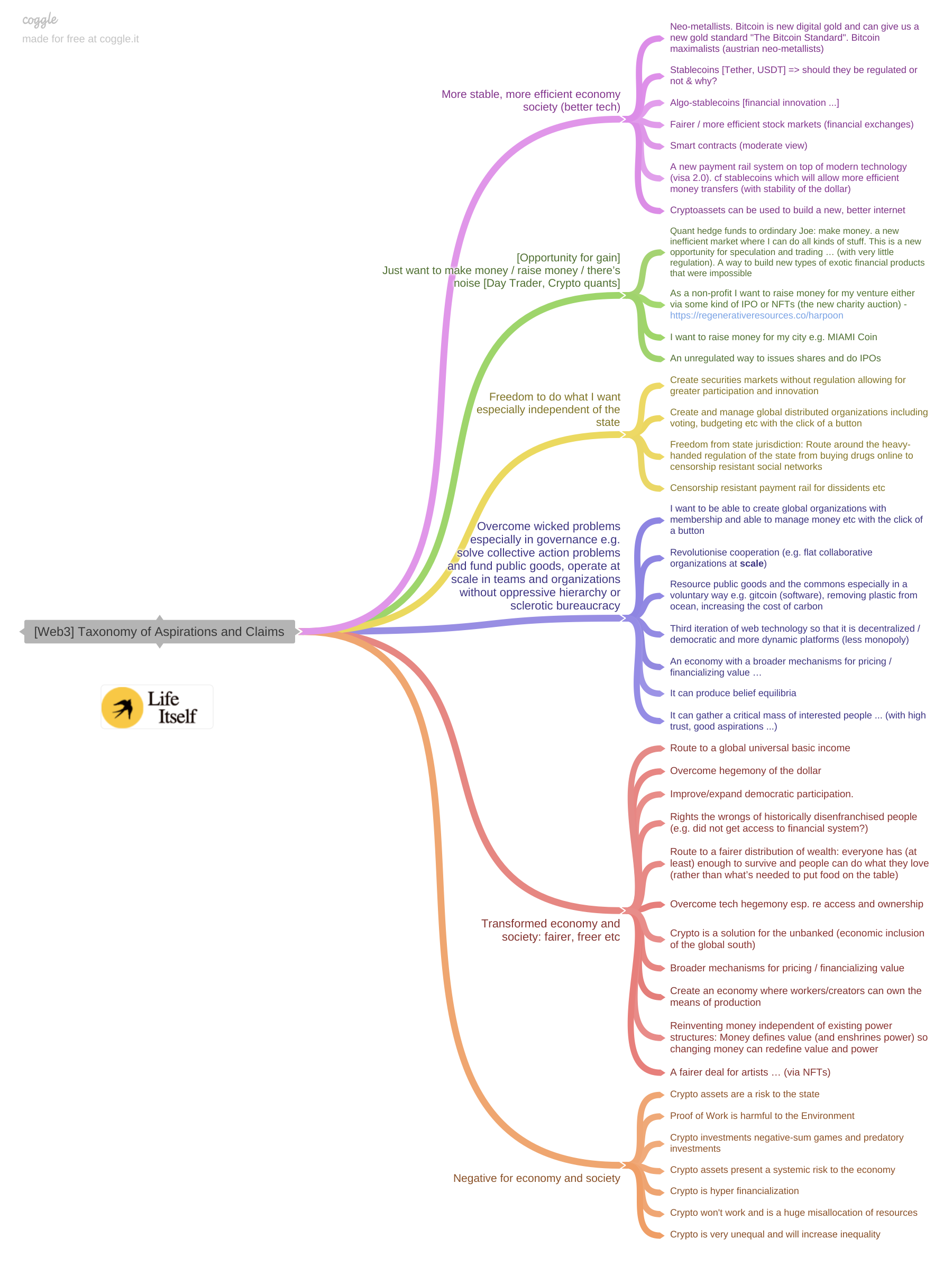
|
||||
[](https://coggle.it/diagram/YhTzF8ZnKihmLdpm/t/web3-taxonomy-of-aspirations-and-claims
|
||||
)
|
||||
|
|
|
|||
|
|
@ -1,15 +1,15 @@
|
|||
# Bitcoin is not a means to counter authoritarian regimes
|
||||
Crypto assets are not a safe haven for one’s investments or a a shield against government tyranny. In his whitepaper *Bitcoin, Currencies, and Fragility*, Nassim Taleb writes of the "safe haven from tyranny" thesis:
|
||||
# Is bitcoin a means to counter authoritarian regimes?
|
||||
**Crypto assets are not a safe haven for one’s investments or a shield against government tyranny.** In his whitepaper *Bitcoin, Currencies, and Fragility*, Nassim Taleb writes of the "safe haven from tyranny" thesis:
|
||||
|
||||
> By its very nature, bitcoin is open for all to see. The belief in one’s ability to hide one’s assets from the government with a public blockchain easily triangularizable at endpoints, and not just read by the FBI but also by people in their living rooms, requires a certain lack of financial seasoning and statistical understanding — perhaps even a lack of minimal common sense. For instance a Wolfram Research specialist was able to statistically detect and triangularize "anonymous" ransom payments made by Colonial Pipeline on May 8 in 2021 — and it did not take long for the FBI to restore the funds. We can safely assume that government structures and computational power will remain stronger than those of distributed operators who, while distrusting one another, can fall prey to simple hoaxes
|
||||
>
|
||||
> [..] The slogan "Escape government tyranny hence bitcoin" is similar to advertisements in the 1960s extolling the health benefits of cigarettes.
|
||||
|
||||
The massive power asymmetries of authoritarian regimes and their control over both traditional payment rails and domestic implies that dissidents attempting to use crypto assets to circumvent repression or capital controls will find it very difficult to move assets or cash out. Without the capacity to cash out the efficacy of their actions is fundamentally limited to external geographic regions outside of the authoritarian regimes. Since no action can effected internal to the regime this fundamentally refutes the argument that crypto assets are an effective tool for dissidents.
|
||||
The massive power asymmetries of authoritarian regimes and their control over both traditional payment rails and domestic implies that dissidents attempting to use crypto assets to circumvent repression or capital controls will find it very difficult to move assets or cash out. Without the capacity to cash out, the efficacy of their actions is fundamentally limited to external geographic regions outside of the authoritarian regimes. Since no action can be effected internal to the regime this refutes the argument that crypto assets are an effective tool for dissidents.
|
||||
|
||||
This is best evidenced by the Canadian convoys in 2022 which attempted to take international donations in crypto assets and found themselves and their accounts frozen by both banks and Canadian [crypto exchanges](../concepts/crypto-exchange.md) which blocked transactions under [illicit financing](../concepts/illicit-financing.md) laws. This made using the donations to purchase supplies impossible and undermined the [crypto assets](../concepts/cryptoasset.md) narrative.
|
||||
|
||||
The complete ban of [crypto asset](../concepts/cryptoasset.md) by the People's Republic of China also does not lend credibility to the thesis that [crypto asset](../concepts/cryptoasset.md) are outside the remit of authoritarian controls and their restriction on capital movement and controls over domestic [money services business](../concepts/money-services-business.md).
|
||||
The complete ban of [crypto assets](../concepts/cryptoasset.md) by the People's Republic of China also does not lend credibility to the thesis that [crypto assets](../concepts/cryptoasset.md) are outside the remit of authoritarian controls and their restriction on capital movement and controls over domestic [money services business](../concepts/money-services-business.md).
|
||||
|
||||
## References
|
||||
1. Bogost, Ian. 2017. ‘Cryptocurrency Might Be a Path to Authoritarianism’. The Atlantic 30.
|
||||
|
|
@ -18,4 +18,4 @@ The complete ban of [crypto asset](../concepts/cryptoasset.md) by the People's R
|
|||
1. Krugman, Paul. 2022. ‘The Strange Alliance of Crypto and MAGA Believers’. The New York Times, 11 January 2022, sec. Opinion. https://www.nytimes.com/2022/01/10/opinion/crypto-cryptocurrency-money-conspiracy.html.
|
||||
1. Xie, Rain. 2019. ‘Why China Had to Ban Cryptocurrency but the U.S. Did Not: A Comparative Analysis of Regulations on Crypto-Markets between the U.S. and China’. Wash. U. Global Stud. L. Rev. 18 (2): 457–89. https://openscholarship.wustl.edu/cgi/viewcontent.cgi?article=1684&context=law_globalstudies.
|
||||
1. Wang, Gangjin, Yanping Tang, Chi Xie, and Shou Chen. 2019. ‘Is Bitcoin a Safe Haven or a Hedging Asset? Evidence from China’. Journal of Management Science and Engineering 4 (3): 173–88. https://doi.org/10.1016/j.jmse.2019.09.001.
|
||||
1. Ottenhof, Luke. 2021. ‘Crypto-Colonialists Use the Most Vulnerable People in the World as Guinea Pigs’. VICE Media.
|
||||
1. Ottenhof, Luke. 2021. ‘Crypto-Colonialists Use the Most Vulnerable People in the World as Guinea Pigs’. VICE Media.
|
||||
|
|
@ -1,22 +1,179 @@
|
|||
# Crypto is not providing faster payment rails or better remittance services
|
||||
Since crypto assets [cannot function as a currency](is-bitcoin-currency.md) they are not useful in building payment rails or remittance services. Crypto assets can be used as an intermediate asset in which trades can be settled in, but this does not serve a technical of financial purpose and simply introduces an unnecessary conversion step for no reason.
|
||||
---
|
||||
title: Crypto will provide better payment and remittance services
|
||||
description: The claim being made here is that a. crypto can provide payment and remittance services by functioning as a currency, and b. crypto can provide better payment rails and remittance services than existing technologies. We find that crypto does not fulfil the definition of a currency is not technologically capable of competing with existing payment rails, and the level of advancement needed to do so should not be considered inevitable. While we do note that crypto does appear to serve the functions of a currency in practice in nations with non-functional financial systems such as Ukraine, this fact should be taken less as a testament to the potential of crypto and more as a sign that political and economic support is needed in these cases.
|
||||
category:
|
||||
- claim: y
|
||||
- featured: y
|
||||
- interview: n
|
||||
- deepdive: n
|
||||
claim:
|
||||
- evaluation: N
|
||||
- confidence: HH
|
||||
---
|
||||
|
||||
If a person wants to send money abroad, say from US dollars to Indian rupees they would typically use a service like MoneyGram or WesternUnion. These services charge a transaction fee and do a direct swap of dollars to rupees from the reserves the company holds in both currencies.
|
||||
## Evaluation: Largely false (high confidence)
|
||||
|
||||
If one postulates using a crypto asset or stablecoin as a means to do remittances then they are stilled faced with the *last leg problem*. Their relative in India still has to convert the crypto asset into the local currency to buy domestic goods and services since supermakets and stores don't accept crypto assets. So instead of a dollar-to-ruppee conversion we would hypothetically do a dollar-to-bitcoin-to-rupee conversion. This introduces [price-risk](../concepts/price-risk.md), [counterparty-risk](../concepts/counterparty-risk.md) and unnecessary conversion fees to accommodate the extraneous third exchange. This is unnecessary complexity and likely more expensive, for no reason.
|
||||
Crypto is not technologically capable of competing with existing payment rails, and the level of advancement needed to do so is far from a sure thing. In fact, crypto is not up to acting as a currency at all. It does appear to serve these functions in practice in developing nations with non-functional financial systems, as the example of Ukraine shows. However this should be taken less as a testament to the potential of crypto and more as a sign that political and economic support is needed in these cases. And, being better than poorly functioning legacy systems is not what the spirit of this claim gestures to.
|
||||
|
||||
See industry analysts describe this proble in more depth: [Does Bitcoin/Blockchain make sense for international money transfers?](https://www.saveonsend.com/bitcoin-blockchain-money-transfer/)
|
||||
## Examples of the claim being made
|
||||
|
||||
## References
|
||||
1. Plant, Luke. 2022. ‘The Technological Case against Bitcoin and Blockchain’. Luke Plant’s Home Page. 5 March 2022. https://lukeplant.me.uk/blog/posts/the-technological-case-against-bitcoin-and-blockchain/.
|
||||
1. White, Molly. 2022a. ‘Blockchain-Based Systems Are Not What They Say They Are’. Molly White (blog). 9 January 2022. https://blog.mollywhite.net/blockchains-are-not-what-they-say/.
|
||||
1. ———. 2022b. ‘Anonymous Cryptocurrency Wallets Are Not So Simple’. Molly White (blog). 12 February 2022. https://blog.mollywhite.net/anonymous-crypto-wallets/.
|
||||
1. ———. 2022c. ‘Cryptocurrency Off-Ramps, and the Shift towards Centralization’. Molly White. 12 February 2022. https://blog.mollywhite.net/off-ramps/.
|
||||
1. ———. 2022d. ‘Cryptocurrency’s Robinhood Effect’. Molly White. 17 February 2022. https://blog.mollywhite.net/cryptocurrencys-robinhood-effect/.
|
||||
1. Cembalest, Michael. 2022. ‘The Maltese Falcoin: On Cryptocurrencies and Blockchains’. https://privatebank.jpmorgan.com/content/dam/jpm-wm-aem/global/pb/en/insights/eye-on-the-market/the-maltese-falcoin.pdf.
|
||||
1. Weaver, Nicholas. 2018. Blockchains and Cryptocurrencies: Burn It With Fire. Berkeley School of Information. https://www.youtube.com/watch?v=xCHab0dNnj4.
|
||||
1. Steele, Graham. 2021. ‘The Miner of Last Resort: Digital Currency, Shadow Money and the Role of the Central Bank’. Technology and Government, Emerald Studies in Media and Communications, Forthcoming.
|
||||
1. Amato, Massimo, and Luca Fantacci. 2020. A Fistful of Bitcoins: The Risks and Opportunities of Virtual Currencies. Bocconi University Press. https://www.egeaeditore.it/ita/prodotti/economia/a-fistful-of-bitcoins.aspx.
|
||||
1. Krugman, Paul. 2018. ‘Transaction Costs and Tethers: Why I’m a Crypto Skeptic’. The New York Times 21.
|
||||
1. ———. 2021. ‘Technobabble, Libertarian Derp and Bitcoin’. The New York Times 21.
|
||||
1. Stinchcombe, Kai. 2017. ‘Ten Years In, Nobody Has Come Up With a Use for Blockchain’. Hackernoon. 22 December 2017. https://hackernoon.com/ten-years-in-nobody-has-come-up-with-a-use-case-for-blockchain-ee98c180100.
|
||||
BLOCKDATA (2019) ‘Blockchain is disrupting the $700 billion remittance industry’, _Medium_, 7 March. Available at https://medium.com/@blockdata_tech/blockchain-is-disrupting-the-700-billion-remittance-industry-b79a01a95a10 (Accessed: 13 September 2022).
|
||||
|
||||
CMT, B.M.I., CFA (2015) ‘The Value Investor’s Case for... Bitcoin?!’, _Miller Value Partners_, 8 September. Available at: https://millervalue.com/a-value-investors-case-for-bitcoin/ (Accessed: 13 September 2022):
|
||||
|
||||
> The open ledger combined with the complexity of transaction data makes Bitcoin a very secure method of payment... One of Bitcoin’s biggest advantages over other payment networks like Visa (V) and MasterCard (MA) is minimal transactions fees. While other payments networks typically charge the greater of ~3% and $0.15, Bitcoin’s transaction fee tends to be a negligible fraction of the transaction, if any at all. Lower transaction fees not only enable buyers and sellers to transact at prices that are better for both parties, but they could enable micropayments in markets that are not otherwise compatible with a $0.15 surcharge on low-price, low-margin goods and services.
|
||||
|
||||
Ver, Roger. quoted in COINTELEGRAPH (2013) _Western Union is not yet ready for bitcoin international transfer_, _Cointelegraph_. Available at: https://cointelegraph.com/news/western_union_is_not_yet_ready_for_bitcoin_international_transfer (Accessed: 13 September 2022):
|
||||
|
||||
> I think we will know when bitcoin has reached prime time when it is transferring more value each day than Western Union or MoneyGram... I think we may see that happen within another two years.
|
||||
|
||||
Nakamoto, S. *Bitcoin: A Peer-to-Peer Electronic Cash System*. Available at: https://www.ussc.gov/sites/default/files/pdf/training/annual-national-training-seminar/2018/Emerging_Tech_Bitcoin_Crypto.pdf
|
||||
|
||||
|
||||
## Claim steel-manned
|
||||
|
||||
|
||||
### Subclaim 1: Crypto can provide payment and remittance services by virtue of fulfilling the functions of a currency
|
||||
|
||||
Payment systems and remittance services need to pay in something. That something must either be a [currency](/concepts/currency.md) (eg dollars) or a [commodity](/concepts/commodity.md) (eg cows).
|
||||
|
||||
Crypto can provide payment systems and remittance services because it serves the three functions of a currency:
|
||||
|
||||
1. It can be a unit of account in that it’s a standard and divisible unit of measurement of market value (i.e. it can be used to signal what something is worth).
|
||||
|
||||
2. It can be a medium of exchange in that we can use it as an intermediary instrument to transact for goods and services.
|
||||
|
||||
3. It can act as a [store of value](/concepts/store-of-value.md) in that it (at least ideally) retains its purchasing power over time, such that we can retrieve the value of our investment at a later date without making a significant loss.
|
||||
|
||||
|
||||
### Subclaim 2: Crypto can provide _better payment_ rails and remittance services
|
||||
|
||||
Crypto can provide us with better payment rails - i.e. a better Visa, Stripe etc - and more efficient international remittances - I can send money abroad, e.g. from US dollars to Indian rupees using crypto. These blockchain-based payment rails would have reduced friction and costs resulting in a cheaper, faster, more efficient service.
|
||||
|
||||
|
||||
## Evaluation: Largely false (high confidence)
|
||||
|
||||
|
||||
### Subclaim 1: Crypto can provide payment and remittance services by virtue of fulfilling the functions of a currency
|
||||
|
||||
Crypto assets are [not currencies](/claims/is-bitcoin-currency.md) because they cannot fulfill the definition of [money](/concepts/money.md).
|
||||
|
||||
Crypto assets do not currently seem promising as a medium of exchange. Even the latest technologies have yet to show they can reliably process transaction volumes at a similar level to traditional payment rails[^1]. They thus don’t work as a global currency system as they can’t process transactions fast enough.
|
||||
|
||||
Proponents argue that technical innovations, from third party protocols such as the lightning network[^2] to the shift from proof-of-work to alternative validation methods such as proof-of-stake[^3], will help solve this throughput problem. However even with these new technologies in place blockchains are a long way from competing with traditional payment rails in speed and reliability. Significant leaps in capability are required to reach parity, let alone exceed existing payment methods, and these should not be taken as an inevitability.
|
||||
|
||||
One further hurdle to new crypto assets acting as a widespread medium of exchange is privacy. The public blockchains which dominate web3 record all transactions on an openly viewable ledger, meaning even transactions using anonymised wallets are often easily traceable[^4]. Many users are unlikely to be happy with this potential lack of privacy, particularly businesses who are concerned with revealing sensitive information to their competitors. Emerging methods and technologies are targeting the problem of privacy, however again they are a far cry from being able to guarantee widespread transaction privacy on public blockchains any time in the near future.
|
||||
|
||||
Crypto assets also do not appear to hold potential as a store of value given their extremely high price variance. If they were to behave as a [store of value](/concepts/store-of-value.md), they would have to abandon hypervolatility, and there is no easily identifiable economic mechanism for this to happen. It should be noted that this volatility could at least in theory ease with time. However, as we have previously noted, the price dynamics of crypto assets are predominantly determined by bubble dynamics fuelled by economic narratives and [“animal spirits”](https://www.investopedia.com/terms/a/animal-spirits.asp) of investors. The vast majority of crypto projects are detached from productive economic activity and generate assets with no use value beyond speculation. This has been played out in the repeated, large scale crypto crashes of 2022[^5]. Given this, vulnerability to price volatility seems all but guaranteed to continue.
|
||||
|
||||
|
||||
### Subclaim 2: Crypto can provide _better_ payment rails and remittance services
|
||||
|
||||
Since crypto assets cannot function as a currency, they are not useful in building payment rails or remittance services. Crypto assets can be used as an intermediate asset in which trades can be settled in, but this does not serve a technical or financial purpose; it simply introduces an unnecessary conversion step.
|
||||
|
||||
If a person wants to send money abroad, say from US dollars to Indian rupees, they would typically use a service like MoneyGram or WesternUnion. These services charge a transaction fee and do a direct swap of dollars to rupees from the reserves the company holds in both currencies.
|
||||
|
||||
If one postulates using a crypto asset or stablecoin as a means to do remittances then they are still faced with the _last mile problem_[^6]. Their relatives in India still have to convert the crypto asset into the local currency to buy domestic goods and services since supermarkets and stores don't accept crypto assets. So instead of a dollar-to-rupee conversion we would hypothetically do a dollar-to-bitcoin-to-rupee conversion. This introduces [price-risk](/concepts/price-risk.md), [counterparty-risk](/concepts/counterparty-risk.md) and unnecessary conversion fees to accommodate the extraneous third exchange. The process adds unnecessary complexity and is likely more expensive.
|
||||
|
||||
In addition, if crypto were to provide _cheaper_ and _faster_ payment rails, it’s likely this will have been achieved not via technological advancements, but by removing safeguards. The costs present in most retail financial services have very little to do with the technology. Transaction costs associated with payments are fraud mitigation, transaction reversal, custodial services, customer service, and compliance. Customers want these safeguards. Once we add compliance back to crypto payment rails, it’s unclear that there would be any efficiency increase or cost savings.
|
||||
|
||||
See industry analysts describe this problem in more depth: [Does Bitcoin/Blockchain make sense for international money transfers?](https://www.saveonsend.com/bitcoin-blockchain-money-transfer/)
|
||||
|
||||
|
||||
## Do developing nations qualify our analysis?
|
||||
|
||||
One potential qualification to this analysis is the use of cryptocurrency to bypass traditional economic apparatus which is otherwise dysfunctional. The most prominent recent example has been Ukraine, where both non-state actors and the government itself have raised significant amounts of money in cryptocurrencies to support the war effort[^7]. The standard crypto-skeptic response to this is that there is nothing to stop donations being made via traditional payment rails. While this is in some sense true, the reality is more complex.
|
||||
|
||||
First, traditional fundraising platforms often block use of funds for the purchase of weapons and other military equipment, which is a priority for Ukrainian forces currently. More interestingly however, it has been reported that the use of cryptocurrencies and particularly crypto tokens such as USDT in Ukraine was already relatively common due to widespread distrust in the government[^8] , a poorly functioning banking system[^9] and persistently high levels of inflation in the local currency. There is anecdotal evidence that this situation gave rise to a secondary economy in the cryptosphere, where direct crypto to crypto transactions were common for more expensive items[^10]. Use of cryptocurrency to purchase war supplies – which proponents engaged in these efforts claim are paid for directly in crypto itself – has also been identified as quicker and easier than trying to navigate the slow and unreliable banking system to make international purchases in a currency such as USD, even for the government itself[^11].
|
||||
|
||||
Should this analysis of the situation in Ukraine and other similar contexts hold true, then the following qualifications may be in order:
|
||||
|
||||
1) The last mile problem will not hold where economic transactions can be carried out directly in cryptocurrency. This may be in states where parallel crypto-economies have emerged to fill a void left by a dysfunctional financial system, or simply due to cryptocurrency being more widely accepted as a direct payment method for things like online transactions (evidenced by major platforms such as PayPal facilitating the use of cryptocurrency to pay for goods and services).
|
||||
|
||||
2) Better is a relative term. Blockchain may well provide a better payment rail compared to highly dysfunctional traditional systems, such as the financial system of Ukraine.
|
||||
|
||||
We should be measured in judging the implications of these qualifications for the overall claim, however. The spirit of the claim is that Web3 can provide better payment rails than the best of existing technology. The fact that Web3 may provide a better payment rail than very poorly functioning versions of traditional financial infrastructure does nothing to further this.
|
||||
|
||||
Further, while the last mile problem can be overcome, the high price volatility in particular of cryptocurrency, and the now well documented risks to the stability of prominent stablecoins[^12], means that crypto assets still appear unsuitable as an effective medium of exchange in all but the most dire of circumstances.
|
||||
|
||||
These observations point to a deeper point it is worth acknowledging. It does seem at least plausible that crypto assets are currently supporting financial activity in certain highly unstable and dysfunctional economies[^13]. However, it is problematic to use this observation to argue that replacing traditional financial infrastructure with blockchain based alternatives is desirable. Technical interventions such as the creation of parallel crypto-economies are akin to sticking plasters - they may address the most severe symptoms in the short term but they are not a feasible long term solution, and do not address the real roots of the problem. Well functioning and stable economies which meet the basic needs of everyone on the planet should be a fairly uncontroversial aspiration. Freedom from runaway inflation and currency depreciation, trustworthy banking and financial systems, the ability to hold money without fear of it being lost or taken, and to quickly and easily make both domestic and international transactions (even during times of crisis and war) are real possibilities. More than that, they are the everyday reality for most of us already in the global north. These can be obtained for everyone on earth, but the levers for doing so lie at the level of political economy _not_ technology. Acknowledging that crypto assets have been used to some effect to bypass the worst symptoms of economic dysfunction should not mean we give up on trying to improve domestic economies or the global economic system more broadly. Claims that we can simply bypass this work through technological means are a dangerous red herring.
|
||||
|
||||
## Conclusion
|
||||
|
||||
Crypto is not technologically capable of competing with existing payment rails, and the level of advancement needed to do so is far from a sure thing. In fact, crypto is not up to acting as a currency at all. It does appear to serve these functions in practice in developing nations with non-functional financial systems, as the example of Ukraine shows. However this should be taken less as a testament to the potential of crypto and more as a sign that political and economic support is needed in these cases. And, being better than poorly functioning legacy systems is not what the spirit of this claim gestures to.
|
||||
|
||||
## Related content
|
||||
|
||||
### Deep dives
|
||||
|
||||
* [Deep Dive: Fintech Incrementalism And Responsible Innovation](/notes/fintech-incrementalism-and-responsible-innovation)
|
||||
* [A Macroeconomics Perspective on Cryptocurrencies](/notes/a-macroeconomics-perspective-on-cryptocurrencies)
|
||||
|
||||
### FAQs
|
||||
|
||||
* [Is an unregulated transnational payment system desirable?](/claims/is-transnational-payment)
|
||||
* [Is bitcoin a currency?](/claims/is-bitcoin-currency)
|
||||
* [Is Web3 a means to rebuild the global financial system?](/claims/is-new-financial-system)
|
||||
* [Is crypto providing faster payment rails or better remittance services?](/claims/is-better-payments)
|
||||
* [Are crypto tokens a hedge against the “debasement” of the dollar?](/claims/is-hedge-debasement)
|
||||
* [Are crypto assets a hedge against inflation?](/claims/is-hedge-inflation)
|
||||
* [Are crypto assets a risk to the dollar?](/claims/is-threat-dollar)
|
||||
* [What type of asset is a crypto token?](/claims/is-type-of-asset)
|
||||
* [How do we value a crypto token?](/claims/is-valuation-model)
|
||||
* [What consumer protections exist for crypto assets?](/claims/is-consumer-protections)
|
||||
* [Are crypto assets a form of predatory inclusion?](/claims/is-predatory)
|
||||
* [Is crypto a solution for the unbanked?](/claims/is-crypto-unbanked)
|
||||
|
||||
### Concepts
|
||||
|
||||
* [Money](/concepts/money)
|
||||
* [Currency](/concepts/currency)
|
||||
* [Crypto exchanges](/concepts/crypto-exchanges)
|
||||
* [Bank](/concepts/bank)
|
||||
* [Income Cashflows](/concepts/income-cashflows)
|
||||
* [Assets](/concepts/assets)
|
||||
* [Capitalism](/concepts/capitalism)
|
||||
* [Store of value](/concepts/store-of-value)
|
||||
* [US dollar](/concepts/dollar)
|
||||
|
||||
|
||||
## Notes
|
||||
|
||||
[^1]:
|
||||
Fonda, Daren. “Solana Could Be the Visa of Crypto Networks. Not So Fast, Says Visa.” _Barrons._ January 2022. [https://www.barrons.com/articles/solana-could-be-the-visa-of-crypto-networks-not-so-fast-says-visa-51642091862](https://www.barrons.com/articles/solana-could-be-the-visa-of-crypto-networks-not-so-fast-says-visa-51642091862)
|
||||
|
||||
[^2]:
|
||||
[‘Lightning Network’, accessed 15 December 2022, https://lightning.network/.](https://www.zotero.org/google-docs/?MKXFNL)
|
||||
|
||||
[^3]:
|
||||
[‘The Merge | Ethereum.Org’, accessed 15 December 2022, https://ethereum.org/en/upgrades/merge/.](https://www.zotero.org/google-docs/?qlUcNZ)
|
||||
|
||||
[^4]:
|
||||
[Molly White, ‘Anonymous Cryptocurrency Wallets Are Not So Simple’, Molly White (blog), 12 February 2022, https://blog.mollywhite.net/anonymous-crypto-wallets/.](https://www.zotero.org/google-docs/?QOjAeD)
|
||||
|
||||
[^5]:
|
||||
[‘Post FTX Collapse Reflections on Crypto | Making Sense of Crypto and Web3’, accessed 15 December 2022, https://web3.lifeitself.org/notes/post-ftx-collapse.](https://www.zotero.org/google-docs/?eItLvY)
|
||||
|
||||
[^6]:
|
||||
[‘Last Mile: What It Means in Reaching Customers’, Investopedia, accessed 15 December 2022, https://www.investopedia.com/terms/l/lastmile.asp.](https://www.zotero.org/google-docs/?xXTIBW)
|
||||
|
||||
[^7]:
|
||||
[‘Ukraine Readies NFT Sales as Crypto Donations Top $60 Million’, Bloomberg.Com, 5 April 2022, https://www.bloomberg.com/news/articles/2022-04-05/ukraine-readies-nft-sales-as-crypto-donations-top-60-million.](https://www.zotero.org/google-docs/?QeIYqD)
|
||||
|
||||
[^8]:
|
||||
Gallup. ‘World-Low 9% of Ukrainians Confident in Government’. Gallup.com, 21 March 2019. [https://news.gallup.com/poll/247976/world-low-ukrainians-confident-government.aspx](https://news.gallup.com/poll/247976/world-low-ukrainians-confident-government.aspx).
|
||||
|
||||
[^9]:
|
||||
Kramer, Andrew E. ‘In Ukraine, Not Even the Top Banker Trusts the Banks’. The New York Times, 1 November 2016, sec. World. https://www.nytimes.com/2016/11/02/world/europe/ukraine-banks-corruption.html.
|
||||
|
||||
[^10]:
|
||||
Patel, Nilay. ‘How Ukraine’s Wide Use of Cryptocurrency Is Playing out during the War’. The Verge. Accessed 22 November 2022. https://www.theverge.com/23138465/decoder-ukraine-war-cryptocurrency-michael-chobanian-interview-bitcoin-usdt
|
||||
|
||||
[^11]:
|
||||
Ibid.
|
||||
|
||||
[^12]:
|
||||
[Steven Ehrlich, ‘Tether Falls From Its $1 Price Peg Amid Market Turmoil Across Multiple Exchanges’, Forbes, accessed 15 December 2022, https://www.forbes.com/sites/stevenehrlich/2022/11/10/tether-falls-from-its-1-peg-amid-market-turmoil/.](https://www.zotero.org/google-docs/?nDiLx2)
|
||||
|
||||
[^13]:
|
||||
[‘Cryptocurrencies: Developing Countries Provide Fertile Ground’, Financial Times, 5 September 2021.](https://www.zotero.org/google-docs/?0GMJeD)
|
||||
|
|
|
|||
|
|
@ -1,4 +1,6 @@
|
|||
# Bitcoin cannot function as a currency
|
||||
# Is bitcoin a currency?
|
||||
**Bitcoin cannot function as a currency.**
|
||||
|
||||
Unlike the namesake of "cryptocurrency" might imply, [bitcoin](../concepts/bitcoin.md) is not a [currency](../concepts/currency.md). It does not fulfil the economic definition of [money](../concepts/money.md). Instead bitcoin is best understood as a [speculative](../concepts/speculation.md) [cryptoasset](../concepts/cryptoasset.md) or [gambling](../concepts/gambling.md) product.
|
||||
|
||||
Since bitcoin is not issued by a sovereign state or [central-banks](../concepts/central-banks.md) there is no central party to manage the [deflationary](../concepts/deflationary.md) spirals that occur in the [price-formation](../concepts/price-formation.md) of the asset. Therefore it is subject to wild and uncontrollable volatility that makes it unsuitable as a *means of exchange*. No amount of technology can fix the volatility problem as it is a function of the economic design of the asset and its fixed supply. This arises out of the political imaginaries of the [neo-metallism](../notes/neo-metallism.md) school and [Austrian economics](../concepts/austrian-economics.md) that informed the design of the bitcoin to resemble the historical [gold-standard](../concepts/gold-standard.md) and the conception of heterodox ideas of [sound money](../concepts/sound-money.md).
|
||||
|
|
@ -27,4 +29,4 @@ Since bitcoin is [deflationary](../concepts/deflationary.md) it encourages hordi
|
|||
1. Plant, Luke. 2022. ‘The Technological Case against Bitcoin and Blockchain’. Luke Plant’s Home Page. 5 March 2022. https://lukeplant.me.uk/blog/posts/the-technological-case-against-bitcoin-and-blockchain/.
|
||||
1. Stinchcombe, Kai. 2018. ‘Blockchain Is Not Only Crappy Technology but a Bad Vision for the Future’. Medium (blog). 9 April 2018. https://medium.com/@kaistinchcombe/decentralized-and-trustless-crypto-paradise-is-actually-a-medieval-hellhole-c1ca122efdec.
|
||||
1. White, Molly. 2022a. ‘Cryptocurrency Off-Ramps, and the Shift towards Centralization’. Molly White. 12 February 2022. https://blog.mollywhite.net/off-ramps/.
|
||||
1. ———. 2022b. ‘Cryptocurrency’s Robinhood Effect’. Molly White. 17 February 2022. https://blog.mollywhite.net/cryptocurrencys-robinhood-effect/.
|
||||
1. ———. 2022b. ‘Cryptocurrency’s Robinhood Effect’. Molly White. 17 February 2022. https://blog.mollywhite.net/cryptocurrencys-robinhood-effect/.
|
||||
|
|
|
|||
|
|
@ -5,13 +5,13 @@ Bitcoin is not compatible with ESG investing.
|
|||
|
||||
**Environmental Problems**
|
||||
|
||||
* [Environmental footprint of mining](environmental-footprint.md)
|
||||
* [Environmental footprint of mining](is-environmental-footprint.md)
|
||||
|
||||
**Social Problems**
|
||||
|
||||
* [Crypto is a market bubble](is-bubble.md)
|
||||
* [Predatory inclusion](is-predatory.md)
|
||||
* [Consumer protections](consumer-protections.md)
|
||||
* [Consumer protections](is-consumer-protections.md)
|
||||
* [Bitcoin is not a currency](is-bitcoin-currency.md)
|
||||
* [Private money is not sustainable](is-private-money.md)
|
||||
* [Crypto is not build a new financial system](is-new-financial-system.md)
|
||||
|
|
@ -1,8 +1,8 @@
|
|||
# Is the underlying technology of "blockchain" useful for non-monetary purposes?
|
||||
Blockchain technology, detached from the sale of tokens or [crypto assets](../concepts/cryptoasset.md) a has shown no track record of providing benefit for any real world applications. So-called [permissioned blockchain](../concepts/permissioned-blockchain.md) solutions offer no benefits over traditional database solutions and introduce a great deal of additional complexity for no value add.
|
||||
|
||||
The technical purpose of blockchains is to create [censorship resistent](../concepts/censorship-resistence.md) networks for the issuance of [crypto asset](../concepts/cryptoasset.md) for [regulatory arbitrage](../concepts/regulatory-arbitrage.md) of [securities](../concepts/security.md) law and [illicit financing](../concepts/illicit-financing.md) purposes. There is no proven use case for the technology outside of scofflawing.
|
||||
|
||||
|
||||
## References
|
||||
1. Schneier, Bruce. 2019. ‘There’s No Good Reason to Trust Blockchain Technology’. Wired Magazine. https://www.wired.com/story/theres-no-good-reason-to-trust-blockchain-technology/.
|
||||
1. Rosenthal, David. n.d. ‘Stanford Lecture on Cryptocurrency’. Accessed 2 March 2022. https://blog.dshr.org/2022/02/ee380-talk.html.
|
||||
|
|
@ -21,4 +21,4 @@ The technical purpose of blockchains is to create [censorship resistent](../conc
|
|||
1. Weaver, Nicholas. 2018. Blockchains and Cryptocurrencies: Burn It With Fire. Berkeley School of Information. https://www.youtube.com/watch?v=xCHab0dNnj4.
|
||||
1. White, Molly. 2022a. ‘Blockchain-Based Systems Are Not What They Say They Are’. Molly White (blog). 9 January 2022. https://blog.mollywhite.net/blockchains-are-not-what-they-say/.
|
||||
1. ———. 2022b. ‘It’s Not Still the Early Days’. Molly White. 14 January 2022. https://blog.mollywhite.net/its-not-still-the-early-days/.
|
||||
1. Bindseil, Ulrich, Patrick Papsdorf, and Jürgen Schaaf. 2022. ‘The Encrypted Threat: Bitcoin’s Social Cost and Regulatory Responses’. 7 January 2022. https://www.suerf.org/docx/f_88b3febc5798a734026c82c1012408f5_38771_suerf.pdf.
|
||||
1. Bindseil, Ulrich, Patrick Papsdorf, and Jürgen Schaaf. 2022. ‘The Encrypted Threat: Bitcoin’s Social Cost and Regulatory Responses’. 7 January 2022. https://www.suerf.org/docx/f_88b3febc5798a734026c82c1012408f5_38771_suerf.pdf.
|
||||
|
|
@ -1,4 +1,6 @@
|
|||
# Crypto assets are a bubble
|
||||
# Are crypto assets a bubble?
|
||||
**Crypto assets are a bubble.**
|
||||
|
||||
Crypto assets have the characterstic price behaviour that resembles many other [bubbles](../concepts/bubble.md) and [market manias](../concepts/madness-crowds.md) throughout history. Bitcoin has been characterised as a [speculative](../concepts/speculation.md) bubble by eight winners of the Nobel Prize in economics.
|
||||
|
||||
* Paul Krugman
|
||||
|
|
@ -34,4 +36,4 @@ And several notable investors have also described it as a bubble:
|
|||
1. Nabilou, Hossein, and André Prüm. 2019. ‘Ignorance, Debt, and Cryptocurrencies: The Old and the New in the Law and Economics of Concurrent Currencies’. Journal of Financial Regulation 5 (1): 29–63. https://doi.org/10.1093/jfr/fjz002.
|
||||
1. Smales, L. A. 2022. ‘Investor Attention in Cryptocurrency Markets’. International Review of Financial Analysis 79: 101972. https://doi.org/10.1016/j.irfa.2021.101972.
|
||||
1. Kolchinski, Alex. 2022. ‘Crypto Is an Unproductive Bubble’. Alex Kolchinski (blog). 18 March 2022. https://alexkolchinski.com/2022/03/18/crypto-is-an-unproductive-bubble/.
|
||||
1. Krugman, Paul. 2021. ‘The Brutal Truth About Bitcoin’. The New York Times 21.
|
||||
1. Krugman, Paul. 2021. ‘The Brutal Truth About Bitcoin’. The New York Times 21.
|
||||
|
|
|
|||
|
|
@ -1,11 +1,13 @@
|
|||
# Crypto tokens are not a means to destroy capitalism
|
||||
# Are crypto tokens a means to destroy capitalism?
|
||||
**Crypto tokens are not a means to destroy capitalism.**
|
||||
|
||||
Crypto tokens are indeed a form of [predatory investment](../concepts/predatory-inclusion.md) that may have wide-reaching consequences in the lives of people it harms. However it is not a means to accelerate the collapse of capitalism even if one subscribes to the [accelerationism](../concepts/accelerationism.md) school of thought and believed this the acceleration of capitalism and its destruction was a good thing.
|
||||
Crypto is not a means to accelerate the collapse of capitalism even if one subscribes to the [accelerationism](../concepts/accelerationism.md) school of thought and believed this the acceleration of capitalism and its destruction was a good thing. Crypto tokens are a form of [predatory investment](../concepts/predatory-inclusion.md) that may have wide-reaching consequences in the lives of people it harms.
|
||||
|
||||
The crypto ideology is an extension of neoliberal project that aims to expand the scope and reach of markets to all aspects of human life, a concept often referred to [as hyperfinancialization](is-hyperfinancialization.md). Since crypto tokens aim to expand the scope of capitalism, they cannot bring about anything but more capitalism.
|
||||
|
||||
## References
|
||||
1. Reijers, Wessel, and Mark Coeckelbergh. 2018. ‘The Blockchain as a Narrative Technology: Investigating the Social Ontology and Normative Configurations of Cryptocurrencies’. Philosophy and Technology 31 (1): 103–30. https://doi.org/10.1007/s13347-016-0239-x.
|
||||
1. Cohney, Shaanan, David Hoffman, Jeremy Sklaroff, and David Wishnick. 2019. ‘Coin-Operated Capitalism’. Columbia Law Review 119 (3): 591–676.
|
||||
1. Golumbia, David. 2013a. ‘Cyberlibertarianism: The Extremist Foundations of “Digital Freedom.”’ Clemson University Department of English.
|
||||
1. ———. 2015. ‘Bitcoin as Politics: Distributed Right-Wing Extremism’. MoneyLab Reader: An Intervention in Digital Economy, Amsterdam: Institute of Network Cultures.
|
||||
1. Stinchcombe, Kai. 2018. ‘Blockchain Is Not Only Crappy Technology but a Bad Vision for the Future’. Medium (blog). 9 April 2018. https://medium.com/@kaistinchcombe/decentralized-and-trustless-crypto-paradise-is-actually-a-medieval-hellhole-c1ca122efdec.
|
||||
|
|
@ -13,4 +15,4 @@ The crypto ideology is an extension of neoliberal project that aims to expand th
|
|||
1. DuPont, Quinn. 2016. ‘The Politics of Cryptography: Bitcoin and the Ordering Machines’. Journal of Peer Production 1 (4): 1–23. http://peerproduction.net/wp-content/uploads/2014/04/DuPont_draft_submission.pdf.
|
||||
1. Hellegren, Z. Isadora. 2017. ‘A History of Crypto-Discourse: Encryption as a Site of Struggles to Define Internet Freedom’. Internet Histories 1 (4): 285–311. https://doi.org/10.1080/24701475.2017.1387466.
|
||||
1. Jarvis, Craig. 2021. ‘Cypherpunk Ideology: Objectives, Profiles, and Influences (1992–1998)’. Internet Histories, 1–27. https://doi.org/10.1080/24701475.2021.1935547.
|
||||
1. Husain, Syed Omer, Alex Franklin, and Dirk Roep. 2020. ‘The Political Imaginaries of Blockchain Projects: Discerning the Expressions of an Emerging Ecosystem’. Sustainability Science, 1–16.
|
||||
1. Husain, Syed Omer, Alex Franklin, and Dirk Roep. 2020. ‘The Political Imaginaries of Blockchain Projects: Discerning the Expressions of an Emerging Ecosystem’. Sustainability Science, 1–16.
|
||||
|
|
|
|||
|
|
@ -1,9 +1,10 @@
|
|||
# Crypto is not a solution for the unbanked
|
||||
# Is crypto a solution for the unbanked?
|
||||
|
||||
Crypto is not a solution for the [unbanked](../concepts/unbanked.md), because by its [deflationary](../concepts/deflationary.md) design it [cannot function as a currency](is-bitcoin-currency.md) therefore it is unusable as a scaleable means for purchasing goods and services.
|
||||
|
||||
The purpose of retail banking services is to provide stable, reliable and safe means for citizens to transact with money that is safely custodied by a trusted third party with the guarantees of regulation by the government that the party will hold their accounts on their behalf. This includes practices like customer service, deposit insurance, fraud detection, transaction reversal and issuing of payment cards.
|
||||
|
||||
[Crypto exchanges](../concepts/crypto-exchange.md) cannot function as [banks](../concepts/bank.md) because the do not custody customer deposits and have no [deposit insurance](../concepts/deposit-insurance.md). This pushes unnecessary counterparty risk down to consumers and in the event of fraud, insolvency or market shocks customers may be left with no access to their funds. This is an unnecessary risk that is strictly worse than traditional banking products and is a form of [predatory inclusion](../concepts/predatory-inclusion.md) with parallels to predatory lending done during the subprime mortgage crisis and alternative money service business like payday loans.
|
||||
[Crypto exchanges](../concepts/crypto-exchange.md) cannot function as [banks](../concepts/bank.md) because they do not custody customer deposits and have no [deposit insurance](../concepts/deposit-insurance.md). This pushes unnecessary counterparty risk down to consumers and in the event of fraud, insolvency or market shocks customers may be left with no access to their funds. This is an unnecessary risk that is strictly worse than traditional banking products and is a form of [predatory inclusion](../concepts/predatory-inclusion.md) with parallels to predatory lending done during the subprime mortgage crisis and alternative money service business like payday loans.
|
||||
|
||||
## References
|
||||
1. Howson, P., & de Vries, A. (2022). Preying on the poor? Opportunities and challenges for tackling the social and environmental threats of cryptocurrencies for vulnerable and low-income communities. Energy Research and Social Science, 84(xxxx), 102394. https://doi.org/10.1016/j.erss.2021.102394
|
||||
|
|
@ -16,4 +17,4 @@ The purpose of retail banking services is to provide stable, reliable and safe m
|
|||
1. Kapsis, I. (2021). Should we trade market stability for more financial inclusion? The case of crypto-assets regulation in EU. FinTech, Artificial Intelligence and the Law: Regulation and Crime Prevention, 85–104. https://doi.org/10.4324/9781003020998-9
|
||||
1. Sen, A., Lindquist, J., & Kolling, M. (2020). Who’s Cashing in? Contemporary Perspectives on New Monies and Global Cashlessness (Vol. 19). Berghahn Books.
|
||||
1. Swartz, L. (2020). New money: How payment became social media. Yale University Press. https://yalebooks.yale.edu/book/9780300233223/new-money
|
||||
1. Vasudevan, R. (2020). Libra and Facebook’s Money Illusion. Challenge, 63(1), 21–39. https://doi.org/10.1080/05775132.2019.1684662
|
||||
1. Vasudevan, R. (2020). Libra and Facebook’s Money Illusion. Challenge, 63(1), 21–39. https://doi.org/10.1080/05775132.2019.1684662
|
||||
|
|
@ -1,10 +1,9 @@
|
|||
# Is web3 a means to dismantle the American tech hegemony?
|
||||
|
||||
Web3 is not a means to disrupt the American tech hegemony, companies like Google, Facebook, Amazon etc. Since web3 has no coherent meaning or purpose, all projects that are currently being developed under the web3 umbrella are aimless technical Potemkin villages that mask thinly veiled [pump and dump](../concepts/pump-and-dump.md) schemes based on [securities](../concepts/security.md) [regulatory arbitrage](../concepts/regulatory-arbitrage.md). This type of company structure is not set up for long term growth or product delivery outside of pumping more token schemes.
|
||||
**Web3 is not a means to disrupt the American tech hegemony, companies like Google, Facebook, Amazon etc.**
|
||||
|
||||
This is further evidenced by the simple fact that [blockchain](../concepts/blockchain.md) technologies have intractable scalability problems, and that the only means they do scale is by [recentralization](../concepts/recentralization.md) thereby recreating just another corporate monolith but based on inferior technology and without the ability to perform [regulatory arbitrage](../concepts/regulatory-arbitrage.md)..
|
||||
[Blockchain](../concepts/blockchain.md) technologies have intractable scalability problems. The only means they do scale is by [recentralization](../concepts/recentralization.md) thereby recreating just another corporate monolith but based on inferior technology and without the ability to perform [regulatory arbitrage](../concepts/regulatory-arbitrage.md).
|
||||
|
||||
There is no future in web3 that poses any threat to tech monopoly because there simply is no meaningful tech to challenge any real business model.
|
||||
|
||||
## References
|
||||
1. Marx, Paris. n.d. ‘Why Web3, the Blockchain and Crypto Internet, Is Doomed to Fail’. Accessed 29 March 2022. https://www.businessinsider.com/web3-blockchain-crypto-internet-doomed-fail-doesnt-live-up-hype-2022-3?r=US&IR=T.
|
||||
|
|
@ -16,4 +15,4 @@ There is no future in web3 that poses any threat to tech monopoly because there
|
|||
1. Soatok. 2021. ‘Against Web3 and Faux-Decentralization’. Dhole Moments. 19 October 2021. https://soatok.blog/2021/10/19/against-web3-and-faux-decentralization/.
|
||||
1. Zitron, Ed. 2022. ‘Solutions That Create Problems’. Substack newsletter. Ed Zitron’s Where’s Your Ed At (blog). 23 February 2022. https://ez.substack.com/p/solutions-that-create-problems.
|
||||
1. Diehl, Stephen. 2021. ‘Web3 Is Bullshit’. 4 December 2021. https://www.stephendiehl.com/blog/web3-bullshit.html.
|
||||
1. White, Molly. 2022. ‘It’s Not Still the Early Days’. Molly White. 14 January 2022. https://blog.mollywhite.net/its-not-still-the-early-days/.
|
||||
1. White, Molly. 2022. ‘It’s Not Still the Early Days’. Molly White. 14 January 2022. https://blog.mollywhite.net/its-not-still-the-early-days/.
|
||||
|
|
|
|||
|
|
@ -0,0 +1,163 @@
|
|||
---
|
||||
title: Crypto is harmful to the environment
|
||||
description: Evaluating the claim that crypto is harmful to the environment.
|
||||
category:
|
||||
- claim: y
|
||||
- featured: y
|
||||
- interview: n
|
||||
- deepdive: n
|
||||
claim:
|
||||
- evaluation: YY
|
||||
- confidence: HH
|
||||
---
|
||||
|
||||
# Claim Steel-Manned
|
||||
|
||||
Crypto is harmful to the environment because crypto [mining](../concepts/mining.md) has a huge environmental footprint. The design of the [Proof of Work](../concepts/proof-of-work.md) (PoW) [consensus algorithm](../concepts/consensus-algorithm.md) is energy wasteful as part of its design.
|
||||
|
||||
# Evidence of claim being made
|
||||
|
||||
Diehl, S. (2021) ‘The Crypto Chernobyl’, 10 February. Available at: https://www.stephendiehl.com/blog/chernobyl.html (Accessed: 25 February 2022).
|
||||
|
||||
> It is an enormously power-hungry and wasteful system that involves doing massive number of trial computations (a process called mining) in parallel across the world in a form of lottery in which computers race to confirm transactions. The more power you can waste, the more bitcoins you can probabilistically win in exchange for your energy waste...
|
||||
> The protocol itself is a runway environmental disaster that incentives an ever increasing amount of waste that can only increase with time. Increasing energy waste is an central and irremovable part of the design.
|
||||
|
||||
Elon Musk [@elonmusk]. ‘Tesla & Bitcoin Https://T.Co/YSswJmVZhP’. Tweet. Twitter, 12 May 2021. https://twitter.com/elonmusk/status/1392602041025843203.
|
||||
|
||||
> Tesla has suspended vehicle purchases using Bitcoin. We are concerened about rapidly increasing use of fossil fuels for Bitcoin mining and transactions, espeically coal, which has the worst emissions of any fuel.
|
||||
|
||||
Igini, M. (2022) 8 Bitcoin Facts: Why is This Cryptocurrency Bad for The Environment?, Earth.Org. Available at: https://earth.org/bitcoin-facts/ (Accessed: 20 September 2022).
|
||||
|
||||
> Bitcoin’s energy consumption is off the charts and each transaction consumes more energy than countries like Sweden or the Netherlands.
|
||||
|
||||
Martin, Katie, and Billy Nauman. ‘Bitcoin’s Growing Energy Problem: “It’s a Dirty Currency”’. Financial Times, 20 May 2021.
|
||||
|
||||
> Bitcoin alone consumes as much electricity as a medium-sized European country,” says Professor Brian Lucey at Trinity College Dublin. “This is a stunning amount of electricity. It’s a dirty business. It’s a dirty currency.
|
||||
|
||||
# Evaluation
|
||||
|
||||
Bitcoin [mining](../concepts/mining.md) **is** enormously harmful to the environment. There are three factors that give rise to its inordinate environmental footprint which is incommensurate with its generated utility.
|
||||
|
||||
1. E-waste from discarded or broken ASIC mining equipment, graphics cards and servers.
|
||||
2. Carbon release from fossil fuels used to power mining data centres.
|
||||
3. Opportunity cost of the energy used to run [consensus algorithm](../concepts/consensus-algorithm.md) compared to more efficient [real time gross settlement systems](../concepts/rtgs.md) and traditional payment rails such as SWIFT, SEPA, Visa and ACH.
|
||||
|
||||
BItcoin mining has the equivalent power consumption of the state of Argentina, a country with a population of 45 million people. Bitcoin mining has an e-waste footprint comparable to that of entire population of Germany.
|
||||
|
||||
Bitcoin mining collectively consumes more power than all data centres run by Google, Amazon, Microsoft, Apple, Netflix, Facebook and YouTube put together.
|
||||
|
||||
Bitcoin is simply one of thousands of crypto assets which use PoW algorithm, including the second largest asset Ethereum, which together with all other assets sum to an even larger and difficult to calculate environmental footprint.
|
||||
|
||||
## References
|
||||
|
||||
Ahl, A. _et al._ (2019) ‘Review of blockchain-based distributed energy: Implications for institutional development’, _Renewable and Sustainable Energy Reviews_, 107, pp. 200–211. Available at: [https://doi.org/10.1016/j.rser.2019.03.002](https://doi.org/10.1016/j.rser.2019.03.002).
|
||||
|
||||
Amenta, C., Riva Sanseverino, E. and Stagnaro, C. (2021) ‘Regulating blockchain for sustainability? The critical relationship between digital innovation, regulation, and electricity governance’, _Energy Research & Social Science_, 76, p. 102060. Available at: [https://doi.org/10.1016/j.erss.2021.102060](https://doi.org/10.1016/j.erss.2021.102060).
|
||||
|
||||
Ante, L., Steinmetz, F. and Fiedler, I. (2021) ‘Blockchain and energy: A bibliometric analysis and review’, _Renewable and Sustainable Energy Reviews_, 137(October 2020), p. 110597. Available at: [https://doi.org/10.1016/j.rser.2020.110597](https://doi.org/10.1016/j.rser.2020.110597).
|
||||
|
||||
Badea, L. and Mungiu-Pupazan, M.C. (2021) ‘The Economic and Environmental Impact of Bitcoin’, _IEEE Access_, 9, pp. 48091–48104. Available at: [https://doi.org/10.1109/ACCESS.2021.3068636](https://doi.org/10.1109/ACCESS.2021.3068636).
|
||||
|
||||
Benetton, M., Compiani, G. and Morse, A. (2021) ‘When Cryptomining Comes to Town: High Electricity-Use Spillovers to the Local Economy’, _SSRN Electronic Journal_ [Preprint]. Available at: [https://doi.org/10.2139/ssrn.3779720](https://doi.org/10.2139/ssrn.3779720).
|
||||
|
||||
Bogensperger, A. _et al._ (2021) ‘Welche Zukunft hat die Blockchain-Technologie in der Energiewirtschaft?’ Available at: [https://www.econstor.eu/handle/10419/237670](https://www.econstor.eu/handle/10419/237670).
|
||||
|
||||
Brilliantova, V. and Thurner, T.W. (2019) ‘Blockchain and the future of energy’, _Technology in Society_, 57, pp. 38–45. Available at: [https://doi.org/10.1016/j.techsoc.2018.11.001](https://doi.org/10.1016/j.techsoc.2018.11.001).
|
||||
|
||||
Buth, M.C. (Annemarie), Wieczorek, A.J. (Anna) and Verbong, G.P.J. (Geert) (2019) ‘The promise of peer-to-peer trading? The potential impact of blockchain on the actor configuration in the Dutch electricity system’, _Energy Research & Social Science_, 53, pp. 194–205. Available at: [https://doi.org/10.1016/j.erss.2019.02.021](https://doi.org/10.1016/j.erss.2019.02.021).
|
||||
|
||||
Campbell-Verduyn, M. (2021) ‘Conjuring a Cooler World? Blockchains, Imaginaries and the Legitimacy of Climate Governance’, _Global Cooperation Research Papers_, 28. Available at: [https://doi.org/doi:10.14282/2198-0411-GCRP-28](https://doi.org/doi:10.14282/2198-0411-GCRP-28).
|
||||
|
||||
Diehl, S. (2021) ‘The Crypto Chernobyl’, 10 February. Available at: [https://www.stephendiehl.com/blog/chernobyl.html](https://www.stephendiehl.com/blog/chernobyl.html) (Accessed: 25 February 2022).
|
||||
|
||||
Dindar, B. and Gül, Ö. (2021) ‘The detection of illicit cryptocurrency mining farms with innovative approaches for the prevention of electricity theft’, _Energy & Environment_, (April), p. 0958305X211045066. Available at: [https://doi.org/10.1177/0958305x211045066](https://doi.org/10.1177/0958305x211045066).
|
||||
|
||||
Dorfleitner, G., Muck, F. and Scheckenbach, I. (2021) ‘Blockchain applications for climate protection: A global empirical investigation’, _Renewable and Sustainable Energy Reviews_, 149(June), p. 111378. Available at: [https://doi.org/10.1016/j.rser.2021.111378](https://doi.org/10.1016/j.rser.2021.111378).
|
||||
|
||||
Gallersdörfer, U. _et al._ (2020) ‘Energy Consumption of Cryptocurrencies Beyond Bitcoin’, _Joule_, 4(2018), pp. 2018–2021. Available at: [https://doi.org/10.1016/j.joule.2020.07.013](https://doi.org/10.1016/j.joule.2020.07.013).
|
||||
|
||||
Gallersdörfer, U., Klaaßen, L. and Stoll, C. (2021) ‘Accounting for carbon emissions caused by cryptocurrency and token systems’. Available at: [https://arxiv.org/abs/2111.06477](https://arxiv.org/abs/2111.06477).
|
||||
|
||||
Goodkind, A.L., Jones, B.A. and Berrens, R.P. (2020) ‘Cryptodamages: Monetary value estimates of the air pollution and human health impacts of cryptocurrency mining’, _Energy Research and Social Science_, 59(March 2019), p. 101281. Available at: [https://doi.org/10.1016/j.erss.2019.101281](https://doi.org/10.1016/j.erss.2019.101281).
|
||||
|
||||
Greenberg, P. and Bugden, D. (2019) ‘Energy consumption boomtowns in the United States: Community responses to a cryptocurrency boom’, _Energy Research and Social Science_, 50(December 2018), pp. 162–167. Available at: [https://doi.org/10.1016/j.erss.2018.12.005](https://doi.org/10.1016/j.erss.2018.12.005).
|
||||
|
||||
Howson, P. _et al._ (2019) ‘Cryptocarbon: The promises and pitfalls of forest protection on a blockchain’, _Geoforum_, 100(February 2019), pp. 1–9. Available at: [https://doi.org/10.1016/j.geoforum.2019.02.011](https://doi.org/10.1016/j.geoforum.2019.02.011).
|
||||
|
||||
Howson, P. (2019) ‘Tackling climate change with blockchain’, _Nature Climate Change_, 9(9), pp. 644–645. Available at: [https://doi.org/10.1038/s41558-019-0567-9](https://doi.org/10.1038/s41558-019-0567-9).
|
||||
|
||||
Howson, P. (2020a) ‘Building trust and equity in marine conservation and fisheries supply chain management with blockchain’, _Marine Policy_, 115, p. 103873. Available at: [https://doi.org/10.1016/J.MARPOL.2020.103873](https://doi.org/10.1016/J.MARPOL.2020.103873).
|
||||
|
||||
Howson, P. (2020b) ‘Climate Crises and Crypto-Colonialism: Conjuring Value on the Blockchain Frontiers of the Global South’, _Frontiers in Blockchain_, 3(May). Available at: [https://doi.org/10.3389/fbloc.2020.00022](https://doi.org/10.3389/fbloc.2020.00022).
|
||||
|
||||
Howson, P. (2021) ‘Distributed degrowth technology: Challenges for blockchain beyond the green economy’, _Ecological Economics_, 184(June 2020), p. 107020. Available at: [https://doi.org/10.1016/j.ecolecon.2021.107020](https://doi.org/10.1016/j.ecolecon.2021.107020).
|
||||
|
||||
Howson, P. and de Vries, A. (2022) ‘Preying on the poor? Opportunities and challenges for tackling the social and environmental threats of cryptocurrencies for vulnerable and low-income communities’, _Energy Research and Social Science_, 84(xxxx), p. 102394. Available at: [https://doi.org/10.1016/j.erss.2021.102394](https://doi.org/10.1016/j.erss.2021.102394).
|
||||
|
||||
Hull, J., Gupta, A. and Kloppenburg, S. (2021) ‘Interrogating the promises and perils of climate cryptogovernance: Blockchain discourses in international climate politics’, _Earth System Governance_, 9, p. 100117. Available at: [https://doi.org/10.1016/j.esg.2021.100117](https://doi.org/10.1016/j.esg.2021.100117).
|
||||
|
||||
Huston, J. (2020) ‘The Energy Consumption of Bitcoin Mining and Potential for Regulation’, _George Washington Journal of Energy and Environmental Law_, 11(1), pp. 32–41. Available at: [https://heinonline.org/hol-cgi-bin/get_pdf.cgi?handle=hein.journals/gwjeel11§ion=6](https://heinonline.org/hol-cgi-bin/get_pdf.cgi?handle=hein.journals/gwjeel11§ion=6).
|
||||
|
||||
Jana, R.K. _et al._ (2021) ‘Determinants of electronic waste generation in Bitcoin network: Evidence from the machine learning approach’, _Technological Forecasting and Social Change_, 173. Available at: [https://doi.org/10.1016/j.techfore.2021.121101](https://doi.org/10.1016/j.techfore.2021.121101).
|
||||
|
||||
Koomey, J. and Masanet, E. (2021) ‘Does not compute: Avoiding pitfalls assessing the Internet’s energy and carbon impacts’, _Joule_, 5(7), pp. 1625–1628. Available at: [https://doi.org/10.1016/j.joule.2021.05.007](https://doi.org/10.1016/j.joule.2021.05.007).
|
||||
|
||||
Küfeoğlu, S. and Özkuran, M. (2019) ‘Bitcoin mining: A global review of energy and power demand’, _Energy Research and Social Science_, 58, p. 101273. Available at: [https://doi.org/10.1016/j.erss.2019.101273](https://doi.org/10.1016/j.erss.2019.101273).
|
||||
|
||||
Li, J. _et al._ (2019) ‘Energy consumption of cryptocurrency mining: A study of electricity consumption in mining cryptocurrencies’, _Energy_, 168, pp. 160–168. Available at: [https://doi.org/10.1016/j.energy.2018.11.046](https://doi.org/10.1016/j.energy.2018.11.046).
|
||||
|
||||
McDonald, K. (2021) ‘Ethereum Emissions: A Bottom-up Estimate’. Available at: [http://arxiv.org/abs/2112.01238](http://arxiv.org/abs/2112.01238).
|
||||
|
||||
Miglani, A. _et al._ (2020) ‘Blockchain for Internet of Energy management: Review, solutions, and challenges’, _Computer Communications_, 151, pp. 395–418. Available at: [https://doi.org/10.1016/j.comcom.2020.01.014](https://doi.org/10.1016/j.comcom.2020.01.014).
|
||||
|
||||
Mollah, M.B. _et al._ (2021) ‘Blockchain for Future Smart Grid: A Comprehensive Survey’, _IEEE Internet of Things Journal_, 8(1), pp. 18–43. Available at: [https://doi.org/10.1109/JIOT.2020.2993601](https://doi.org/10.1109/JIOT.2020.2993601).
|
||||
|
||||
Mora, C. _et al._ (2018) ‘Bitcoin emissions alone could push global warming above 2 C’, _Nature Climate Change_, 8(11), pp. 931–933.
|
||||
|
||||
Náñez Alonso, S.L. _et al._ (2021) ‘Cryptocurrency mining from an economic and environmental perspective. Analysis of the most and least sustainable countries’, _Energies_, 14(14). Available at: [https://doi.org/10.3390/en14144254](https://doi.org/10.3390/en14144254).
|
||||
|
||||
Okorie, D.I. (2021) ‘A network analysis of electricity demand and the cryptocurrency markets’, _International Journal of Finance and Economics_, 26(2), pp. 3093–3108. Available at: [https://doi.org/10.1002/ijfe.1952](https://doi.org/10.1002/ijfe.1952).
|
||||
|
||||
Peplow, M. (2019) ‘Bitcoin poses major electronic-waste problem’, _Chemical & Engineering News_. American Chemical Society. Available at: [http://cen.acs.org/environment/sustainability/Bitcoin-poses-major-electronic-waste/97/i11](http://cen.acs.org/environment/sustainability/Bitcoin-poses-major-electronic-waste/97/i11).
|
||||
|
||||
Petri, I. _et al._ (2020) ‘Blockchain for energy sharing and trading in distributed prosumer communities’, _Computers in Industry_, 123, p. 103282. Available at: [https://doi.org/10.1016/j.compind.2020.103282](https://doi.org/10.1016/j.compind.2020.103282).
|
||||
|
||||
Platt, M. _et al._ (2021) ‘Energy Footprint of Blockchain Consensus Mechanisms Beyond Proof-of-Work’. Available at: [https://arxiv.org/abs/2109.03667](https://arxiv.org/abs/2109.03667).
|
||||
|
||||
Qin, S. _et al._ (2020) ‘Bitcoin’s future carbon footprint’. Available at: [http://arxiv.org/abs/2011.02612](http://arxiv.org/abs/2011.02612).
|
||||
|
||||
Scharnowski, S. and Shi, Y. (2021) ‘Bitcoin Blackout: Proof-of-Work and the Centralization of Mining’, _SSRN Electronic Journal_. Available at: [https://doi.org/10.2139/ssrn.3936787](https://doi.org/10.2139/ssrn.3936787).
|
||||
|
||||
Schinckus, C. (2020) ‘The good, the bad and the ugly: An overview of the sustainability of blockchain technology’, _Energy Research and Social Science_, 69(May), p. 101614. Available at: [https://doi.org/10.1016/j.erss.2020.101614](https://doi.org/10.1016/j.erss.2020.101614).
|
||||
|
||||
Schneiders, A. and Shipworth, D. (2021) ‘Community Energy Groups: Can They Shield Consumers from the Risks of Using Blockchain for Peer-to-Peer Energy Trading?’, _Energies_, 14(12). Available at: [https://doi.org/10.3390/en14123569](https://doi.org/10.3390/en14123569).
|
||||
|
||||
Schulz, K. and Feist, M. (2020) ‘Leveraging Blockchain Technology for Innovative Climate Finance under the Green Climate Fund’, _SSRN Electronic Journal_, 7, p. 100084. Available at: [https://doi.org/10.2139/ssrn.3663176](https://doi.org/10.2139/ssrn.3663176).
|
||||
|
||||
Sedlmeir, J., Buhl, H.U., _et al._ (2020) ‘Ein Blick auf aktuelle Entwicklungen bei Blockchains und deren Auswirkungen auf den Energieverbrauch’, _Informatik-Spektrum_, 43(6), pp. 391–404. Available at: [https://doi.org/10.1007/s00287-020-01321-z](https://doi.org/10.1007/s00287-020-01321-z).
|
||||
|
||||
Sedlmeir, J., Ulrich, H., _et al._ (2020) ‘The Energy Consumption of Blockchain Technology : Beyond Myth’, _Business & Information Systems Engineering_, 62(6), pp. 599–608. Available at: [https://doi.org/10.1007/s12599-020-00656-x](https://doi.org/10.1007/s12599-020-00656-x).
|
||||
|
||||
Stoll, C., Klaaßen, L. and Gallersdörfer, U. (2019) ‘The Carbon Footprint of Bitcoin’, _Joule_, 3(7), pp. 1647–1661. Available at: [https://doi.org/10.1016/j.joule.2019.05.012](https://doi.org/10.1016/j.joule.2019.05.012).
|
||||
|
||||
Teng, F. _et al._ (2021) ‘A comprehensive review of energy blockchain: Application scenarios and development trends’, _International Journal of Energy Research_, 45(12), pp. 17515–17531. Available at: [https://doi.org/10.1002/er.7109](https://doi.org/10.1002/er.7109).
|
||||
|
||||
Teufel, B., Sentic, A. and Barmet, M. (2019) ‘Blockchain energy: Blockchain in future energy systems’, _Journal of Electronic Science and Technology_, 17(4), p. 100011. Available at: [https://doi.org/10.1016/j.jnlest.2020.100011](https://doi.org/10.1016/j.jnlest.2020.100011).
|
||||
|
||||
Truby, J. (2018) ‘Decarbonizing Bitcoin: Law and policy choices for reducing the energy consumption of Blockchain technologies and digital currencies’, _Energy Research and Social Science_, 44(June), pp. 399–410. Available at: [https://doi.org/10.1016/j.erss.2018.06.009](https://doi.org/10.1016/j.erss.2018.06.009).
|
||||
|
||||
Valdivia, A.D. and Balcell, M.P. (2022) ‘Connecting the grids: A review of blockchain governance in distributed energy transitions’, _Energy Research and Social Science_, 84, p. 102383. Available at: [https://doi.org/10.1016/j.erss.2021.102383](https://doi.org/10.1016/j.erss.2021.102383).
|
||||
|
||||
Vries, A.D. (2020) ‘Bitcoin’s energy consumption is underestimated : A market dynamics approach’, _Energy Research & Social Science_, 70(July), p. 101721. Available at: [https://doi.org/10.1016/j.erss.2020.101721](https://doi.org/10.1016/j.erss.2020.101721).
|
||||
|
||||
Wanat, E. (2021) ‘Are Crypto-Assets Green Enough? – An analysis of draft EU Regulation on markets in crypto assets from the perspective of the European Green Deal’, _Osteuropa Recht_, 67(2), pp. 237–250. Available at: [https://doi.org/10.5771/0030-6444-2021-2-237](https://doi.org/10.5771/0030-6444-2021-2-237).
|
||||
|
||||
Yan, L., Mirza, N. and Umar, M. (2021) ‘The cryptocurrency uncertainties and investment transitions: Evidence from high and low carbon energy funds in China’, _Technological Forecasting and Social Change_, p. 121326. Available at: [https://doi.org/10.1016/j.techfore.2021.121326](https://doi.org/10.1016/j.techfore.2021.121326).
|
||||
|
||||
Yapa, C., de Alwis, C. and Liyanage, M. (2021) ‘Can Blockchain Strengthen the Energy Internet?’, _Network_, 1(2), pp. 95–115. Available at: [https://doi.org/10.3390/network1020007](https://doi.org/10.3390/network1020007).
|
||||
|
||||
Yildizbasi, A. (2021) ‘Blockchain and renewable energy: Integration challenges in circular economy era’, _Renewable Energy_, 176, pp. 183–197. Available at: [https://doi.org/10.1016/j.renene.2021.05.053](https://doi.org/10.1016/j.renene.2021.05.053).
|
||||
|
||||
Zannini, A. (2020) _Blockchain technology as the digital enabler to scale up renewable energy communities and cooperatives in Spain_. PhD Thesis.
|
||||
|
||||
Zhu, S. _et al._ (2020) ‘The development of energy blockchain and its implications for China’s energy sector’, _Resources Policy_, 66, p. 101595. Available at: [https://doi.org/10.1016/j.resourpol.2020.101595](https://doi.org/10.1016/j.resourpol.2020.101595).
|
||||
|
|
@ -1,5 +1,7 @@
|
|||
# Crypto assets are a form of gambling
|
||||
Purchasing crypto assets is a form of gambling. Crypto assets have no [income](../concepts/income-cashflows.md) and [use value](../concepts/use-value.md) and are [zero-sum games](../concepts/zero-sum-game.md) and thus have no [fundamental value](../concepts/fundamental-value.md). Trying to time the market of crypto assets is equivalent to games of chance and [gambling](../concepts/gambling.md) with a negative [expected return](../concepts/expected-return.md). This is strictly worse behaviour than participating in [price-formation](../concepts/price-formation.md) in the [stock](../concepts/stock.md) and [commodity](../concepts/commodity.md) markets.
|
||||
# Are crypto assets a form of gambling?
|
||||
**Crypto assets are a form of gambling**
|
||||
|
||||
Crypto assets have no [income](../concepts/income-cashflows.md) and [use value](../concepts/use-value.md) and are [zero-sum games](../concepts/zero-sum-game.md) and thus have no [fundamental value](../concepts/fundamental-value.md). Trying to time the market of crypto assets is equivalent to games of chance and [gambling](../concepts/gambling.md) with a negative [expected return](../concepts/expected-return.md).
|
||||
|
||||
Crypto assets are not gambling if one participates in a [cartel](../concepts/cartel.md) which does [pump and dump schemes](../concepts/pump-and-dump.md) or other forms of [market manipulation](../concepts/market-manipulation.md) which uses [asymmetric information](../concepts/asymmetric-information.md) to defraud other market participants. Pump and dump schemes result in a net wealth transfer from the larger [market](../concepts/market.md) to a small set of insiders.
|
||||
|
||||
|
|
@ -22,4 +24,4 @@ Crypto assets are not gambling if one participates in a [cartel](../concepts/car
|
|||
1. ———. 2018b. ‘Transaction Costs and Tethers: Why I’m a Crypto Skeptic’. The New York Times 21.
|
||||
1. ———. 2021. ‘The Brutal Truth About Bitcoin’. The New York Times 21.
|
||||
1. Taleb, Nassim Nicholas. 2021. ‘Bitcoin, Currencies, and Fragility’. ArXiv:2106.14204 [Physics, q-Fin], July. http://arxiv.org/abs/2106.14204.
|
||||
1. Weaver, Nicholas. 2018. Blockchains and Cryptocurrencies: Burn It With Fire. Berkeley School of Information. https://www.youtube.com/watch?v=xCHab0dNnj4.
|
||||
1. Weaver, Nicholas. 2018. Blockchains and Cryptocurrencies: Burn It With Fire. Berkeley School of Information. https://www.youtube.com/watch?v=xCHab0dNnj4.
|
||||
|
|
|
|||
|
|
@ -1,5 +1,5 @@
|
|||
# Crypto assets are not a hedge against the "debasement" of the dollar
|
||||
Crypto assets are not a hedge against the "debasement" of the dollar. This thesis is predicated on an [Austrian economics](../concepts/austrian-economics.md) reading of United States monetary policy and policy a conspiracy theories about the Federal Reserve.
|
||||
# Are crypto assets a hedge against the "debasement" of the dollar?
|
||||
**Crypto assets are not a hedge against the "debasement" of the dollar.** This thesis is predicated on an [Austrian economics](../concepts/austrian-economics.md) reading of United States monetary policy and policy a conspiracy theories about the Federal Reserve.
|
||||
|
||||
As part of the normal functioning of the dollar system, the Federal Reserve will make
|
||||
[interventionist](../concepts/keynsian-economics.md) adjustments to its quantitative easing policy and interest rates with the aims of achieving dollar price stability. The economy adjusts to these changes and factors them into the pricing of goods and services and this system results in relatively predictable inflation which encourages economic growth. The use of the pejorative term "debasement" to describe the natural and principled monetary policy rests on a fallacy which presumes fringe economic theories.
|
||||
|
|
@ -12,4 +12,4 @@ Crypto assets are not a hedge against these empty notions, because "debasement"
|
|||
1. Binder, Carola. 2021. ‘Technopopulism and Central Banks’. SSRN Electronic Journal. https://papers.ssrn.com/sol3/papers.cfm?abstract_id=3823456.
|
||||
1. Braun, Benjamin, and Daniela Gabor. 2019. ‘Central Banking, Shadow Banking, and Infrastructural Power’. https://doi.org/10.31235/osf.io/nf9ms.
|
||||
1. Brennecke, Martin, Benjamin Schellinger, Nils Urbach, and Tobias Guggenberger. 2022. ‘The De-Central Bank in Decentralized Finance: A Case Study of MakerDAO’. In 55th Hawaii International Conference on System Sciences (2022). https://doi.org/10.24251/HICSS.2022.737.
|
||||
1. Malloy, Matthew, and David Lowe. 2021. ‘Global Stablecoins: Monetary Policy Implementation Considerations from the U.S. Perspective’. Finance and Economics Discussion Series 2021 (020): 1–14. https://doi.org/10.17016/feds.2021.020.
|
||||
1. Malloy, Matthew, and David Lowe. 2021. ‘Global Stablecoins: Monetary Policy Implementation Considerations from the U.S. Perspective’. Finance and Economics Discussion Series 2021 (020): 1–14. https://doi.org/10.17016/feds.2021.020.
|
||||
|
|
@ -12,6 +12,7 @@ Projects like NFTs and the their increasing enclosure of culture have indicated
|
|||
1. Olson, Dan. 2022a. Line Goes Up – The Problem With NFTs. https://www.youtube.com/watch?v=YQ_xWvX1n9g.
|
||||
1. McKay, Ian (2014). "A Half-Century of Possessive Individualism: C.B. Macpherson and the Twenty-First-Century Prospects of Liberalism". Journal of the Canadian Historical Association. 25 (1): 307–340. doi:10.7202/1032806ar. ISSN 1712-6274.
|
||||
1. Bellinger, Matthew. 2018. ‘The Rhetoric of Bitcoin: Money, Politics, and the Construction of Blockchain Communities’. ResearchWorks Archive. PhD Thesis. https://digital.lib.washington.edu/researchworks/handle/1773/43342.
|
||||
1. Cohney, Shaanan, David Hoffman, Jeremy Sklaroff, and David Wishnick. 2019. ‘Coin-Operated Capitalism’. Columbia Law Review 119 (3): 591–676.
|
||||
1. Breidbach, Christoph F., and Silviana Tana. 2021. ‘Betting on Bitcoin: How Social Collectives Shape Cryptocurrency Markets’. Journal of Business Research 122: 311–20. https://doi.org/10.1016/j.jbusres.2020.09.017.
|
||||
1. Bruun, Maja Hojer, Astrid Oberborbeck Andersen, and Adrienne Mannov. 2020. ‘Infrastructures of Trust and Distrust: The Politics and Ethics of Emerging Cryptographic Technologies’. Anthropology Today 36 (2): 13–17. https://doi.org/10.1111/1467-8322.12562.
|
||||
1. Diehl, Stephen. 2021a. ‘Gamestop, Bitcoin and the Commoditization of Populist Rage’. 3 February 2021. https://www.stephendiehl.com/blog/gamestop.html.
|
||||
|
|
|
|||
|
|
@ -1,9 +1,8 @@
|
|||
# Legality of crypto assets
|
||||
# Are crypto assets legal?
|
||||
The legality of buying these risky products depends on the jurisdiction of the buyer and seller.
|
||||
|
||||
Crypto assets are unlicensed [security](../concepts/security.md) contracts for unregulated [speculative](../concepts/speculation.md) investments. Crypto assets are effectively like buying unregulated penny stocks, except with no recourse to the courts in the case of the project being a [Ponzi scheme](../concepts/ponzi-scheme.md) or [exit scam](../concepts/exit-scam.md).
|
||||
|
||||
The legality of buying these risky products depends on the jurisdiction of the buyer and seller.
|
||||
|
||||
In the United States the sale of unregistered securities to the public is illegal. The legality of the purchase of of unregistered securities will depend on the facts and circumstances of the sale, but regardless of legality these type of extra-legal transactions expose the buyer to unnecessary [risk](../concepts/risk.md) compared to buying normal [financial assets](../concepts/financial-asset.md) within the regulatory perimeter. Buying crypto assets is thus legally inadvisable from both a risk and compliance perspective.
|
||||
|
||||
## References
|
||||
|
|
@ -14,4 +13,4 @@ In the United States the sale of unregistered securities to the public is illega
|
|||
1. Huang, Sherena Sheng. 2021. ‘Crypto Assets Regulation in the UK: An Assessment of the Regulatory Effectiveness and Consistency’. Journal of Financial Regulation and Compliance.
|
||||
1. Rae, Shaela W, and Lorraine Mastersmith. 2019. ‘Crypto Asset Trading in Canada: Entering a New Era of Regulation’. Banking & Finance Law Review 35 (1): 153–85.
|
||||
1. Shri T Rabi Sankar. n.d. ‘Cryptocurrencies – An Assessment’. Reserve Bank of India. Accessed 2 March 2022. https://rbi.org.in/Scripts/BS_SpeechesView.aspx?Id=1196.
|
||||
1. Zwitter, Andrej, and Jilles Hazenberg. 2020. ‘Decentralized Network Governance: Blockchain Technology and the Future of Regulation’. Frontiers in Blockchain 3. https://www.frontiersin.org/article/10.3389/fbloc.2020.00012.
|
||||
1. Zwitter, Andrej, and Jilles Hazenberg. 2020. ‘Decentralized Network Governance: Blockchain Technology and the Future of Regulation’. Frontiers in Blockchain 3. https://www.frontiersin.org/article/10.3389/fbloc.2020.00012.
|
||||
|
|
|
|||
|
|
@ -5,9 +5,9 @@ The economist Robert J. Shiller defines [narrative economics](../concepts/narrat
|
|||
|
||||
The phenomenon of [cryptoasset](../concepts/cryptoasset.md) and their [bubble](../concepts/bubble.md) nature is largely driven by narratives, which may differ drastically between projects. These narratives speak to different human needs and beliefs that touch upon ideas as vast as culture, [value](../concepts/value.md), money, art, law, identity and politics.
|
||||
|
||||
Bitcoin has a [narrative economics](../claims/narrative-economics.md) based on [libertarianism](../concepts/libertarianism.md), [regulatory arbitrage](regulatory-arbitrage.md) and aspirations of [private money](private-money.md).
|
||||
Bitcoin has a [narrative economics](is-narrative-economics.md) based on [libertarianism](../concepts/libertarianism.md), [regulatory arbitrage](regulatory-arbitrage.md) and aspirations of [private money](private-money.md).
|
||||
|
||||
Ethereum has a [narrative economics](../claims/narrative-economics.md) based on [technosolutionism](../concepts/technosolutionism.md), [libertarianism](../concepts/libertarianism.md), [regulatory arbitrage](regulatory-arbitrage.md) and aspirations of [private money](private-money.md).
|
||||
Ethereum has a [narrative economics](is-narrative-economics.md) based on [technosolutionism](../concepts/technosolutionism.md), [libertarianism](../concepts/libertarianism.md), [regulatory arbitrage](regulatory-arbitrage.md) and aspirations of [private money](private-money.md).
|
||||
|
||||
Dogecoin is an example of a crypto asset with no political imaginaries, no [currency](currency.md) narrative, no pretense of [use value](use-value.md), no [fundamental value](fundamental-value.md), and no narrative economics whatsoever. it is a pure manifestation of the [greater fool theory](greater-fool-theory.md) with an investment thesis rooted purely in [financial nihilism](../concepts/financial-nihilism.md).
|
||||
|
||||
|
|
@ -1,4 +1,4 @@
|
|||
# Investing in crypto assets is a negative-sum game
|
||||
# Is investing in crypto assets a negative-sum game?
|
||||
Investing in crypto assets is a [negative sum game](../concepts/zero-sum-game.md) as defined in game theory and economics. Negative sum games result in a net loss across participants and multiple losers associated with every one winner.
|
||||
|
||||
Since crypto assets are [investments](../concepts/security.md) the purpose of buying a crypto asset is to buy it at a lower price and sell it at a higher price to generate a return denominated in a [real currency](../concepts/currency.md). However as an investment crypto assets have no [income-cashflows](../concepts/income-cashflows.md) therefore the only money that exists to pay out investors is money that is brought in by later investors. This makes the entire scheme a [zero sum game](../concepts/zero-sum-game.md). All money won by [speculation](../concepts/speculation.md) is ultimately money that is equally lost by another participant.
|
||||
|
|
@ -22,4 +22,4 @@ See [assets](../concepts/assets.md) comparison chart for comparison of crypto as
|
|||
1. Shri T Rabi Sankar. n.d. ‘Cryptocurrencies – An Assessment’. Reserve Bank of India. Accessed 2 March 2022. https://rbi.org.in/Scripts/BS_SpeechesView.aspx?Id=1196.
|
||||
1. Diehl, Stephen. 2021. ‘The Intellectual Incoherence of Cryptoassets’. 7 November 2021. https://www.stephendiehl.com/blog/crypto-absurd.html.
|
||||
1. ———. n.d. ‘The Case Against Crypto’. Accessed 17 February 2022. https://www.stephendiehl.com/blog/against-crypto.html.
|
||||
1. Stivers, A. 2019. ‘The Alchemy of a Pyramid: Transmutating Business Opportunity Into a Negative Sum Wealth Transfer’. http://ssrn.com/paper=3497682.
|
||||
1. Stivers, A. 2019. ‘The Alchemy of a Pyramid: Transmutating Business Opportunity Into a Negative Sum Wealth Transfer’. http://ssrn.com/paper=3497682.
|
||||
|
|
@ -1,4 +1,6 @@
|
|||
# Web3 is not a means to rebuild the global financial system.
|
||||
# Is web3 a means to rebuild the global financial system?
|
||||
**Web3 is not a means to rebuild the global financial system.**
|
||||
|
||||
Crypto assets do [not have the capacity](is-bitcoin-currency.md) to function as [money](../concepts/money.md) which serves as the foundation for a financial system. Without money which can mediate transactions, serve as a medium exchange, be used to denominate contracts and issue debt products in, all of modern finance could not exist.
|
||||
|
||||
Crypto has no theoretical basis as a foundation for a financial system because it is not fit for purpose and is not a [currency](../concepts/currency.md).
|
||||
|
|
@ -8,4 +10,4 @@ Crypto has no theoretical basis as a foundation for a financial system because i
|
|||
1. Varoufakis, Yanis. 2021. ‘What Is Money, Really? And Why Bitcoin Is Not the Answer (Even If Blockchain Is Brilliant & Potentially Helpful in Democratising Money)’. Yanis Varoufakis (blog). 2 August 2021. https://www.yanisvaroufakis.eu/2021/08/02/what-is-money/.
|
||||
1. Dini, Paolo, and Alexandros Kioupkiolis. 2019. ‘The Alter-Politics of Complementary Currencies: The Case of Sardex’. Cogent Social Sciences 5 (1). https://doi.org/10.1080/23311886.2019.1646625.
|
||||
1. Petz, Marcus. 2020. ‘When Is Money Not a Currency? Developments from Finland of Proto-Community Currencies’. International Journal of Community Currency Research 24 (2): 30–53.
|
||||
1. Gorton, Gary B, and Jeffery Zhang. 2021. ‘Taming Wildcat Stablecoins’. Available at SSRN 3888752.
|
||||
1. Gorton, Gary B, and Jeffery Zhang. 2021. ‘Taming Wildcat Stablecoins’. Available at SSRN 3888752.
|
||||
|
|
|
|||
|
|
@ -1,4 +1,6 @@
|
|||
# Crypto is not building a new internet
|
||||
# Is crypto building a new internet?
|
||||
|
||||
## Analysis
|
||||
|
||||
The meme of a "new internet" is a consistent and persistent marketing term that has always existed in technology, to the point where the term itself is widely considered a joke. Many technologies are described as being a new iteration of the internet as a way of generating hype or marketing themselves to the public or regulators as important "innovation". [Crypto assets](../concepts/cryptoasset.md) continue on in this marketing trend, yet the underlying reality of the tech is completely removed from any level of paradigm shift that the early internet ushered in.
|
||||
|
||||
|
|
@ -6,8 +8,6 @@ The early internet was a collaboration between the United States defense sector
|
|||
|
||||
At each step along the evolution early of the internet, its design was informed and shaped by real applications and the solutions which developed rapidly were fit-for-purpose. Crypto does not resemble this kind of technical formation in any way, because crypto is a solution in search of a problem whose existence is predicated on the political imaginaries of its acolytes who advance the solution allegedly as a means to do reconfiguration projects or enrich themselves through [regulatory arbitrage](../concepts/regulatory-arbitrage.md). Thus there is no resemblance to the early internet in either form or function.
|
||||
|
||||
The notion that crypto is building new internet is pernicious form of myth-making that wrapped in phoney populism as an excuse for the already wealthy to enrich themselves on the back of securities fraud and phoney aimless innovation detached from any real world problems.
|
||||
|
||||
## References
|
||||
1. Blank, Steve. "A Secret History of Silicon Valley." Computer History Museum (2008).
|
||||
1. O’Reilly, Tim. 2021. ‘Why It’s Too Early to Get Excited About Web3’. O’Reilly Media. 13 December 2021. https://www.oreilly.com/radar/why-its-too-early-to-get-excited-about-web3/.
|
||||
|
|
@ -22,4 +22,4 @@ The notion that crypto is building new internet is pernicious form of myth-makin
|
|||
1. Yaffe-Bellany, David. 2022. ‘Millions for Crypto Start-Ups, No Real Names Necessary’. The New York Times, 2 March 2022, sec. Technology. https://www.nytimes.com/2022/03/02/technology/cryptocurrency-anonymity-alarm.html.
|
||||
1. Zitron, Ed. 2022. ‘Solutions That Create Problems’. Substack newsletter. Ed Zitron’s Where’s Your Ed At (blog). 23 February 2022. https://ez.substack.com/p/solutions-that-create-problems.
|
||||
1. Diehl, Stephen. 2021. ‘Web3 Is Bullshit’. 4 December 2021. https://www.stephendiehl.com/blog/web3-bullshit.html.
|
||||
1. White, Molly. 2022. ‘It’s Not Still the Early Days’. Molly White. 14 January 2022. https://blog.mollywhite.net/its-not-still-the-early-days/.
|
||||
1. White, Molly. 2022. ‘It’s Not Still the Early Days’. Molly White. 14 January 2022. https://blog.mollywhite.net/its-not-still-the-early-days/.
|
||||
|
|
@ -1,11 +1,13 @@
|
|||
# NFTs are not a net good for artists
|
||||
# Are NFTs good for artists?
|
||||
**Nfts are not a net good for artists.**
|
||||
|
||||
The economic structure of [NFTs](../concepts/nft.md) is almost identical to that of [multilevel marketing schemes](../concepts/mlm.md). Both MLMs and NFTs share the same set of psychological tricks to create fear of missing out and false promises of financial windfalls to entice more victims into the scheme. Just like with MLM schemes, NFTs require an upfront buy-in cost in order to mint the NFT projects. These minting fees must be paid in a specific [cryptoasset](../concepts/cryptoasset.md) which creates [artificial demand](../concepts/artificial-demand.md) for the token since artists are forced to buy the token at any price to buy into the scheme.
|
||||
|
||||
Since the NFT market depends highly on [sign-value](../concepts/sign-value.md), hype, and promotion generation the returns on any one NFT projects are only a factor of their visibility and [market manipulation](../concepts/market-manipulation.md). Thus artist who will see higher returns are ones who outside of their NFT projects already have high visibility and are thus able to leverage their influence to create exit liquidity in their NFT scheme.
|
||||
|
||||
Because digital tokens have no inherent value and are not backed by any other asset, hype is crypto's product and those with the most to lose are in the worst positions. NFTs are a form of [predatory inclusion](../concepts/predatory-inclusion.md) that on average does not liberate artists. Instead most artiists will engage in the token sales at a loss, making almost nothing in return. The return and payout structure is similar to that of MLMs which depend on [asymmetric information](../concepts/asymmetric-information.md) to incentiveize a small pool of individuals at the expensive a vast number of others who are victims of the scheme.
|
||||
Because digital tokens have no inherent value and are not backed by any other asset, hype is crypto's product and those with the most to lose are in the worst positions. NFTs are a form of [predatory inclusion](../concepts/predatory-inclusion.md) that on average does not liberate artists. Instead most artists will engage in the token sales at a loss, making almost nothing in return. The return and payout structure is similar to that of MLMs which depend on [asymmetric information](../concepts/asymmetric-information.md) to incentiveize a small pool of individuals at the expense of a vast number of others who are victims of the scheme.
|
||||
|
||||
On the whole, NFTs create more harm to than good like most [negative-sum](negative-sum.md) investment schemes.
|
||||
On the whole, NFTs create more harm than good like most [is-negative-sum](is-negative-sum.md) investment schemes.
|
||||
|
||||
## References
|
||||
1. Olson, Dan. 2022a. Line Goes Up – The Problem With NFTs. https://www.youtube.com/watch?v=YQ_xWvX1n9g.
|
||||
|
|
@ -36,4 +38,4 @@ On the whole, NFTs create more harm to than good like most [negative-sum](negati
|
|||
|
||||
* [Web3 is Going Great](https://web3isgoinggreat.com)
|
||||
* [Line Goes Up - The Problem with NFTs](https://www.youtube.com/watch?v=YQ_xWvX1n9g)
|
||||
* [The NFTBay](https://thenftbay.org)
|
||||
* [The NFTBay](https://thenftbay.org)
|
||||
|
|
@ -1,8 +1,8 @@
|
|||
# There is an enormous opportunity cost to building crypto
|
||||
# Is there an opportunity cost to building crypto?
|
||||
|
||||
Crypto companies and projects are draining resources and capital that could be better invested in [productive assets](../concepts/productive-asset.md). Since these assets are [non-economic](../concepts/non-economic.md) they do not produce any net wealth or value for society as a whole, much like buying and holding physical commodities but without the commodities having [any use case or purpose](../concepts/ficticious-commodity.md).
|
||||
|
||||
The crypto project on a whole is therefore a drain on both capital markets and the technology industry since it is consuming time, resources, and talent that could be put towards more productive enterprises. It is a form a civilizational brain-drain towards projects which result in no net good and massive negative exteranlities on the world.
|
||||
The crypto project on a whole is therefore a drain on both capital markets and the technology industry since it is consuming time, resources, and talent that could be put towards more productive enterprises.
|
||||
|
||||
## References
|
||||
1. Cembalest, Michael. 2022. ‘The Maltese Falcoin: On Cryptocurrencies and Blockchains’. https://privatebank.jpmorgan.com/content/dam/jpm-wm-aem/global/pb/en/insights/eye-on-the-market/the-maltese-falcoin.pdf.
|
||||
|
|
|
|||
|
|
@ -1,9 +1,11 @@
|
|||
# Crypto assets are predatory investments
|
||||
Crypto assets are a form of predatory financial product. Crypto asset [market making](../concepts/market-maker.md) is subject to extreme forms of [market manipulation](../concepts/market-manipulation.md) not found in other regulated markets. The [price formation](../concepts/price-formation.md) of crypto assets is untethered to any [fundamental value](../concepts/fundamental-value.md) and instead depends purely on the [greater fool theory](../concepts/greater-fool-theory.md).
|
||||
# Are crypto assets predatory investments?
|
||||
Crypto assets are a form of predatory financial product.
|
||||
|
||||
Crypto asset [market making](../concepts/market-maker.md) is subject to extreme forms of [market manipulation](../concepts/market-manipulation.md) not found in other regulated markets. The [price formation](../concepts/price-formation.md) of crypto assets is untethered to any [fundamental value](../concepts/fundamental-value.md) and instead depends purely on the [greater fool theory](../concepts/greater-fool-theory.md).
|
||||
|
||||
The price setting by crypto exchanges and [order book](../concepts/order-book.md) design admits extreme forms of [asymmetric information](../concepts/asymmetric-information.md) which privileges an [economic cartel](../concepts/cartel.md) who can manipulate crypto assets to extract wealth from public from unfair market making.
|
||||
|
||||
The base economics of crypto assets make them [negative sum](negative-sum.md) which guarantees the amount of loses in the asset class exceed the gains.
|
||||
The base economics of crypto assets make them [negative sum](is-negative-sum.md) which guarantees the amount of loses in the asset class exceed the gains.
|
||||
|
||||
Crypto assets are thus a form of predatory finance with negative [expected-return](../concepts/expected-return.md) much like [gambling](../concepts/gambling.md) in a rigged casino.
|
||||
|
||||
|
|
@ -17,7 +19,6 @@ Crypto assets are thus a form of predatory finance with negative [expected-retur
|
|||
1. Tozze, Arianna, Josh Kamps, Eray Arda Akartuna, Toby Davies, Florian Hetzel, and Shane D. Johnson. 2021. ‘Cryptocurrencies and Future Crime’. Crime Science 11 (1): 4. https://doi.org/10.1186/s40163-021-00163-8.
|
||||
1. Xia, Pengcheng, Haoyu Wang, Xiapu Luo, Lei Wu, Yajin Zhou, Guangdong Bai, Guoai Xu, Gang Huang, and Xuanzhe Liu. 2020. ‘Don’t Fish in Troubled Waters! Characterizing Coronavirus-Themed Cryptocurrency Scams’. ArXiv Preprint ArXiv:2007.13639.
|
||||
1. Dhawan, Anirudh, and Tālis J Putniņš. 2020. ‘A New Wolf in Town? Pump-and-Dump Manipulation in Cryptocurrency Markets’. Pump-and-Dump Manipulation in Cryptocurrency Markets (August 10, 2020).
|
||||
1. Dhawan, Anirudh, and Talis J. Putnins. 2020. ‘A New Wolf in Town? Pump-and-Dump Manipulation in Cryptocurrency Markets’. SSRN Electronic Journal. https://doi.org/10.2139/ssrn.3670714.
|
||||
1. Hamrick, JT, Farhang Rouhi, Arghya Mukherjee, Amir Feder, Neil Gandal, Tyler Moore, and Marie Vasek. 2018a. ‘An Examination of the Cryptocurrency Pump and Dump Ecosystem’. http://ssrn.com/paper=3303365.
|
||||
1. ———. 2018b. ‘The Economics of Cryptocurrency Pump and Dump Schemes’.
|
||||
1. Kamps, Josh, and Bennett Kleinberg. 2018. ‘To the Moon: Defining and Detecting Cryptocurrency Pump-and-Dumps’. Crime Science 7 (1): 18.
|
||||
|
|
@ -28,4 +29,4 @@ Crypto assets are thus a form of predatory finance with negative [expected-retur
|
|||
———. 2018b. ‘Transaction Costs and Tethers: Why I’m a Crypto Skeptic’. The New York Times 21.
|
||||
1. ———. 2021a. ‘Technobabble, Libertarian Derp and Bitcoin’. The New York Times 21.
|
||||
1. ———. 2021b. ‘The Brutal Truth About Bitcoin’. The New York Times 21.
|
||||
1. Taleb, Nassim Nicholas. 2021. ‘Bitcoin, Currencies, and Fragility’. ArXiv:2106.14204 [Physics, q-Fin], July. http://arxiv.org/abs/2106.14204.
|
||||
1. Taleb, Nassim Nicholas. 2021. ‘Bitcoin, Currencies, and Fragility’. ArXiv:2106.14204 [Physics, q-Fin], July. http://arxiv.org/abs/2106.14204.
|
||||
|
|
|
|||
|
|
@ -1,4 +1,5 @@
|
|||
# Private money is not desirable
|
||||
# Is private money desirable?
|
||||
**Private money is not desirable**
|
||||
|
||||
The aspirations of some [cryptoasset](../concepts/cryptoasset.md) is to reinvent historical ideas of private money issuance, effectively shifting the control of an alleged currency from the democratically elected officials to the unaccountable individuals in the private sector. Unless one subscribes to extreme forms of [libertarianism](../concepts/libertarianism.md) or [anarchocapitalism](../concepts/anarchocapitalism.md) this is not a desirable state and the historical precedence on private money is one of repeated disasters compared to the normal issuance of money.
|
||||
|
||||
|
|
@ -22,4 +23,4 @@ Money exists as a platform to enable commerce and disparate competing currencies
|
|||
1. North, Peter. 2007. Money and Liberation: The Micropolitics of Alternative Currency Movements. University of Minnesota Press. https://www.upress.umn.edu/book-division/books/money-and-liberation.
|
||||
1. Pacione, Michael. 1997. ‘Local Exchange Trading Systems as a Response to the Globalisation of Capitalism’. Urban Studies 34 (8): 1179–99. https://doi.org/10.1080/0042098975583.
|
||||
1. Petz, Marcus. 2020. ‘When Is Money Not a Currency? Developments from Finland of Proto-Community Currencies’. International Journal of Community Currency Research 24 (2): 30–53.
|
||||
1. Schroeder, Rolf F. H. 2020. ‘Beyond the Veil of Money: Boundaries as Constitutive Elements of Complementary Currencies’. The Japanese Political Economy 46 (1): 17–41. https://doi.org/10.1080/2329194x.2020.1762499.
|
||||
1. Schroeder, Rolf F. H. 2020. ‘Beyond the Veil of Money: Boundaries as Constitutive Elements of Complementary Currencies’. The Japanese Political Economy 46 (1): 17–41. https://doi.org/10.1080/2329194x.2020.1762499.
|
||||
|
|
|
|||
|
|
@ -1,3 +0,0 @@
|
|||
# Crypto is not a sustainable way to fund public goods
|
||||
|
||||
## References
|
||||
|
|
@ -1,3 +1,8 @@
|
|||
# Can I raise money for my non-profit using crypto tokens?
|
||||
Raising money for a non-profit or common enterprise may be regulated as a crowdsale in the United States.
|
||||
|
||||
Origin and provenance of funds is important to protect against illict financing that may run counter the organization's goals.
|
||||
|
||||
See also [ICO](../concepts/ico.md), [regulatory arbitrage](../concepts/regulatory-arbitrage.md), [pre-mine](../concepts/pre-mine.md) and [security](../concepts/security.md).
|
||||
|
||||
## References
|
||||
|
|
@ -1,4 +1,5 @@
|
|||
# Crypto assets may pose systemic risk to the larger economy
|
||||
# Do crypto assets pose systemic risk to the larger economy?
|
||||
**Crypto assets may pose systemic risk to the larger economy.**
|
||||
|
||||
Crypto assets do not currently pose a [systemic risk](../concepts/systemic-risk.md) to the United States economy, but may in the future if their growth is left unchecked. Allegedly the [paper wealth](paper-wealth.md) locked up into crypto tokens is allegedly only on the order of the $1 trillion which is inconsequential next to the amount of capital allocated in both the US equities and bond markets. Crypto is still a relatively tiny asset class and a sudden crash in the market, while devastating to individual retail investors, would likely not bring amount much damage to financial institutions or markets as a whole.
|
||||
|
||||
|
|
@ -8,4 +9,4 @@ In the event of a sudden crash retail investors and the public who have chosen t
|
|||
|
||||
## References
|
||||
1. Nolan, Hamilton. n.d. ‘The Ticking Bomb of Crypto Fascism’. Accessed 21 March 2022. https://inthesetimes.com/article/the-ticking-bomb-of-crypto-fascism.
|
||||
1. Hanley, Brian P. 2018. ‘The False Premises and Promises of Bitcoin’. ArXiv:1312.2048 [Cs, q-Fin], July. http://arxiv.org/abs/1312.2048.
|
||||
1. Hanley, Brian P. 2018. ‘The False Premises and Promises of Bitcoin’. ArXiv:1312.2048 [Cs, q-Fin], July. http://arxiv.org/abs/1312.2048.
|
||||
|
|
|
|||
|
|
@ -1,10 +1,12 @@
|
|||
# Bitcoin does not threaten the US dollar as reserve currency
|
||||
# Does bitcoin threaten the US dollar as reserve currency?
|
||||
|
||||
**Bitcoin does not threaten the US dollar as reserve currency**
|
||||
|
||||
Crypto assets, such as bitcoin, do not threaten the US dollar as an international [reserve currency](../concepts/reserve-currency.md) currency because they [cannot function as a currency](is-bitcoin-currency.md). To quote financial historian Adam Tooze:
|
||||
|
||||
> [The dollar] is backed by "nothing" other than the trifling matter of tens of trillions of dollars in private credit, the rule of law and the power of the state, itself inserted into a state system. In other words, the entire structure of global macrofinance.
|
||||
|
||||
Since bitcoin cannot be used to issue debt products, denominate contracts or scale to act as a medium of exchange for commerce it lacks *any* of the properties of [money](../concepts/money.md) that a reserve currency would have to fulfil. Bitcoin cannot upend the entire structure of global macrofinance any more than beanie babies or tulip bulbs could.
|
||||
Since bitcoin cannot be used to issue debt products, denominate contracts or scale to act as a medium of exchange for commerce it lacks *any* of the properties of [money](../concepts/money.md) that a reserve currency would have to fulfil. Bitcoin cannot upend the entire structure of global macrofinance any more than tulip bulbs could.
|
||||
|
||||
## References
|
||||
1. Varoufakis, Yanis. 2021. ‘What Is Money, Really? And Why Bitcoin Is Not the Answer (Even If Blockchain Is Brilliant & Potentially Helpful in Democratising Money)’. Yanis Varoufakis (blog). 2 August 2021. https://www.yanisvaroufakis.eu/2021/08/02/what-is-money/.
|
||||
|
|
@ -19,4 +21,4 @@ Since bitcoin cannot be used to issue debt products, denominate contracts or sca
|
|||
1. ———. 2021b. ‘The Brutal Truth About Bitcoin’. The New York Times 21.
|
||||
1. Olson, Dan. 2022. Line Goes Up – The Problem With NFTs. https://www.youtube.com/watch?v=YQ_xWvX1n9g.
|
||||
1. Plant, Luke. 2022. ‘The Technological Case against Bitcoin and Blockchain’. Luke Plant’s Home Page. 5 March 2022. https://lukeplant.me.uk/blog/posts/the-technological-case-against-bitcoin-and-blockchain/.
|
||||
1. Stinchcombe, Kai. 2018. ‘Blockchain Is Not Only Crappy Technology but a Bad Vision for the Future’. Medium (blog). 9 April 2018. https://medium.com/@kaistinchcombe/decentralized-and-trustless-crypto-paradise-is-actually-a-medieval-hellhole-c1ca122efdec.
|
||||
1. Stinchcombe, Kai. 2018. ‘Blockchain Is Not Only Crappy Technology but a Bad Vision for the Future’. Medium (blog). 9 April 2018. https://medium.com/@kaistinchcombe/decentralized-and-trustless-crypto-paradise-is-actually-a-medieval-hellhole-c1ca122efdec.
|
||||
|
|
@ -1,12 +1,12 @@
|
|||
# An unregulated transnational payment is not desirable
|
||||
# Is an unregulated transnational payment desirable?
|
||||
|
||||
The stated aspirations of some crypto projects is to build a global transnational payment system which is [censorship resistant](../concepts/censorship-resistence.md) against nation state actors, effectively allowing parties from any jurisdiction to move value anonymously and with no controls. However from the perspective of civil society this is not desirable since the world already struggles with an excess of offshore tax evasion and dark money flows, as evidenced by the recent Panama Paper leaks.
|
||||
The stated aspirations of some crypto projects is to build a global supranational payment system which is [censorship resistant](../concepts/censorship-resistence.md) against nation state actors, effectively allowing parties from any jurisdiction to move value anonymously and with no controls. However from the perspective of civil society this is not desirable since the world already struggles with an excess of offshore tax evasion and dark money flows, as evidenced by the recent Panama Paper leaks.
|
||||
|
||||
Today there already exists and enormous [shadow banking](../concepts/shadow-bank.md) space which facilitates the creation of credit and movement of money through jurisdictions with questionable money controls and loose enforcement of policy. Many wealthy individuals avail themselves of this transnational network of trusts and shell companies to avoid paying taxes in their country of residence, opting to instead hide their money abroad in opaque financial structures set up in island nations like the Bahamas or Cayman Islands.
|
||||
Today there already exists an enormous [shadow banking](../concepts/shadow-bank.md) space which facilitates the creation of credit and movement of money through jurisdictions with questionable money controls and loose enforcement of policy. Many wealthy individuals avail themselves of this transnational network of trusts and shell companies to avoid paying taxes in their country of residence, opting to instead hide their money abroad in opaque financial structures set up in island nations like the Bahamas or Cayman Islands.
|
||||
|
||||
The incorporation of crypto into the shadow banking system, which is already happening, is providing even easier access for disreputable individuals to avoid taxes and to expand their holdings abroad. Instead of offshore shell companies, these individuals will use [stablecoin](../concepts/stablecoin.md) and [cryptoasset](../concepts/cryptoasset.md) to hide their money from tax authorities.
|
||||
|
||||
From the public interest perspective none of this setup is desirable, since it allows the already wealth to avoid paying taxes and supporting [public goods](../concepts/public-goods-problem.md) and the welfare state which supports people with less resources than wealthy individuals. Crypto thus exasperates wealth inequality and allows individuals to circumvent the rule of law and undermine the entire social contract of democracy.
|
||||
From the public interest perspective none of this setup is desirable, since it allows the already wealthy to avoid paying taxes and supporting [public goods](../concepts/public-goods-problem.md) and the welfare state which supports people with less resources than wealthy individuals. Crypto thus exasperates wealth inequality and allows individuals to circumvent the rule of law and undermine the entire social contract of democracy.
|
||||
|
||||
## References
|
||||
1. Allen, Hilary J. 2022. ‘DeFi: Shadow Banking 2.0?’ William & Mary Law Review, Forthcoming.
|
||||
|
|
@ -15,4 +15,4 @@ From the public interest perspective none of this setup is desirable, since it a
|
|||
1. Malloy, Matthew, and David Lowe. 2021. ‘Global Stablecoins: Monetary Policy Implementation Considerations from the U.S. Perspective’. Finance and Economics Discussion Series 2021 (020): 1–14. https://doi.org/10.17016/feds.2021.020.
|
||||
1. Pupolizio, Ivan. 2021. ‘From Libra to Diem. The Pursuit of a Global Private Currency’. Global Jurist. https://doi.org/10.1515/gj-2021-0055.
|
||||
1. Orcutt, Mike. 2020. ‘This Is How North Korea Uses Cutting-Edge Crypto Money Laundering to Steal Millions’. MIT Technology Review. MIT Technology Review. http://www.technologyreview.com/2020/03/05/916688/north-korean-hackers-cryptocurrency-money-laundering/.
|
||||
1. Fanusie, Yaya, and Tom Robinson. 2018. ‘Bitcoin Laundering: An Analysis of Illicit Flows into Digital Currency Services’. Center on Sanctions and Illicit Finance Memorandum, January.
|
||||
1. Fanusie, Yaya, and Tom Robinson. 2018. ‘Bitcoin Laundering: An Analysis of Illicit Flows into Digital Currency Services’. Center on Sanctions and Illicit Finance Memorandum, January.
|
||||
|
|
@ -25,16 +25,16 @@ While crypto assets are securities contracts, they are a pathological form of a
|
|||
|
||||
## References
|
||||
1. Krugman, Paul. 2018. ‘Bitcoin Is Basically a Ponzi Scheme’. The Seattle Times 30.
|
||||
1. ———. 2013. ‘Bitcoin Is Evil’. Paul Krugman Blog (blog). 28 December 2013. https://krugman.blogs.nytimes.com/2013/12/28/bitcoin-is-evil/.
|
||||
1. ———. 2021a. ‘Technobabble, Libertarian Derp and Bitcoin’. The New York Times 21.
|
||||
1. ———. 2021b. ‘The Brutal Truth About Bitcoin’. The New York Times 21.
|
||||
1. Taleb, Nassim Nicholas. 2021. ‘Bitcoin, Currencies, and Fragility’. ArXiv:2106.14204 [Physics, q-Fin], July. http://arxiv.org/abs/2106.14204.
|
||||
1. Shri T Rabi Sankar. n.d. ‘Cryptocurrencies – An Assessment’. Reserve Bank of India. Accessed 2 March 2022. https://rbi.org.in/Scripts/BS_SpeechesView.aspx?Id=1196.
|
||||
1. Cembalest, Michael. 2022. ‘The Maltese Falcoin: On Cryptocurrencies and Blockchains’. https://privatebank.jpmorgan.com/content/dam/jpm-wm-aem/global/pb/en/insights/eye-on-the-market/the-maltese-falcoin.pdf.
|
||||
1. Bindseil, Ulrich, Patrick Papsdorf, and Jürgen Schaaf. 2022. ‘The Encrypted Threat: Bitcoin’s Social Cost and Regulatory Responses’. 7 January 2022. https://www.suerf.org/docx/f_88b3febc5798a734026c82c1012408f5_38771_suerf.pdf.
|
||||
1. Walch, Angela. 2017. ‘Blockchain’s Treacherous Vocabulary: One More Challenge for Regulators’. Journal of Internet Law 21 (2).
|
||||
1. Corradi, Fiammetta, and Philipp Höfner. 2018. ‘The Disenchantment of Bitcoin: Unveiling the Myth of a Digital Currency’. International Review of Sociology 28 (1): 193–207. https://doi.org/10.1080/03906701.2018.1430067.
|
||||
1. Computerphile. 2018. Why Bitcoin Is Not Cash - Computerphile. https://www.youtube.com/watch?v=p9HH_dFcoLc.
|
||||
1. Diehl, Stephen. 2021. ‘The Intellectual Incoherence of Cryptoassets’. 7 November 2021. https://www.stephendiehl.com/blog/crypto-absurd.html.
|
||||
1. ———. n.d. ‘The Case Against Crypto’. Accessed 17 February 2022. https://www.stephendiehl.com/blog/against-crypto.html.
|
||||
1. Weisenthal, Joe. n.d. ‘Bitcoin Is a Faith-Based Asset’. Accessed 2 March 2022. https://www.bloomberg.com/news/articles/2021-01-21/bitcoin-is-a-faith-based-asset-joe-weisenthal.
|
||||
1. Silverman, Gary. 2021. ‘Crypto Has “No Inherent Worth” But Is Good to Trade, Says Man Group Chief’. Financial Times, 26 July 2021. https://www.ft.com/content/9275baf4-0422-43a1-b8c9-9317882ca874.
|
||||
1. Silverman, Gary. 2021. ‘Crypto Has “No Inherent Worth” But Is Good to Trade, Says Man Group Chief’. Financial Times, 26 July 2021. https://www.ft.com/content/9275baf4-0422-43a1-b8c9-9317882ca874.
|
||||
|
|
@ -1,4 +1,6 @@
|
|||
# Crypto assets do not have a verifiable valuation model
|
||||
# Do crypto assets have a verifiable valuation model?
|
||||
**Crypto assets do not have a verifiable valuation model**
|
||||
|
||||
Crypto tokens have no reliable [valuation method](../concepts/valuation-model.md). It is not possible to develop a theoretical [value](../concepts/value.md) for a crypto token because there is no demand curve generated by a [use case](../concepts/use-value.md) or any [income or cashflows](../concepts/income-cashflows.md) associated with the [security](../concepts/security.md). Crypto tokens have a strictly zero [fundamental value](../concepts/fundamental-value.md) and a [present value](../concepts/present-value.md) of zero because they have zero income.
|
||||
|
||||
Instead the price of a crypto asset swings about wildly depending on the whims of fluctuating demand, random sentiment and market mania of the larger crypto [bubble](../concepts/bubble.md). Crypto assets are a manifestation of the [greater fool theory](../concepts/greater-fool-theory.md) and the price of a crypto asset is defined simply by what people believe the next "fool" will pay for it.
|
||||
|
|
@ -8,6 +10,8 @@ Models such as "Stock To Flow" have shown no predictive power to explain the [pr
|
|||
Other products in [bubble](../concepts/bubble.md) such as tulips or beanie babies have exhibited similar market structure to crypto tokens but on smaller scales.
|
||||
|
||||
## References
|
||||
|
||||
1. Shiller, Robert J. 2017. ‘What Is Bitcoin Really Worth? Don’t Even Ask.’ The New York Times, 15 December 2017, sec. Business. https://www.nytimes.com/2017/12/15/business/bitcoin-investing.html.
|
||||
1. Taleb, Nassim Nicholas. 2021. ‘Bitcoin, Currencies, and Fragility’. ArXiv:2106.14204 [Physics, q-Fin], July. http://arxiv.org/abs/2106.14204.
|
||||
1. Cembalest, Michael. 2022. ‘The Maltese Falcoin: On Cryptocurrencies and Blockchains’. https://privatebank.jpmorgan.com/content/dam/jpm-wm-aem/global/pb/en/insights/eye-on-the-market/the-maltese-falcoin.pdf.
|
||||
1. Silverman, Gary. 2021. ‘Crypto Has “No Inherent Worth” But Is Good to Trade, Says Man Group Chief’. Financial Times, 26 July 2021. https://www.ft.com/content/9275baf4-0422-43a1-b8c9-9317882ca874.
|
||||
|
|
@ -1,8 +1,8 @@
|
|||
# Web3 is not decentralized
|
||||
# Is web3 decentralized?
|
||||
|
||||
In all scenarios web3 still requires central parties for its technical operation and simply involves [recentralization](../concepts/recentralization.md) of services that already exist. Since web3 is centralized then it has neither the [censorship resistance](../concepts/censorship-resistence.md) properties or [decentralization](../concepts/decentralization.md) claims its myth-making and marketing claims.
|
||||
In all current scenarios web3 still requires central parties for its technical operation and simply involves [recentralization](../concepts/recentralization.md) of services that already exist. To the extent web3 is centralized, it has neither the [censorship resistance](../concepts/censorship-resistence.md) properties or [decentralization](../concepts/decentralization.md) its marketing claims.
|
||||
|
||||
Web3 is either a completely nonsensical buzzword, or a term about reinventing existing business models either poorly or as a thinly veiled scheme for securities fraud for transferring wealth from the public to a few (centralized) operators of the scheme.
|
||||
See [our summary](https://web3.lifeitself.us/notes/deconstructing-decentralization) of Angela Walch's ‘Deconstructing ‘Decentralization’: Exploring the Core Claim of Crypto Systems’.
|
||||
|
||||
## References
|
||||
1. Walch, Angela. 2019. ‘Deconstructing ‘Decentralization’: Exploring the Core Claim of Crypto Systems’. C. Brummer (Ed.), Crypto Assets: Legal and Monetary Perspectives, 1–36. https://papers.ssrn.com/sol3/papers.cfm?abstract_id=3326244.
|
||||
|
|
@ -29,4 +29,4 @@ Web3 is either a completely nonsensical buzzword, or a term about reinventing ex
|
|||
1. Rocas-Royo, Marc. 2021. ‘The Blockchain That Was Not: The Case of Four Cooperative Agroecological Supermarkets’. Frontiers in Blockchain 4 (April): 1–10. https://doi.org/10.3389/fbloc.2021.624810.
|
||||
1. Sai, Ashish Rajendra. 2021. ‘Towards a Holistic Assessment of Centralization in Distributed Ledgers’. https://ulir.ul.ie/handle/10344/10766.
|
||||
1. Sai, Ashish Rajendra, Jim Buckley, Brian Fitzgerald, and Andrew Le Gear. 2021. ‘Taxonomy of Centralization in Public Blockchain Systems: A Systematic Literature Review’. Information Processing and Management 58 (4): 102584. https://doi.org/10.1016/j.ipm.2021.102584.
|
||||
1. Schneider, Nathan. 2019. ‘Decentralization: An Incomplete Ambition’. Journal of Cultural Economy. https://doi.org/10.1080/17530350.2019.1589553.
|
||||
1. Schneider, Nathan. 2019. ‘Decentralization: An Incomplete Ambition’. Journal of Cultural Economy. https://doi.org/10.1080/17530350.2019.1589553.
|
||||
|
|
@ -1,5 +1,5 @@
|
|||
# Web3 is not well-defined
|
||||
Web3 does not have any universally agreed upon definition.
|
||||
# Is web3 well-defined?
|
||||
**Web3 does not have any universally agreed upon definition.**
|
||||
|
||||
Web3 has been [criticised](https://www.stephendiehl.com/blog/web3-bullshit.html) as being an intentionally ambiguous buzzword.
|
||||
|
||||
|
|
@ -13,12 +13,13 @@ Web3 has also been described as a means of doing [regulatory arbitrage](regulato
|
|||
1. O’Reilly, Tim. 2021. ‘Why It’s Too Early to Get Excited About Web3’. O’Reilly Media. 13 December 2021. https://www.oreilly.com/radar/why-its-too-early-to-get-excited-about-web3/.
|
||||
1. Patterson, Dan. 2022. ‘Internet Guru Tim O’Reilly on Web3: “Get Ready for the Crash”’. CBS News. 10 February 2022. https://www.cbsnews.com/news/web3-cryptocurrency-nft-tim-oreilly/.
|
||||
1. Weaver, Nicholas. 2021. ‘The Web3 Fraud’. USENIX. 16 December 2021. https://www.usenix.org/publications/loginonline/web3-fraud.
|
||||
1. Walch, Angela. 2017. ‘Blockchain’s Treacherous Vocabulary: One More Challenge for Regulators’. Journal of Internet Law 21 (2).
|
||||
1. Tante. 2021. ‘The Third Web’. Nodes in a Social Network (blog). 17 December 2021. https://tante.cc/2021/12/17/the-third-web/.
|
||||
1. Marlinspike, Moxie. 2022. ‘My First Impressions of Web3’. Moxie Marlinspike. 7 January 2022. https://moxie.org/2022/01/07/web3-first-impressions.html.
|
||||
1. Levine, Matt. 2022. ‘Web3 Takes Trust Too’. 10 January 2022. https://www.bloomberg.com/opinion/articles/2022-01-10/web3-takes-trust-too.
|
||||
1. Marx, Paris. n.d. ‘Why Web3, the Blockchain and Crypto Internet, Is Doomed to Fail’. Accessed 29 March 2022. https://www.businessinsider.com/web3-blockchain-crypto-internet-doomed-fail-doesnt-live-up-hype-2022-3?r=US&IR=T.
|
||||
1. Soatok. 2021. ‘Against Web3 and Faux-Decentralization’. Dhole Moments. 19 October 2021. https://soatok.blog/2021/10/19/against-web3-and-faux-decentralization/.
|
||||
1. Tonelli, Emily. 2022. ‘Internet Guru Tim O’Reilly: Crypto and NFTs Are “Pretty Serious Speculative Bubble”’. Decrypt. 10 February 2022. https://decrypt.co/92676/internet-guru-tim-oreilly-crypto-nfts-serious-speculative-bubble.
|
||||
1. Yaffe-Bellany, David. 2022. ‘Millions for Crypto Start-Ups, No Real Names Necessary’. The New York Times, 2 March 2022, sec. Technology. https://www.nytimes.com/2022/03/02/technology/cryptocurrency-anonymity-alarm.html.
|
||||
1. Zitron, Ed. 2022. ‘Solutions That Create Problems’. Substack newsletter. Ed Zitron’s Where’s Your Ed At (blog). 23 February 2022. https://ez.substack.com/p/solutions-that-create-problems.
|
||||
1. Diehl, Stephen. 2021. ‘Web3 Is Bullshit’. 4 December 2021. https://www.stephendiehl.com/blog/web3-bullshit.html.
|
||||
1. White, Molly. 2022. ‘It’s Not Still the Early Days’. Molly White. 14 January 2022. https://blog.mollywhite.net/its-not-still-the-early-days/.
|
||||
1. White, Molly. 2022. ‘It’s Not Still the Early Days’. Molly White. 14 January 2022. https://blog.mollywhite.net/its-not-still-the-early-days/.
|
||||
|
|
@ -1,11 +1,12 @@
|
|||
# Why do people invest in crypto assets?
|
||||
|
||||
As has been consistently noted [2,3,8] throughout historical [market manias](../concepts/market-mania.md), the behavior of investors is not always rational and the investor herd mentality and [madness of crowds](../concepts/madness-crowds.md) sometimes gives rise to [bubbles](../concepts/bubble.md). Burton Malkiel wrote in his book *A Random Walk Down Wall Street*:
|
||||
|
||||
> A [bubble](../concepts/bubble.md) starts when any group of stocks, in this case those associated with the excitement of the Internet, begin to rise. The updraft encourages [more people](../concepts/bandwagon-bias.md) to buy the stocks, which causes more TV and print coverage, which causes even more people to buy, which creates big profits for early Internet stockholders. The successful investors tell you at cocktail parties how easy it is to get rich, which causes the stocks to rise further, which pulls in larger and larger groups of investors. But the whole mechanism is a kind of [Ponzi scheme](../concepts/ponzi-scheme.md) where more and more credulous investors must be found to buy the stock from the earlier investors. Eventually, one runs out of [greater fools](../concepts/greater-fool-theory.md)
|
||||
|
||||
This coupled with the [weird subculture](weird-culture.md) of crypto assets and a [narrative economics](../concepts/narrative-economics.md) of belonging to a [high control group](../concepts/high-control-group.md) with the promises of [easy money](../concepts/ponzi-scheme.md) is a psychologically enticing proposition for a large demographic. The synthesis of the market mania and the narrative appeal of the culture and its political [imaginaries](narrative-economics.md) appears to be the main driver of the crypto bubble.
|
||||
This coupled with the subculture of crypto assets and a [narrative economics](../concepts/narrative-economics.md) with the promises of [easy money](../concepts/ponzi-scheme.md) is a psychologically enticing proposition for a large demographic. The synthesis of the market mania and the narrative appeal of the culture and its political [imaginaries](is-narrative-economics.md) appears to be the main driver of the crypto bubble.
|
||||
|
||||
There is also a strong sample bias in self-reported winnings of crypto assets. With partipants who make outsized returns [gambling](../concepts/gambling.md) on the [bubble](../concepts/bubble.md) are more likely to report this returns compared to the vast majority of those who lost money as guaranteed by the [negative-sum](../concepts/zero-sum-game.md) dynamics of gambling on [crypto assets](../concepts/cryptoasset.md).
|
||||
There is also a strong sample bias in self-reported winnings of crypto assets. With participants who make outsized returns [gambling](../concepts/gambling.md) on the [bubble](../concepts/bubble.md) are more likely to report this returns compared to the vast majority of those who lost money as guaranteed by the [negative-sum](../concepts/zero-sum-game.md) dynamics of gambling on [crypto assets](../concepts/cryptoasset.md).
|
||||
|
||||
See [madness of crowds](../concepts/madness-crowds.md), [bubble](../concepts/bubble.md), [market mania](../concepts/market-mania.md), [speculation](../concepts/speculation.md) and [bandwagon bias](../concepts/bandwagon-bias.md).
|
||||
|
||||
|
|
@ -23,4 +24,4 @@ See [madness of crowds](../concepts/madness-crowds.md), [bubble](../concepts/bub
|
|||
1. Knauer, Florian, and Andreas Mann. 2019. ‘What Is in It for Me? Identifying Drivers of Blockchain Acceptance among German Consumers’. The Journal of the British Blockchain Association, 10484.
|
||||
1. Koning, J.P. 2020. ‘Bitcoin Financial Literacy and Crypto-Twitter’. American Institute for Economic Research. https://www.aier.org/article/bitcoin-financial-literacy-and-crypto-twitter/.
|
||||
1. Panos, Georgios A, and Tatja Karkkainen. 2019. ‘Financial Literacy and Attitudes to Cryptocurrencies’. Available at SSRN 3482083.
|
||||
1. Hellegren, Z. Isadora. 2017. ‘A History of Crypto-Discourse: Encryption as a Site of Struggles to Define Internet Freedom’. Internet Histories 1 (4): 285–311. https://doi.org/10.1080/24701475.2017.1387466.
|
||||
1. Hellegren, Z. Isadora. 2017. ‘A History of Crypto-Discourse: Encryption as a Site of Struggles to Define Internet Freedom’. Internet Histories 1 (4): 285–311. https://doi.org/10.1080/24701475.2017.1387466.
|
||||
|
|
@ -0,0 +1,111 @@
|
|||
---
|
||||
title: "Opportunity for gain"
|
||||
description: "Evaluating the thesis that unregulated crypto markets are desirable due to the opportunity for gain. We find the adverse effects of crypto trading to outweigh any benefits, and as such find this claim to be false."
|
||||
category:
|
||||
- claim: y
|
||||
- featured: y
|
||||
- interview: n
|
||||
- deepdive: n
|
||||
claim:
|
||||
- evaluation: NN
|
||||
- confidence: HH
|
||||
---
|
||||
|
||||
# Summary
|
||||
|
||||
## Claim Steel-Manned
|
||||
|
||||
### Opportunity for gain: Retail traders (individual, non-professional market participants)
|
||||
|
||||
Investing in crypto has the possibility of gaining me huge assymetric returns. I've heard other people making huge gains by investing in crypto, therefore it is possible that I can make huge gains aswell.
|
||||
|
||||
### Opportunity for gain: Quants and hedge funds
|
||||
|
||||
If I'm allowed to trade products that are massively [asymmetric](../concepts/asymmetric-information.md) and disadvantageous to retail traders, then I can and I will. Markets are a force akin to evolution: inefficient players will be elimated, and the strongest will be rewarded.
|
||||
|
||||
Even if I know it’s a [greater fool asset](../concepts/greater-fool-theory) and has no [fundamental value](/concepts/fundamental-value.md), if I have access to non-public information and more capital I can (and should) use it and exit before the other fools.
|
||||
|
||||
If the market allows [market manipulation](../concepts/market-manipulation.md) ([pump and dumps](../concepts/pump-and-dump.md), insider trading, [wash trading](../concepts/wash-trading.md)) this is public knowledge and it is reflected in the price formation of the assets. There is no non-public disclosure about the risks of these assets. Everyone is going in with their eyes open that this is the wild west.
|
||||
|
||||
Some people legitimately did make money trading on [bubbles](../concepts/bubble.md): South Sea Bubble, Dotcom Bubble, Tulip Mania. These booms and busts are just a natural part of market cycles.
|
||||
|
||||
## Evidence of claim being made
|
||||
|
||||
Retail trader interviewd by the FT in [Barrett, Claer. ‘Why Young Investors Bet the Farm on Cryptocurrencies’. Financial Times, 2021:](https:www.ft.com/content/162839aa-0437-478b-a4d4-4a8d7ab71458)
|
||||
> Sam found out his younger brother had turned a £3,000 investment into £30,000 within four years — money he now intends to use as a property deposit. "I was very surprised and it made me feel a bit stupid . . . why aren’t I doing this?... I'll either be rich or wrong".
|
||||
|
||||
Mann Group chief in [Silverman, Gary. ‘Crypto Has “No Inherent Worth” but Is Good to Trade, Says Man Group Chief’. Financial Times, 2021:](https://www.ft.com/content/9275baf4-0422-43a1-b8c9-9317882ca874)
|
||||
> If you look at cryptocurrencies as a whole, it is a pure trading instrument. There is no inherent worth in it whatsoever. It is a tulip bulb.
|
||||
|
||||
[Huang, Matt. ‘Bitcoin for the Open-Minded Skeptic’. Matt Huang, May 2020:](https://www.matthuang.com/posts/bitcoin_for_the_open_minded_skeptic.)
|
||||
> Bitcoin offers a compelling risk/reward profile for patient, long-term investors willing to spend the time to truly understand Bitcoin.
|
||||
|
||||
[HQ, Ikigai. ‘The Case for a Small Allocation to Bitcoin’. Kana and Katana, 1 March 2019:](https://www.kanaandkatana.com/valuation-depot-contents/2019/4/11/the-case-for-a-small-allocation-to-bitcoin)
|
||||
> Bitcoin offers a unique opportunity for a non-material exposure to produce a material outcome. It would be irresponsible to have an exposure to Bitcoin that one cannot afford to lose because the risk of losing the principal is very real. But it would be almost as irresponsible to not have any exposure at all.
|
||||
|
||||
## Evaluation
|
||||
|
||||
### Risk to traders
|
||||
|
||||
Investing in crypto assets is a [negative sum game](../concepts/zero-sum-game.md) as defined in game theory and economics. Negative sum games result in a net loss across participants and multiple losers associated with every one winner.
|
||||
|
||||
Since crypto assets are [investments](../concepts/security.md) the purpose of buying a crypto asset is to buy it at a lower price and sell it at a higher price to generate a return denominated in a [real currency](../concepts/currency.md). However as an investment, crypto assets have no [income-cashflows](../concepts/income-cashflows.md) therefore the only money that exists to pay out investors is money that is brought in by later investors. This makes the entire scheme a [zero sum game](../concepts/zero-sum-game.md). All money won by [speculation](../concepts/speculation.md) is ultimately money that is equally lost by another participant.
|
||||
|
||||
This is comparable to the analogy of a game of poker and other [gambling](../concepts/gambling.md) games The only money that can be won in a poker game "pot" provided by the players of the card game. The act of playing poker does not generate any money, it simply redistributes to participants according to a game of chance. If the "house" or casino takes a percentage of the pot on every round of the game played then the size of the pot must decrease over time. This turns the zero-sum game into a negative-sum game which admits a negative [expected return](../concepts/expected-return.md).
|
||||
|
||||
Investing in crypto assets is statistically guaranteed to lose money for almost all market participants because as investments they have no [income-cashflows](../concepts/income-cashflows.md). This differs drastically from [productive assets](../concepts/productive-asset.md) such as [stocks](../concepts/stock.md), [bonds](../concepts/bond.md) and [real-estate](../concepts/real-estate.md).
|
||||
|
||||
While there is evidence of some people making gains trading crypto, there is a strong sample bias in self-reported winnings of crypto assets: participants who make outsized returns gambling on the bubble are more likely to report these returns compared to the vast majority of those who lose money investing in crypto assets.
|
||||
|
||||
And in such an asymetric and "wild west" market, the chances of a minow beating out the sharks is tiny.
|
||||
|
||||
Everything that has been illegal for 80 years is suddenly allowed: [wash trading](../concepts/wash-trading.md); [front running](../concepts/front-running.md); [insider trading](../concepts/asymmetric-information.md); price manipulation and [order book](../concepts/order-book.md) tampering;[refusing cash withdrawels](../concepts/counterparty-risk.md); [pump and dumps](../concepts/pump-and-dump). Exchanges are basically like bucket shops from the 1920s.
|
||||
|
||||
What we are seeing is a captive market for fictitious commodities that is controlled by opaque unregulated market making and an economic cartel. This is great if you're inside the cartel. Not so great if you aren’t. Wealth transfer from the public to insiders is all but guaranteed by the [information asymmetry](../concepts/asymmetric-information).
|
||||
|
||||
#### Wider risk
|
||||
|
||||
Crypto assets have the characterstic price behaviour that resembles many other [bubbles](../claims/is-bubble.md) and [market manias](../concepts/market-mania.md) throughout history.
|
||||
|
||||
Where [bubble](../concepts/bubble.md) assets have complex financial instruments built on top, there is risk of far reaching systemic damage. The 2008 subprime crisis provides a demonstration of what happens when a range of complex financial products are completely dependent on the cash flows of a fundamentally unstable asset. Just as a fall in house prices caused mass mortgage defaults by borrowers in precarious financial positions, and in doing so brought down the entire financial system propped up by their repackaged debt, the cautionary tale of Terra shows the very same vulnerability throughout the system of [decentralized finance](../concepts/defi.md) (DeFi), which hinges on speculation-driven token value.
|
||||
|
||||
In her 2022 paper ‘DeFi: Shadow Banking 2.0?’ Prof. Hilary Allen warns that the current defi system risks emulating the “shadow banking” services (functional equivalents for banking products which operate outside the regulated banking sphere) which contributed to the 2008 banking crisis:
|
||||
|
||||
“if DeFi is permitted to develop without any regulatory intervention, it will magnify the tendencies towards heightened leverage, rigidity, and runs that characterized Shadow Banking 1.0.”
|
||||
|
||||
Commentators have raised concerns about stablecoins in particular, describing them as analogous to the money market funds (MMF) at the heart of the 2008 crisis in their potential to cause runs. Prof. Allen explains:
|
||||
|
||||
“If something were to shake confidence in stablecoins’ acceptance in the DeFi ecosystem (this ‘something’ could range from a hack, to a problem with the reserve of assets backing a stablecoin, to a problem with the smart contracts managing the value of a decentralized stablecoin), we could then expect holders to exchange their stablecoins for fiat currency and exchanges to seek redemption, forcing stablecoin issuers to start liquidating the reserve of assets backing the stablecoin, depressing the market value of those assets, and cutting off credit for the corporations in which MMFs usually invest through the commercial paper market.”
|
||||
|
||||
This fragility and extreme vulnerability pervades the entire crypto-economy. The core mechanism – of minting tokens with no use value and who’s market price is artificially driven by speculative hype – underpins almost the whole system. What might appear as a recipe for perpetual growth and financial gain in fact appears highly likely to have created a speculation fuelled [bubble](../concepts/bubble.md).
|
||||
|
||||
Where does all this lead to?
|
||||
* If the crypto marklet is left unregulated, [systemic risk](..claims/is-systemic-risk.md)
|
||||
* Inequality (money flows to the sharks)
|
||||
* Distrust and cynicism in
|
||||
* society: I’m out for myself, other people are just out for themselves. Dishonesty and exploitation are a normal part of (capitalist) society.
|
||||
* markets: assuming that markets have some value then undermining faith in them is problematic.
|
||||
* the state and its institutions:When it goes wrong the state and its institutions and leaders are blamed, further corroding trust in our collective capabilities.
|
||||
* [Moral hazard](../concepts/moral-hazard.md) - public is incentivized to take on disproportionate risk expecting a bailout.
|
||||
* A terribly pathological form of [capitalism](../concepts/capitalism.md) that doesn't result in price formation on collective enterprise, goods or services.
|
||||
|
||||
# References
|
||||
|
||||
Akerlof, G.A. (1978) ‘The market for “lemons”: Quality uncertainty and the market mechanism’, in Uncertainty in economics. Elsevier, pp. 235–251.
|
||||
|
||||
Allen, H.J. (2022) ‘DeFi: Shadow Banking 2.0?’, SSRN Electronic Journal [Preprint]. Available at: https://doi.org/10.2139/ssrn.4038788.
|
||||
|
||||
Burilov, V. (2019) ‘Regulation of Crypto Tokens and Initial Coin Offerings in the EU: De lege lata and de lege ferenda’, European Journal of Comparative Law and Governance, 6(2), pp. 146–186. Available at: https://doi.org/10.1163/22134514-00602003.
|
||||
|
||||
Cumming, D.J., Johan, S. and Pant, A. (2019) ‘Regulation of the Crypto-Economy: Managing Risks, Challenges, and Regulatory Uncertainty’, Journal of Risk and Financial Management, 12(3), p. 126. Available at: https://doi.org/10.3390/jrfm12030126.
|
||||
|
||||
Dhawan, A. and Putnins, T.J. (2020) ‘A New Wolf in Town? Pump-and-Dump Manipulation in Cryptocurrency Markets’, SSRN Electronic Journal [Preprint]. Available at: https://doi.org/10.2139/ssrn.3670714.
|
||||
|
||||
Ferrari, V. (2020) ‘The regulation of crypto-assets in the EU – investment and payment tokens under the radar’, Maastricht Journal of European and Comparative Law, 27(3), pp. 325–342. Available at: https://doi.org/10.1177/1023263X20911538.
|
||||
|
||||
HQ, I. (2019) The case for a small allocation to Bitcoin, Kana and Katana. Available at: https://www.kanaandkatana.com/valuation-depot-contents/2019/4/11/the-case-for-a-small-allocation-to-bitcoin (Accessed: 14 September 2022).
|
||||
|
||||
Huang, M. (2020) Bitcoin for the Open-Minded Skeptic, Matt Huang. Available at: https://www.matthuang.com/posts/bitcoin_for_the_open_minded_skeptic (Accessed: 14 September 2022).
|
||||
|
||||
Lefevre, E. (2004) Reminiscences of a stock operator. John Wiley & Sons.
|
||||
Malkiel, B.G. (1999) A random walk down Wall Street: including a life-cycle guide to personal investing. WW Norton & Company.
|
||||
|
|
@ -1,11 +0,0 @@
|
|||
# Is Web3 green?
|
||||
Web3 is allegedly based on crypto assets which have a known [environmental footprint](environmental-footprint.md) problem. Therefore web3 is not green.
|
||||
|
||||
See also [ESG investing and crypto](bitcoin-esg.md), [environmental-footprint](environmental-footprint.md) and [mining](../concepts/mining.md).
|
||||
|
||||
## References
|
||||
1. Wanat, Emanuel. 2021. ‘Are Crypto-Assets Green Enough? – An Analysis of Draft EU Regulation on Markets in Crypto Assets from the Perspective of the European Green Deal’. Osteuropa Recht 67 (2): 237–50. https://doi.org/10.5771/0030-6444-2021-2-237.
|
||||
1. Dindar, B., and Ö. Gül. ‘The Detection of Illicit Cryptocurrency Mining Farms with Innovative Approaches for the Prevention of Electricity Theft’. Energy & Environment, no. April (2021): 0958305X211045066. https://doi.org/10.1177/0958305x211045066.
|
||||
1. Vries, Alex De. ‘Bitcoin’s Energy Consumption Is Underestimated : A Market Dynamics Approach’. Energy Research & Social Science 70, no. July (2020): 101721. https://doi.org/10.1016/j.erss.2020.101721.
|
||||
1. Vries, Alex de. ‘Bitcoin’s Growing Energy Problem’. Joule 2, no. 5 (2018): 801–5. https://doi.org/10.1016/j.joule.2018.04.016.
|
||||
1. Vries, Alex de, and Christian Stoll. ‘Bitcoin’s Growing e-Waste Problem’. Resources, Conservation and Recycling 175, no. September (2021): 105901. https://doi.org/10.1016/j.resconrec.2021.105901.
|
||||
|
|
@ -1,62 +0,0 @@
|
|||
# Crypto has a weird subculture
|
||||
The crypto subculture is an example of a self-organizing [high control group](../concepts/high-control-group.md) whose existence organically creates a market mania, [bubble](../concepts/bubble.md) and [narrative economics](../concepts/narrative-economics.md) that entices the public to invest in the asset class or join the group and its subculture.
|
||||
|
||||
Since the asset class is [non-productive](../concepts/productive-asset.md) and [negative-sum](negative-sum.md) the crypto scheme entirely depends on attracting new investor inflows based on narratives of "money for nothing" and "easy wealth" that clash with traditional readings of [economics](../concepts/keynsian-economics.md). These schemes may also depend on [technosolutionism](../concepts/technosolutionism.md) or [libertarianism](../concepts/libertarianism.md) to justify bringing more [greater fools](../concepts/greater-fool-theory.md) into the scheme.
|
||||
|
||||
Crypto culture depends heavily on a distortion of language to signify belonging to an ingroup and leans heavily on [thought terminating cliches](../concepts/thought-terminating-cliches.md) to quell dissent and rational discourse. Within the crypto [subculture](../claims/weird-culture.md) there are several thought-terminating cliches.
|
||||
|
||||
* "have fun staying poor" / "hfsp"
|
||||
* "If you don't believe it or don't get it, I don't have the time to try to convince you"
|
||||
* "we're all going to make" / "wagmi"
|
||||
* "hold on for dear life" / "hodl"
|
||||
* "the dollar is a ponzi scheme" / everything is a ponzi"
|
||||
* "now do the dollar"
|
||||
* "FUD"
|
||||
* "few understand"
|
||||
* "bullish"
|
||||
* "to the moon"
|
||||
* "diamond hands"
|
||||
|
||||
## References
|
||||
1. Venkataramakrishnan, Siddharth, and Robin Wigglesworth. 2021. ‘Inside the Cult of Crypto’. Financial Times, 10 September 2021. https://www.ft.com/content/9e787670-6aa7-4479-934f-f4a9fedf4829.
|
||||
1. Olson, Dan. 2022. Line Goes Up – The Problem With NFTs. https://www.youtube.com/watch?v=YQ_xWvX1n9g.
|
||||
1. Bellinger, M. (2018). The Rhetoric of Bitcoin: Money, Politics, and the Construction of Blockchain Communities [PhD Thesis]. In ResearchWorks Archive. https://digital.lib.washington.edu/researchworks/handle/1773/43342
|
||||
1. Bernstein, W. J. (2021). The Delusions of Crowds: Why People Go Mad in Groups. Grove Press.
|
||||
1. Breidbach, C. F., & Tana, S. (2021). Betting on Bitcoin: How social collectives shape cryptocurrency markets. Journal of Business Research, 122, 311–320. https://doi.org/10.1016/j.jbusres.2020.09.017
|
||||
1. Brunton, F. (2019). Digital Cash: The Unknown History of the Anarchists, Utopians, and Technologists Who Created Cryptocurrency. Princeton University Press. https://press.princeton.edu/books/hardcover/9780691179490/digital-cash
|
||||
1. Bruun, M. H., Andersen, A. O., & Mannov, A. (2020). Infrastructures of trust and distrust: The politics and ethics of emerging cryptographic technologies. Anthropology Today, 36(2), 13–17. https://doi.org/10.1111/1467-8322.12562
|
||||
1. Diehl, S. (2021, February 3). Gamestop, Bitcoin and the Commoditization of Populist Rage. https://www.stephendiehl.com/blog/gamestop.html
|
||||
1. DuPont, Q. (2017). Experiments in algorithmic governance: A history and ethnography of “The DAO,” a failed decentralized autonomous organization. In Bitcoin and beyond (pp. 157–177). Routledge. http://iqdupont.com/wp-content/uploads/2018/06/DuPont-Experiments_in_Algorithmic_Governance-2017.pdf
|
||||
1. Faria, I. (2021). The market, the regulator, and the government: Making a blockchain ecosystem in the Netherlands. Finance and Society, 7(1), 40–56. https://doi.org/10.2218/finsoc.v7i1.5590
|
||||
1. Faustino, S. (2019). How metaphors matter: An ethnography of blockchain-based re-descriptions of the world. Journal of Cultural Economy, 12(6), 478–490. https://doi.org/10.1080/17530350.2019.1629330
|
||||
1. Fletcher, J. (2013). Currency in Transition: An Ethnographic Inquiry of Bitcoin Adherents. https://stars.library.ucf.edu/etd/2748/
|
||||
1. Gerard, David. 2017. Attack of the 50 Foot Blockchain: Bitcoin, Blockchain, Ethereum & Smart Contracts. David Gerard.
|
||||
1. Gerard, D. (n.d.). Neo-Nazis Bet Big on Bitcoin (And Lost). Retrieved 3 March 2022, from https://foreignpolicy.com/2019/03/19/neo-nazis-banked-on-bitcoin-cryptocurrency-farright-christchurch/
|
||||
1. Glongloff, M. (n.d.). Bitcoin, GameStop Are More Cults Than Investments. Bloomberg. Retrieved 2 March 2022, from https://www.bloomberg.com/opinion/articles/2021-03-02/bitcoin-btc-gamestop-gme-are-more-cults-than-investments
|
||||
1. Golumbia, D. (2016). The Politics of Bitcoin: Software as Right-wing Extremism. University of Minnesota Press.
|
||||
1. Hayden, M., & Squire, M. (n.d.). How Cryptocurrency Revolutionized the White Supremacist Movement. Souther Poverty Law Center. Retrieved 3 March 2022, from https://www.splcenter.org/hatewatch/2021/12/09/how-cryptocurrency-revolutionized-white-supremacist-movement
|
||||
1. Jarvis, C. (2021). Cypherpunk ideology: Objectives, profiles, and influences (1992–1998). Internet Histories, 1–27. https://doi.org/10.1080/24701475.2021.1935547
|
||||
1. Kavanagh, D., Miscione, G., & Ennis, P. J. (2019). The Bitcoin game: Ethno-resonance as method. Organization, 26(4), 517–536. https://doi.org/10.1177/1350508419828567
|
||||
1. Kosmarski, A., & Gordiychuk, N. (2021). Anthropology and blockchain. In Anthropology Today (Vol. 37, Issue 6, pp. 1–3). Wiley Online Library. https://doi.org/10.1111/1467-8322.12683
|
||||
1. Krugman, P. (2022, January 11). The Strange Alliance of Crypto and MAGA Believers. The New York Times. https://www.nytimes.com/2022/01/10/opinion/crypto-cryptocurrency-money-conspiracy.html
|
||||
1. Lee, S. C. (2020). Magical capitalism, gambler subjects: South Korea’s bitcoin investment frenzy. Cultural Studies, 0(0), 1–24. https://doi.org/10.1080/09502386.2020.1788620
|
||||
1. Maddox, A. (2020). Disrupting the Ethnographic Imaginarium: Challenges of Immersion in the Silk Road Cryptomarket Community. Journal of Digital Social Research, 2(1), 20–38. https://doi.org/10.33621/jdsr.v2i1.23
|
||||
1. Peebles, G. (2020). Banking on Digital Money: Swedish Cashlessness and the Fraying Currency Tether. Cultural Anthropology, 36(1), 1–24. https://doi.org/10.14506/ca36.1.01
|
||||
1. Penny, L. (2018). Four Days Trapped at Sea With Crypto’s Nouveau Riche. In BREAKERMAG. https://breakermag.com/trapped-at-sea-with-cryptos-nouveau-riche/
|
||||
1. Starita, G. D. (2018). On Bitcoin usage, Techno-optimism and Participation-An anthropological perspective on Rovereto s Bitcoin Valley users [Master’s Thesis]. https://dspace.library.uu.nl/handle/1874/374186
|
||||
1. Stephenson, W. (n.d.). Cryptonomicon. Harpers Review. Retrieved 2 March 2022, from https://harpers.org/archive/2022/03/cryptonomicon-bitcoin-maximalists-miami/
|
||||
1. The charm of cryptocurrencies for white supremacists. (2022, February 5). The Economist. https://www.economist.com/united-states/2022/02/05/the-charm-of-cryptocurrencies-for-white-supremacists
|
||||
1. Tremčinský, M. (2022). Bitcoin and its spheres of consumption: Transactional orders of consuming money in the Czech and Slovak Bitcoin community. Economic Anthropology, 9(1), 35–46. https://doi.org/10.1002/sea2.12189
|
||||
1. Valley, B. (2018). On Bitcoin usage, Techno-optimism and Participation (Issue August) [PhD Thesis]. https://dspace.library.uu.nl/handle/1874/374186
|
||||
1. Venkataramakrishnan, S., & Wigglesworth, R. (2021, September 10). Inside the cult of crypto. Financial Times. https://www.ft.com/content/9e787670-6aa7-4479-934f-f4a9fedf4829
|
||||
1. Warzel, C. (2021, May 11). The Absurdity is the Point [Substack newsletter]. Galaxy Brain. https://warzel.substack.com/p/the-absurdity-is-the-point
|
||||
1. Weisenthal, J. (n.d.). Bitcoin Is a Faith-Based Asset. Retrieved 2 March 2022, from https://www.bloomberg.com/news/articles/2021-01-21/bitcoin-is-a-faith-based-asset-joe-weisenthal
|
||||
1. Xu, Y. (2021). Digitizing death: Commodification of joss paper on Chinese online cemetery. Journal of Cultural Economy, 0(0), 1–17. https://doi.org/10.1080/17530350.2021.1952099
|
||||
1. Faustino, S. (2019). How metaphors matter: An ethnography of blockchain-based re-descriptions of the world. Journal of Cultural Economy, 12(6), 478–490. https://doi.org/10.1080/17530350.2019.1629330
|
||||
1. Penny, L. (2018). Four Days Trapped at Sea With Crypto’s Nouveau Riche. In BREAKERMAG. https://breakermag.com/trapped-at-sea-with-cryptos-nouveau-riche/
|
||||
1. Stephenson, W. (n.d.). Cryptonomicon. Harpers Review. Retrieved 2 March 2022, from https://harpers.org/archive/2022/03/cryptonomicon-bitcoin-maximalists-miami/
|
||||
1. Faustino, Sandra, Inês Faria, and Rafael Marques. 2021. ‘The Myths and Legends of King Satoshi and the Knights of Blockchain’. Journal of Cultural Economy 0 (0): 1–14. https://doi.org/10.1080/17530350.2021.1921830.
|
||||
1. Golumbia, David. 2018. ‘Zealots of the Blockchain: The True Believers of the Bitcoin Cult’. The Baffler, no. 38: 102–11.
|
||||
1. Lee, Seung Cheol. 2020. ‘Magical Capitalism, Gambler Subjects: South Korea’s Bitcoin Investment Frenzy’. Cultural Studies 0 (0): 1–24. https://doi.org/10.1080/09502386.2020.1788620.
|
||||
1. Mackay, Charles. 2012. Extraordinary Popular Delusions and the Madness of Crowds. Simon and Schuster.
|
||||
1. Samman, Amin, and Stefano Sgambati. n.d. ‘Financial Eschatology and the Libidinal Economy of Leverage’. Theory, Culture & Society (Forthcoming). https://doi.org/10.1177/02632764211070805.
|
||||
|
|
@ -1,8 +1,8 @@
|
|||
# Accelerationism
|
||||
Accelerationism is reactionary belief system that proposes that processes like capitalist growth and technological change should be drastically intensified or "accelerated" as a mechanism to effect radical social change.
|
||||
Accelerationism is a reactionary belief system that proposes that processes like capitalist growth and technological change should be drastically intensified or "accelerated" as a mechanism to effect radical social change.
|
||||
|
||||
The notion coincides with crypto advocacy as some believe that an acceleration to a variant of [capitalism](capitalism.md) with no regulation, caveat emptor investments, and extreme financialization of all aspects of human life as a means to accelerate the collapse of capitalism itself or to build a new financial system like a phoenix from the ashes of the old one.
|
||||
|
||||
## References
|
||||
1. Husain, Syed Omer, Alex Franklin, and Dirk Roep. 2020. ‘The Political Imaginaries of Blockchain Projects: Discerning the Expressions of an Emerging Ecosystem’. Sustainability Science 15 (2): 379–94. https://doi.org/10.1007/s11625-020-00786-x.
|
||||
1. Hussain, Syed Omer. 2020. ‘Prefigurative Post-Politics as Strategy: The Case of Government-Led Blockchain Projects’. The Journal of The British Blockchain Association 3 (1): 1–11. https://doi.org/10.31585/jbba-3-1-(2)2020.
|
||||
1. Hussain, Syed Omer. 2020. ‘Prefigurative Post-Politics as Strategy: The Case of Government-Led Blockchain Projects’. The Journal of The British Blockchain Association 3 (1): 1–11. https://doi.org/10.31585/jbba-3-1-(2)2020.
|
||||
|
|
|
|||
|
|
@ -0,0 +1 @@
|
|||
# Automated Clearing House
|
||||
|
|
@ -1,5 +1,5 @@
|
|||
# Anarcho-capitalism
|
||||
Anarcho-capitalism is a political ideology that synthesises beliefs from [capitalism](capitalism.md) and anarchy. It's adherents believe in the the elimination of centralized nation states in favour of of a system of pure private property enforced by private agencies, free markets and self-ownership without the need for laws or the state.
|
||||
Anarcho-capitalism is a political ideology that synthesises beliefs from [capitalism](capitalism.md) and anarchy. Its adherents believe in the elimination of centralized nation states in favour of a system of pure private property enforced by private agencies, free markets and self-ownership without the need for laws or the state.
|
||||
|
||||
In the absence of the nation state, anarcho-capitalists suppose that society will inevitably contractually self-regulate and participation in the free market will sustain or replace the need for [public goods](public-goods-problem.md).
|
||||
|
||||
|
|
@ -20,4 +20,4 @@ See [cryptoanarchism](cryptoanarchism.md), [post-state technocracy](../../notes/
|
|||
1. May, Timothy. 1992. ‘The Crypto Anarchist Manifesto’. High Noon on the Electronic Frontier: Conceptual Issues in Cyberspace.
|
||||
1. Beltramini, Enrico. 2021. ‘Against Technocratic Authoritarianism. A Short Intellectual History of the Cypherpunk Movement’. Internet Histories 5 (2): 101–18. https://doi.org/10.1080/24701475.2020.1731249.
|
||||
1. Inwood, Olivia, and Michele Zappavigna. 2021. ‘Ideology, Attitudinal Positioning, and the Blockchain: A Social Semiotic Approach to Understanding the Values Construed in the Whitepapers of Blockchain Start-Ups’. Social Semiotics, 1–19. https://doi.org/10.1080/10350330.2021.1877995.
|
||||
1. Korhonen, Outi, and Juho Rantala. 2021. ‘Blockchain Governance Challenges: Beyond Libertarianism’. AJIL Unbound 115: 408–12. https://doi.org/10.1017/aju.2021.65.
|
||||
1. Korhonen, Outi, and Juho Rantala. 2021. ‘Blockchain Governance Challenges: Beyond Libertarianism’. AJIL Unbound 115: 408–12. https://doi.org/10.1017/aju.2021.65.
|
||||
|
|
|
|||
|
|
@ -1,9 +1,9 @@
|
|||
# Austrian Economics
|
||||
A heterodox school of economics that attempts to reason about human behaviour from first principles and deductive reasoning instead of quantitative analysis. Popular in the early 20th century but largely rejected by the modern academy.
|
||||
|
||||
This school of thought has seen a resurgence in relation to [crypto assets](../cryptoasset.md). These ideas often resonates with advocacy for the [gold standard](../gold-standard.md) and [libertarianism](libertarianism.md).
|
||||
This school of thought has seen a resurgence in relation to [crypto assets](../cryptoasset.md). These ideas often resonate with advocacy for the [gold standard](../gold-standard.md) and [libertarianism](libertarianism.md).
|
||||
|
||||
Prominent Thinkers in the Austrian tradition are:
|
||||
Prominent thinkers in the Austrian tradition are:
|
||||
|
||||
* Murry Rothbards
|
||||
* Ludwig von Mises
|
||||
|
|
@ -15,4 +15,4 @@ Austrian economics is now widely regarded as a heterodox or crank school of econ
|
|||
## References
|
||||
1. Krugman, Paul. "The hangover theory." Slate. December 3 (1998).
|
||||
1. Krugman, Paul (7 April 2010). "The Conscience of a Liberal: Martin And The Austrians". The New York Times. Archived from the original on 23 September 2011.
|
||||
1. Friedrich, Carl J. "The Road to Serfdom." (1945): 575-579.
|
||||
1. Friedrich, Carl J. "The Road to Serfdom." (1945): 575-579.
|
||||
|
|
|
|||
|
|
@ -3,4 +3,5 @@ The bandwagon bias refers to the tendency people have to adopt a certain trend-f
|
|||
|
||||
See [madness of crowds](madness-crowds.md), [bubble](bubble.md) and [market mania](market-mania.md).
|
||||
|
||||
## References
|
||||
## References
|
||||
1. Leibenstein, Harvey. "Bandwagon, snob, and Veblen effects in the theory of consumers' demand." The quarterly journal of economics 64, no. 2 (1950): 183-207.
|
||||
|
|
|
|||
|
|
@ -4,4 +4,5 @@ In financial regulation, a bank run is the sudden withdrawal of [deposits](depos
|
|||
Bank runs where a common occurrence in United States in the market crash of 1929 and during the 1930s. Regulation and federal policy [deposit insurance](deposit-insurance.md) entirely eliminated this phenomenon in subsequent decades.
|
||||
|
||||
## References
|
||||
1. Diamond, Douglas W., and Philip H. Dybvig. "Bank runs, deposit insurance, and liquidity." Journal of political economy 91, no. 3 (1983): 401-419.
|
||||
1. Roche, Cullen O. 2011. ‘Understanding the Modern Monetary System’. http://ssrn.com/paper=1905625.
|
||||
|
|
@ -15,4 +15,4 @@ The term has been overloaded extensively and other data structures and topologie
|
|||
1. Plant, Luke. 2022. ‘The Technological Case against Bitcoin and Blockchain’. Luke Plant’s Home Page. 5 March 2022. https://lukeplant.me.uk/blog/posts/the-technological-case-against-bitcoin-and-blockchain/.
|
||||
1. Weaver, Nicholas. 2018. Blockchains and Cryptocurrencies: Burn It With Fire. Berkeley School of Information. https://www.youtube.com/watch?v=xCHab0dNnj4.
|
||||
1. White, Molly. 2022a. ‘Blockchain-Based Systems Are Not What They Say They Are’. Molly White (blog). 9 January 2022. https://blog.mollywhite.net/blockchains-are-not-what-they-say/.
|
||||
1. ———. 2022b. ‘It’s Not Still the Early Days’. Molly White. 14 January 2022. https://blog.mollywhite.net/its-not-still-the-early-days/.
|
||||
1. ———. 2022b. ‘It’s Not Still the Early Days’. Molly White. 14 January 2022. https://blog.mollywhite.net/its-not-still-the-early-days/.
|
||||
|
|
|
|||
|
|
@ -0,0 +1 @@
|
|||
# Clearinghouse
|
||||
|
|
@ -1,7 +1,7 @@
|
|||
# Consensus Algorithm
|
||||
A mechanism by which data is synchronised across computer and kept in a consistent state. An integral part of a [blockchain](blockchain.md) network.
|
||||
|
||||
Many consensus algorithms use tokens rewards as an economic incentive for partipants to maintain servers which [mine](mining.md), [stake](staking.md) or participate in the consensus algorithm..
|
||||
Many consensus algorithms use tokens rewards as an economic incentive for partipants to maintain servers which [mine](mining.md), [stake](staking.md) or participate in the consensus algorithm.
|
||||
|
||||
## Proof of Work
|
||||
|
||||
|
|
@ -23,4 +23,4 @@ An algorithm where blocks in the blockchain are validated by the consumption of
|
|||
1. Rosenthal, David. n.d. ‘Stanford Lecture on Cryptocurrency’. Accessed 2 March 2022. https://blog.dshr.org/2022/02/ee380-talk.html.
|
||||
1. Plant, Luke. 2022. ‘The Technological Case against Bitcoin and Blockchain’. Luke Plant’s Home Page. 5 March 2022. https://lukeplant.me.uk/blog/posts/the-technological-case-against-bitcoin-and-blockchain/.
|
||||
1. Weaver, Nicholas. 2018. Blockchains and Cryptocurrencies: Burn It With Fire. Berkeley School of Information. https://www.youtube.com/watch?v=xCHab0dNnj4.
|
||||
1. Schneier, Bruce. 2019. ‘There’s No Good Reason to Trust Blockchain Technology’. Wired Magazine. https://www.wired.com/story/theres-no-good-reason-to-trust-blockchain-technology/.
|
||||
1. Schneier, Bruce. 2019. ‘There’s No Good Reason to Trust Blockchain Technology’. Wired Magazine. https://www.wired.com/story/theres-no-good-reason-to-trust-blockchain-technology/.
|
||||
|
|
|
|||
|
|
@ -3,7 +3,7 @@ In crypto technology a *cross bridge* is a combination of [smart-contracts](smar
|
|||
|
||||
Cross bridges are commonly used for [money laundering](money-laundering.md) transactions in which multiple [cryptoassets](cryptoasset.md) are swapped in a method called *chain-hopping* which is used to obscure the provenance of funds associated with [illicit financing](illicit-financing.md).
|
||||
|
||||
See also [defi](defi.md) and [money-laundering](money-laundering.md).
|
||||
See also [DeFi](defi.md) and [money-laundering](money-laundering.md).
|
||||
|
||||
## References
|
||||
1. Orcutt, Mike. 2020. ‘This Is How North Korea Uses Cutting-Edge Crypto Money Laundering to Steal Millions’. MIT Technology Review. MIT Technology Review. http://www.technologyreview.com/2020/03/05/916688/north-korean-hackers-cryptocurrency-money-laundering/.
|
||||
|
|
|
|||
|
|
@ -0,0 +1,6 @@
|
|||
# Crowdfunding
|
||||
Crowdfunding refers to any type of business model that uses an online platform to facilitate payments of small amounts of money from a large group of people to fund a common venture or joint cause.
|
||||
|
||||
See also [security](security.md).
|
||||
|
||||
## References
|
||||
|
|
@ -5,14 +5,13 @@ Crypto exchanes are not regulated as [market makers](market-maker.md) or [broker
|
|||
|
||||
Many crypto exchanges offer their own [stablecoin](stablecoin.md) whose reserves may be comingled with customer funds.
|
||||
|
||||
Crypto exchanges are commonly set up in jurisdictions with loose or corrupt financial regulatory authorities. These include, but are not limited to:
|
||||
Crypto exchanges are commonly set up in jurisdictions with loose or corrupt financial regulatory regimes. These include, but are not limited to:
|
||||
|
||||
* Antigua
|
||||
* Barbuda
|
||||
* Antigua & Barbuda
|
||||
* Seychelles
|
||||
* Malta
|
||||
* Jersey
|
||||
* Isle of Mann
|
||||
* Isle of Man
|
||||
* The Bahamas
|
||||
* Cayman Islands
|
||||
* Singapore
|
||||
|
|
@ -28,4 +27,4 @@ See also [bucket shop](bucket-shop.md), [market manipulation](market-manipulatio
|
|||
1. Canning, Tonya. 2018. ‘"We Don’t Want Hippy Money”: Contradiction and Exchange in a Local Currency System’. PhD Thesis. https://dalspace.library.dal.ca/handle/10222/74190.
|
||||
1. Johnson, Kristin N. 2021. ‘Decentralized Finance: Regulating Cryptocurrency Exchanges’. SSRN Electronic Journal. https://doi.org/10.2139/ssrn.3831439.
|
||||
1. Mizrach, Bruce. 2021. ‘Stablecoins: Survivorship, Transactions Costs and Exchange Microstructure’. SSRN Electronic Journal. https://doi.org/10.2139/ssrn.3835219.
|
||||
1. Roubini, Nouriel. 2019. ‘The Great Crypto Heist’. Project Syndicate 16. https://www.project-syndicate.org/commentary/cryptocurrency-exchanges-are-financial-scams-by-nouriel-roubini-2019-07.
|
||||
1. Roubini, Nouriel. 2019. ‘The Great Crypto Heist’. Project Syndicate 16. https://www.project-syndicate.org/commentary/cryptocurrency-exchanges-are-financial-scams-by-nouriel-roubini-2019-07.
|
||||
|
|
|
|||
|
|
@ -1,13 +1,13 @@
|
|||
# Cryptoanarchism
|
||||
Cryptoanarchism or cyberanarchism is a political ideology whose aim is to achieve the protection of privacy, political freedom and economic freedom through the use the use of cryptography and [crypto assets](../cryptoasset.md). Cryptoanarchism sees itself as reaction to the overreach of governments and the state into the private and financial lives of citizens and asserts the need for so-called *total freedom*.
|
||||
Cryptoanarchism or cyberanarchism is a political ideology the aim of which is to achieve the protection of privacy, political freedom and economic freedom through the use of cryptography and [crypto assets](../cryptoasset.md). Cryptoanarchism sees itself as a reaction to the overreach of governments and the state into the private and financial lives of citizens and asserts the need for so-called *total freedom*.
|
||||
|
||||
* Total anonymity of individuals in the digital spaces.
|
||||
* Total anonymity of individuals in the digital spaces
|
||||
* Total freedom of speech without censorship or moderation
|
||||
* Total freedom to trade without regulation or protections
|
||||
|
||||
The idea revolves around the politics that individuals are self-sovereign and that the internet or cyberspace as a whole is an independent territory outside the remit and regulation of governments. This is outlined in the seminal writing by cryptoanarchist leader John Barlow in his writing *A Declaration of the Independence of Cyberspace*.
|
||||
|
||||
The ideas behind [bitcoin](../bitcoin.md) can be traced to another seminal work *The Crypto Anarchist Manifesto*.
|
||||
The ideas behind [bitcoin](../bitcoin.md) can be traced to another seminal work, *The Crypto Anarchist Manifesto*.
|
||||
|
||||
See also [anarchocapitalism](../anarchocapitalism.md), [libertarianism](libertarianism.md) and [post-state technocracy](../../notes/post-state-technocracy.md).
|
||||
|
||||
|
|
@ -38,4 +38,4 @@ See also [anarchocapitalism](../anarchocapitalism.md), [libertarianism](libertar
|
|||
1. Jarvis, Craig. 2021. ‘Cypherpunk Ideology: Objectives, Profiles, and Influences (1992–1998)’. Internet Histories, 1–27. https://doi.org/10.1080/24701475.2021.1935547.
|
||||
1. Phillips, David J. 1998. Digital Cash and the Surveillance Society: Negotiating Identification in New Consumer Payment Systems. University of Pennsylvania. https://search.proquest.com/openview/7ca922683fe4b5a94427e0ba59af4def/1?pq-origsite=gscholar&cbl=18750&diss=y.
|
||||
1. West, Sarah Myers. 2018. ‘Cryptographic Imaginaries and the Networked Public’. Internet Policy Review 7 (2): 1–16. https://doi.org/10.14763/2018.2.792.
|
||||
1. ———. 2020. ‘Survival of the Cryptic: Tracing Technological Imaginaries across Ideologies, Infrastructures, and Community Practices’. New Media and Society, 1461444820983017. https://doi.org/10.1177/1461444820983017.
|
||||
1. ———. 2020. ‘Survival of the Cryptic: Tracing Technological Imaginaries across Ideologies, Infrastructures, and Community Practices’. New Media and Society, 1461444820983017. https://doi.org/10.1177/1461444820983017.
|
||||
|
|
|
|||
|
|
@ -1,5 +1,5 @@
|
|||
# Crypto Asset
|
||||
A digital [asset](assets.md) that is traded on a [blockchain](blockchain.md) network. Sometimes also referred to by "cryptocurrency" although this namesake has semantic issues due to confusion around differing [currency](currency.md) definitions.
|
||||
A digital [asset](assets.md) that is traded on a [blockchain](blockchain.md) network. Sometimes also referred to as "cryptocurrency" although this name has semantic issues due to confusion around differing [currency](currency.md) definitions.
|
||||
|
||||
Examples of crypto assets include, but are not limited to:
|
||||
* [Bitcoin](bitcoin.md)
|
||||
|
|
@ -15,4 +15,4 @@ Examples of crypto assets include, but are not limited to:
|
|||
1. Varoufakis, Yanis. 2021. ‘What Is Money, Really? And Why Bitcoin Is Not the Answer (Even If Blockchain Is Brilliant & Potentially Helpful in Democratising Money)’. Yanis Varoufakis (blog). 2 August 2021. https://www.yanisvaroufakis.eu/2021/08/02/what-is-money/.
|
||||
1. Larue, Louis. 2020. ‘“A Conceptual Framework for Classifying Currencies”.’ International Journal of Community Currency Research 24 (1): 45–60.
|
||||
1. Pele, Daniel Traian, Niels Wesselhöfft, Wolfgang Karl Härdle, Michalis Kolossiatis, and Yannis G. Yatracos. 2021. ‘Are Cryptos Becoming Alternative Assets?’ European Journal of Finance, 1–42. https://doi.org/10.1080/1351847X.2021.1960403.
|
||||
1. Taleb, Nassim Nicholas. 2021. ‘Bitcoin, Currencies, and Fragility’. ArXiv:2106.14204 [Physics, q-Fin], July. http://arxiv.org/abs/2106.14204.
|
||||
1. Taleb, Nassim Nicholas. 2021. ‘Bitcoin, Currencies, and Fragility’. ArXiv:2106.14204 [Physics, q-Fin], July. http://arxiv.org/abs/2106.14204.
|
||||
|
|
|
|||
|
|
@ -2,5 +2,6 @@
|
|||
A [currency](currency.md) peg is a policy in which an asset is set to a specific fixed exchange rate for its currency with a foreign currency or basket of currencies.
|
||||
|
||||
## References
|
||||
1. Daniels, Joseph P., Peter G. Toumanoff, and Marc von der Ruhr. "Optimal currency basket pegs for developing and emerging economies." Journal of Economic Integration (2001): 128-145.
|
||||
1. Roche, Cullen O. 2011. ‘Understanding the Modern Monetary System’. http://ssrn.com/paper=1905625.
|
||||
1. Braun, Benjamin, and Daniela Gabor. 2019. ‘Central Banking, Shadow Banking, and Infrastructural Power’. https://doi.org/10.31235/osf.io/nf9ms.
|
||||
|
|
@ -5,20 +5,21 @@ DAOs are experiments in autonomous governance and voting structures (quadratic v
|
|||
|
||||
DAOs are a form of [regulatory arbitrage](regulatory-arbitrage.md) which attempt to recreate the regulated of creating voting shares in corporations. Instead this DAOs place this practice outside the regulatory perimeter and have no recourse for shareholders in the presence of fraud.
|
||||
|
||||
DAOs are best understood as shares in a common enterprise which is run by potentially anonymous entities and which has no restrictions on the provenance of funds held by the "corporation" basically acting as a self-governing crypto slush fund. DAOs may be attached to a enterprise which is an attempt at solving a hard [public goods problem](public-goods-problem.md) such as fixing climate change or universal basic income.
|
||||
DAOs are best understood as shares in a common enterprise which is run by potentially anonymous entities and which has no restrictions on the provenance of funds held by the "corporation". DAOs may be attached to an enterprise which is attempting to solve a hard [public goods problem](public-goods-problem.md) such as fixing climate change or providing universal basic income.
|
||||
|
||||
## Examples
|
||||
|
||||
* Constitution DAO
|
||||
* Spice DAO
|
||||
* [democracy.earth](../dao/democracy.earth.md)
|
||||
* [diatom.fund](../dao/diatom.fund.md)
|
||||
* [hive.io](../dao/hive.io.md)
|
||||
* [hypha.earth](../dao/hypha.earth.md)
|
||||
* [joinseeds.earth](../dao/joinseeds.earth.md)
|
||||
* [klimadao.finance](../dao/klimadao.finance.md)
|
||||
* [Panvala](../dao/panvala.com.md)
|
||||
* [yogacoin.tech](../dao/yogacoin.tech.md)
|
||||
* [democracy.earth](../notes/democracy.earth.md)
|
||||
* [diatom.fund](../notes/diatom.fund.md)
|
||||
* [hive.io](../notes/hive.io.md)
|
||||
* [hypha.earth](../notes/hypha.earth.md)
|
||||
* [joinseeds.earth](../notes/joinseeds.earth.md)
|
||||
* [klimadao.finance](../notes/klimadao.finance.md)
|
||||
* [Panvala](../notes/panvala.com.md)
|
||||
* [uniswap.org](../notes/uniswap.org.md)
|
||||
* [yogacoin.tech](../notes/yogacoin.tech.md)
|
||||
|
||||
## References
|
||||
1. Walch, Angela. 2019. ‘Deconstructing ‘Decentralization’: Exploring the Core Claim of Crypto Systems’. C. Brummer (Ed.), Crypto Assets: Legal and Monetary Perspectives, 1–36. https://papers.ssrn.com/sol3/papers.cfm?abstract_id=3326244.
|
||||
|
|
|
|||
|
|
@ -2,4 +2,5 @@
|
|||
The endowment effect is a result in behavioral economical that people are more likely to retain an object they own than acquire that same object when they do not own it. It is a cognitive distortion in which the perceived [value](value.md) of an [asset](assets.md) is biased by the act of owning it and ties into the psychological phenomenon of loss aversion. Instead of objectively valuing the [asset](asset.md), independent of their holdings, the individual will overvalue assets they currently hold.
|
||||
|
||||
## References
|
||||
1. Plott, Charles R., and Kathryn Zeiler. "Exchange asymmetries incorrectly interpreted as evidence of endowment effect theory and prospect theory?." American Economic Review 97, no. 4 (2007): 1449-1466.
|
||||
1. Plott, Charles R., and Kathryn Zeiler. "Exchange asymmetries incorrectly interpreted as evidence of endowment effect theory and prospect theory?." American Economic Review 97, no. 4 (2007): 1449-1466.
|
||||
1. Leibenstein, Harvey. "Bandwagon, snob, and Veblen effects in the theory of consumers' demand." The quarterly journal of economics 64, no. 2 (1950): 183-207.
|
||||
|
|
@ -6,7 +6,7 @@ NB: following common usage we are using Ethereum for both the protocol itself, i
|
|||
|
||||
## Properties
|
||||
|
||||
Ethereum is based on the [consensus algorithm](consensus-algorithm.md) known as Proof of Work [mining](mining.md).
|
||||
Ethereum is based on the [consensus algorithm](consensus-algorithm.md) known as Proof of Stake (having shifted from Proof of Work in late 2022)
|
||||
|
||||
Ethereum is not a [currency](currency.md). Ethereum is a protocol and Ether is a protocol token and not a currency.
|
||||
|
||||
|
|
|
|||
|
|
@ -0,0 +1 @@
|
|||
# Exchange Value
|
||||
|
|
@ -2,7 +2,7 @@
|
|||
The problems with crypto assets fall into several categories.
|
||||
|
||||
## Environmental
|
||||
1. [Crypto investments that use proof of work have an absurd environmental footprint.](../claims/environmental-footprint.md)
|
||||
1. [Crypto investments that use proof of work have an absurd environmental footprint.](../claims/is-environmental-footprint.md)
|
||||
2. Crypto investments waste energy that is better spent on more productive enterprises.
|
||||
|
||||
## Legal
|
||||
|
|
|
|||
Some files were not shown because too many files have changed in this diff Show More
Loading…
Reference in New Issue